Let’s be real for a second. If you’ve ever so much as mentioned cannabis at a family dinner, you’ve probably been hit with a barrage of warnings: “It’ll rot your brain,” “It’s a gateway to harder stuff,” or “It’s just as bad as heroin.” On the flip side, scroll through social media, and you might think it’s a miracle cure for absolutely everything with zero consequences.
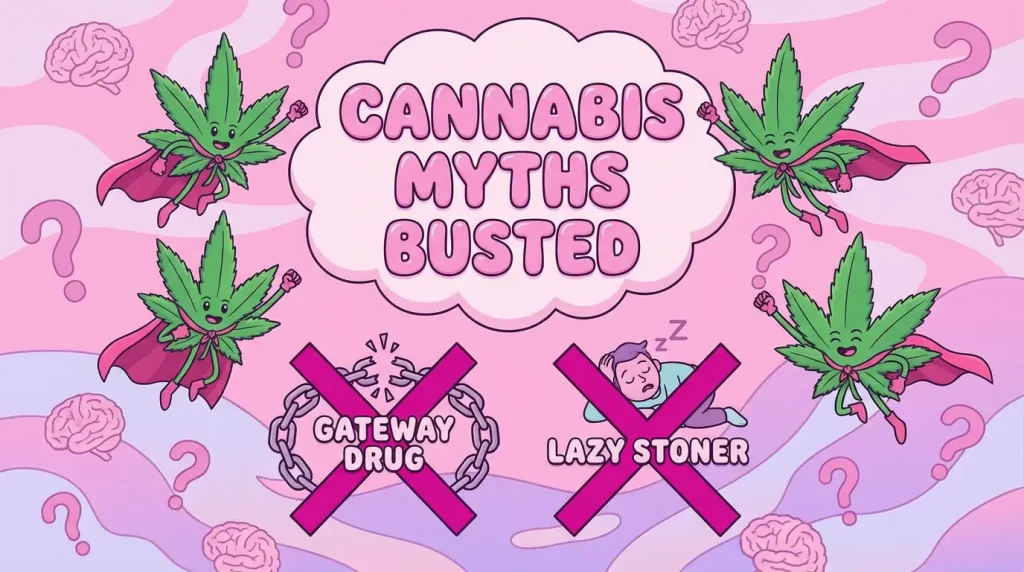
It’s confusing, right? How can one plant be both a dangerous narcotic and a harmless superfood? The truth, as always, lies somewhere in the middle. The conversation around cannabis is changing faster than ever in 2026, yet it’s still clouded by outdated propaganda and flashy misinformation. If you’re tired of not knowing what to believe, you’re in the right place. In this article, we are going to dive deep into the science, pull back the curtain, and get those cannabis myths busted once and for all.
We’ll be relying on hard data from institutions like Harvard, the National Academies of Science, and international health agencies to give you a clear, unbiased picture. Whether you’re a curious newcomer, a medical patient, or just someone trying to understand the changing laws, stick around. By the end of this read, you’ll have the facts you need to navigate the green rush with your eyes wide open.
The Great Debate: Is Cannabis Medicine or Menace?
To understand where we are today, we have to look back. For decades, the narrative was singular: cannabis is a dangerous substance with no medical value. This was cemented in 1970 with the U.S. Controlled Substances Act, which placed it in Schedule I—the same category as heroin—defining it as having a “high potential for abuse” and “no accepted medical use” .
But here’s the kicker: even as the Drug Enforcement Administration (DEA) held this line, the science was moving in a different direction. In 1999, long before any state legalized recreational weed, the National Academy of Sciences’ Institute of Medicine released a landmark report. It concluded that marijuana does have medical benefits, particularly for mitigating nausea, appetite loss, pain, and anxiety .
This disconnect between federal law, public perception, and scientific reality is where most myths are born. So, let’s put on our lab coats and start debunking the most persistent claims.
Myth 1: “Marijuana is a Gateway Drug to Harder Substances”
We’ve all heard the “Reefer Madness” style logic: one puff of a joint, and you’ll be chasing a heroin dragon by the end of the week. It’s a powerful image, but is it true? Absolutely not. This is arguably the most successfully debunked myth in the history of drug policy.
The reality is that the vast majority of people who have used cannabis never try any other illicit drugs . The idea of a pharmacological gateway—where the THC in weed chemically primes your brain for addiction to other drugs—has been rejected by mainstream science. According to the CDC, there is limited evidence suggesting that marijuana use increases the risk of using other drugs, but this is more easily explained by social and environmental factors rather than a biological inevitability .
Think about it this way: most people start with alcohol and tobacco, too. Does that make beer a gateway to cigarettes? Correlation is not causation. Marijuana myths busted by data from the International Centre for Science in Drug Policy show that during a period in the UK where cannabis use increased fourfold (1970–2010), the rates of schizophrenia and hard drug addiction did not rise proportionally . People experiment with substances based on personality, environment, and access—not because a plant “forces” them to move down a chain.
Myth 2: “Today’s Marijuana Will Make You Stupid or Kill Your IQ”
This myth has two faces: one claims cannabis kills brain cells, and the other claims it permanently lowers your IQ. Let’s tackle the “brain damage” claim first. Despite decades of anti-drug campaigns, there is no conclusive evidence that marijuana kills brain cells or causes structural brain damage, even in long-term heavy consumers . A study published in the Journal of Neuroscience found that even daily marijuana use was not associated with changes in brain volume in adults or adolescents .
What about IQ? You might remember a famous study from New Zealand that suggested adolescent cannabis use led to a permanent drop in IQ. However, later and more robust research, including a study from University College London, found “no relationship between marijuana use and IQ,” even among the heaviest users . Interestingly, that same team noted that alcohol use is strongly associated with a decline in IQ .
However, let’s not swing too far the other way. While it doesn’t permanently “dumb you down,” heavy, daily use—especially in adolescents whose brains are still developing—can impair memory, attention, and learning while the person is using . Dr. Kevin Hill, an addiction psychiatrist at Harvard Medical School, notes that heavy users (daily, multiple times a day) can experience cognitive issues, but these risks are dose-dependent and often remit with abstinence . So, while you won’t turn into a vegetable, moderation matters.
Myth 3: “You Can Fatally Overdose on Marijuana”
This is a common fear, but from a pharmacological standpoint, it’s virtually impossible. The National Academies of Sciences, Engineering, and Medicine concluded in 2017 that no link has been established between marijuana and fatal overdoses . To put it in perspective, the CDC attributes tens of thousands of deaths per year in the U.S. to alcohol (including poisoning) and hundreds of thousands to tobacco. For marijuana? Zero .
Now, does that mean you can’t have “too much”? Absolutely not. While you won’t die, you can definitely “over-consume,” especially with the high-potency concentrates available today. This can lead to what’s often called a “greening out”—acute anxiety, panic attacks, paranoia, nausea, and in extreme cases, temporary psychosis . This is an acute, distressing reaction, but it is not a fatal overdose.
In 2025, with the rise of edibles and dabs, new users need to be particularly careful. A common mistake is eating an edible, feeling nothing after 30 minutes, and eating more—only to be hit by a tidal wave of effects an hour later. So, while you can’t die, cannabis misuse can land you in the emergency room with severe anxiety or Cannabinoid Hyperemesis Syndrome (a condition where chronic users experience cyclic vomiting) .
Myth 4: “Marijuana Has No Medical Value (And It’s Just Like Any Other Medicine)”
This myth is perpetuated by two extremes. On one hand, prohibitionists claim it has zero medical use (hence the Schedule I status). On the other, some enthusiasts claim it cures cancer. The truth is nuanced, but leaning heavily toward “yes, it has value.”
First, let’s bust the “no medical value” claim. In 2018, the FDA approved Epidiolex, a purified form of CBD (cannabidiol), for the treatment of severe forms of epilepsy . This was a game-changer. It proved, beyond a shadow of a doubt, that a cannabis-derived compound can be a safe and effective pharmaceutical drug. Studies showed that after using Epidiolex for 12 weeks, the median number of seizures in patients dropped from 144 per two weeks to just 52 .
Beyond that, there is substantial evidence supporting the use of cannabis or cannabinoids for:
- Chronic Pain: One of the most common reasons people seek medical cannabis.
- Nausea and Vomiting: Particularly associated with chemotherapy .
- Multiple Sclerosis (MS): To reduce spasticity and muscle spasms .
However, it’s not a magic bullet. The claim that it “cures cancer” is dangerous and unsupported. While lab studies show that high concentrations of THC can kill certain cancer cells in a petri dish, the concentrations achievable in the human body through smoking or eating are far lower and have actually been shown in some studies to potentially promote tumor growth in certain contexts . Separating fact from fiction here is critical: cannabis is a powerful tool for managing symptoms of illness and side effects of treatment, but it is not a cure for the diseases themselves.
Myth 5: “CBD is Just a Placebo and Does Nothing”
As the “weed light” craze exploded, so did the skepticism. Many people assumed that CBD (cannabidiol) was just a wellness fad, a ” placebo” sold by wellness influencers. But in 2025, the science is rock solid. CBD offers real benefits.
Beyond the FDA-approved epilepsy treatment, research is piling up. A 2024 study from King’s College London demonstrated CBD’s ability to reduce anxiety by interacting with serotonin receptors in the brain . It’s also gaining credibility for managing chronic pain, inflammation, and even skin conditions like acne due to its anti-inflammatory properties .
However, a crucial part of debunking cannabis claims is being honest about the market. The CBD industry is still the “Wild West.” If you buy CBD at a gas station, you might be getting something with little to no actual CBD, or worse, contaminants. But the compound itself? It’s a legitimate therapeutic agent supported by peer-reviewed research.
Myth 6: “Legalization Turns Society into a Nation of Addicts”
Whenever a new state or country discusses legalization, the opposition warns of societal collapse. But we have over a decade of data from places like Colorado and Washington, and now Canada, to see what actually happens.
The results? Society hasn’t collapsed. In fact, a 2025 Home Office review in the UK found that usage rates have remained stable despite medical access expanding . In the U.S., states with legal cannabis have not seen the explosion of teen use that prohibitionists predicted. Actually, according to the CDC and Monitoring the Future surveys, youth marijuana use has dropped significantly between 2011 and 2024, even as half the country legalized it . In Washington and Colorado, adolescent use has decreased by over 35% since legalization .
Why? Because regulation works. It moves sales out of the unregulated black market (where IDs aren’t checked) and into licensed dispensaries (where age verification is strict). Cannabis legalization allows for product testing, labeling, and public health education—tools that prohibition simply doesn’t provide.
The Real Risks: What the Evidence Actually Says
If we want to be credible, we can’t just talk about the good stuff. An honest look at the evidence reveals real risks, which often depend on dose, frequency, and age.
- Adolescent Brain Development: This is the biggest red flag. Heavy, regular use in teenagers is linked to impairments in attention, memory, and executive functioning . Because the brain is still developing until the mid-20s, this is the group that needs the clearest warnings.
- Mental Health: There is a link between cannabis use and psychosis. The nuance here is key: it’s an association, not a simple cause-and-effect. People predisposed to schizophrenia might trigger its onset with heavy use, but the evidence does not show that cannabis causes schizophrenia in otherwise healthy individuals . If it did, schizophrenia rates would have skyrocketed as cannabis use went up—they didn’t .
- Dependency: Yes, you can become addicted. It’s not as addictive as alcohol or opioids, but about 9% of people who use cannabis will develop a dependency . For those who start in their teens, that number jumps to about 17% . This is a real cannabis use disorder where users continue to use despite negative impacts on work, school, and relationships.
FAQ: Your Burning Questions Answered
To wrap this up, let’s tackle some of the most common questions people are typing into search engines (and asking their AI assistants) in 2025.
Q: Is cannabis a superfood?
A: Hemp seeds are absolutely a superfood. They are packed with Omega-3 and Omega-6 fatty acids, protein, and fiber . However, the flowering buds smoked or vaped for medical or recreational use are a drug, not a “food” in the nutritional sense. Don’t confuse industrial hemp with high-THC cannabis flower.
Q: Does cannabis help you sleep?
A: It’s complicated. For some, THC can help fall asleep faster. However, it also suppresses REM sleep (the dream stage). Long-term, heavy use can actually degrade sleep quality, leading to dependence on the drug to fall asleep .
Q: Can I use cannabis during pregnancy?
A: No. This is a serious risk. Studies show that marijuana use during pregnancy is associated with an increased risk of preterm birth and low birth weight . Alarmingly, studies also show that a majority of dispensaries in legal states have incorrectly advised pregnant women that it is safe, which is a dangerous trend .
Q: Is marijuana safe to use with other medications?
A: Not always. Cannabis can interact with other drugs, just like grapefruit does. It can affect how the liver metabolizes certain medications, such as blood thinners like warfarin, potentially leading to dangerous bleeding . Always consult your doctor if you are taking prescription meds.
Q: Is dabbing safer than smoking flower?
A: In terms of dosage control, it is riskier. Dabbing involves vaporizing concentrated butane hash oil (BHO), which can have THC concentrations 4 to 30 times higher than the cannabis flower . This can lead to severe neurotoxicity, cardiotoxicity, and immediate tolerance buildup .
Conclusion: Seeing Through the Smoke
So, where does that leave us? We’ve taken a long, hard look at the evidence, and the picture is clear: cannabis is neither the devil’s lettuce nor a panacea. It’s a complex plant with real therapeutic potential and real risks that must be respected.
By getting these cannabis myths busted, we can finally have an honest conversation. We can advocate for policies based on science rather than fear. We can make personal decisions based on facts rather than hype.
If you’re considering using cannabis—whether for wellness, medical reasons, or recreation—go in informed. Start low and go slow. Buy from licensed, regulated sources where testing is mandatory. And most importantly, keep the conversation going. Share this article with someone who still believes that “weed kills brain cells.” The more we talk about it, the faster the truth will spread.