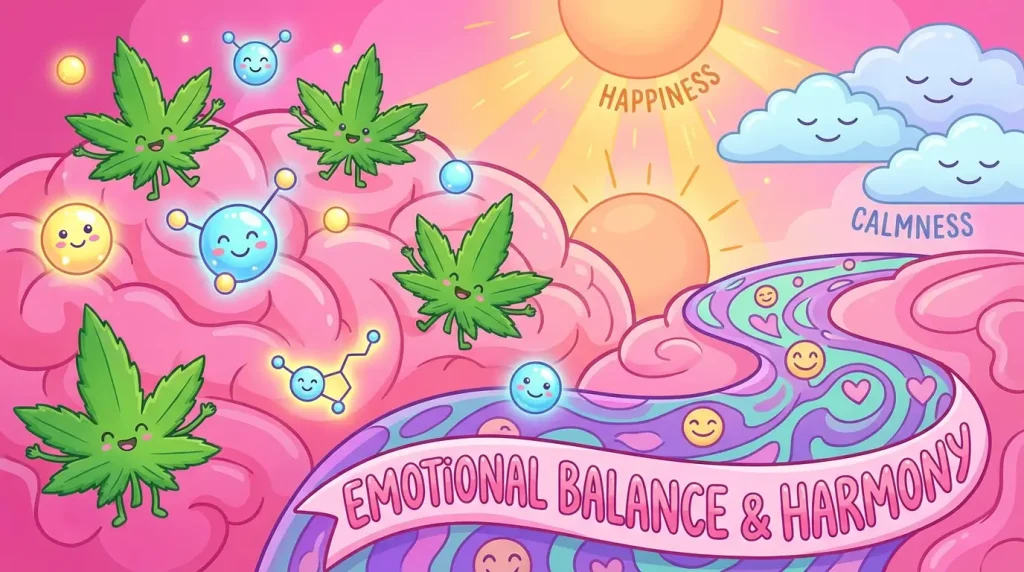
Ever had one of those days where your mood swings feel like a pendulum in a hurricane? You’re not alone. Millions of people are turning a critical eye toward their mental wellness toolkit, and inevitably, the conversation lands on a controversial green plant. We aren’t here to sell you on a lifestyle or judge your choices. We’re here to cut through the smoke and look at the hard neurochemistry. Specifically, we’re answering the question: How cannabis modulates the serotonin system and impacts mood regulation.
Most people equate serotonin with happiness—it’s that little “up” button in your brain that SSRIs try to protect. But the relationship between cannabis and this crucial neurotransmitter is far more nuanced than “getting high to feel good.” In fact, the interaction between cannabinoids and serotonin receptors explains why some people find relief from anxiety with CBD while others might find THC sends them into a spiral of paranoia.
Do you know which specific receptor acts as the primary bridge between plant compounds and your emotional state? If not, you’re in the right place. We’re diving deep into the 2025 research to give you the actionable, science-backed insights you need to understand this connection—without the bro-science or the fearmongering.
The Serotonin Symphony: Understanding Your Brain’s Mood Conductor
Before we can understand how cannabis modulates the serotonin system, we need a clear picture of what serotonin actually does. Serotonin (5-HT) is a monoamine neurotransmitter primarily produced in the dorsal raphe nucleus (DRN) of the brainstem. Think of the DRN as the central train station for mood signals, sending tracks out to the prefrontal cortex (your CEO brain), the amygdala (your fear alarm), and the hippocampus (your memory vault) .
When serotonin signaling is robust, you feel calm, focused, and resilient. When those tracks are rusty or the trains aren’t running on time, you get the classic symptoms of mood dysregulation: anxiety, depression, and irritability.
The key takeaway? Serotonin doesn’t just float around making you “happy.” It acts as a modulator, fine-tuning the volume of other neurotransmitters like glutamate and GABA. It’s less the lead singer and more the sound engineer of your brain’s rock concert. When the serotonin system and mood regulation are out of sync, the whole show sounds like feedback and static.
The 5-HT1A Receptor: The Cellular “Off Switch” for Anxiety
If serotonin is the sound engineer, the 5-HT1A receptor is the master volume knob. This specific protein sits on the surface of neurons and, when activated, typically tells the cell to calm down and stop firing so rapidly.
This is a crucial distinction in neuropharmacology. Activating the 5-HT1A receptor generally produces anxiolytic (anti-anxiety) and antidepressant effects. It’s why drugs like Buspirone work. Now, here’s where cannabis enters the chat. Research has confirmed that cannabidiol (CBD) acts as an agonist of 5-HT1A receptors . This means CBD physically binds to this receptor and flips the switch, promoting that cascade of calm.
What about THC? Delta-9-tetrahydrocannabinol (THC) has a much messier relationship with serotonin. While it indirectly influences serotonin release via the CB1 receptor, it doesn’t directly bind to 5-HT1A with the same finesse as CBD . This is why high-THC cannabis without balancing cannabinoids can sometimes lead to mood dysregulation rather than relief.
CBD as a Serotonin Modulator: Agonist or Allosteric Modulator?
The plot thickens when we look at the mechanics. While early studies labeled CBD simply as an agonist, newer research from 2025 suggests a more sophisticated role. We now understand that the pharmacodynamic interaction between CBD and the 5-HT1A receptor is contingent upon dosage and cellular context .
Here’s the distinction in plain English:
- Agonist: A key that turns the ignition.
- Allosteric Modulator: A hand on the gear shift that changes how the car drives even if you’re using the same key.
Emerging data indicates CBD can act as a negative allosteric modulator at other serotonin receptors, like 5-HT2A . This is actually a good thing for mood stability. The 5-HT2A receptor is associated with psychedelic experiences and, when overactive, psychosis. By gently modulating this site, CBD acts like a bouncer, keeping the neural party from getting out of hand.
Are you starting to see why the type of cannabis product you choose—full-spectrum, broad-spectrum, or isolate—matters so much for mood regulation?
The Biphasic Effect: Why Dosage Dictates Your Mood Outcomes
Does cannabis help with anxiety or cause it? The answer isn’t binary. It’s biphasic. This is perhaps the most critical concept for anyone using cannabis for mood regulation.
- Low to Moderate Doses of CBD: Preclinical studies show that low doses of CBD can correct the sequelae induced by chronic stress. A 2025 study published in Neuropharmacology found that low-dose cannabidiol treatment prevented stress-induced phenotypes and restored mature synapses in the medial prefrontal cortex (mPFC) . In short: It helps your brain’s command center adapt and stay resilient.
- High Doses of THC: Conversely, high doses of THC can overstimulate the endocannabinoid system, leading to downregulation of CB1 receptors and potentially triggering anxiety or paranoia. This is the “greening out” phenomenon.
Checklist for Mood Optimization:
- Start Low, Go Slow: If using full-spectrum products, begin with 1-2mg of THC and a minimum of 10-20mg of CBD.
- Track Your Ratio: The CBD:THC ratio is your steering wheel. Aim for high CBD ratios (10:1 or 20:1) if you are prone to anxiety .
- Journal Your Response: Serotonin modulation is subjective. Track your sleep latency and morning anxiety levels.
THC vs. CBD: Why One Calms and the Other Can Cause Chaos
Why does this opposition exist? It comes down to the endocannabinoid system (ECS). Think of the ECS as a dimmer switch for neural activity.
THC is a partial agonist at the CB1 receptor. It steps on the gas pedal. Sometimes that feels like euphoria. Other times, it’s a racing heart and existential dread. Critically, THC’s binding displaces the body’s natural endocannabinoids, depleting anandamide—a molecule often called the “bliss molecule” .
CBD, on the other hand, is a non-competitive antagonist at the CB1 receptor. It doesn’t kick THC off the receptor; it just changes the shape of the receptor so THC can’t bind as effectively. More importantly for serotonin, CBD increases anandamide levels by inhibiting the enzyme FAAH (fatty acid amide hydrolase). Elevated anandamide is linked to improved mood and stress resilience, partially explaining CBD’s role in mood regulation .
Is it possible that your previous negative experience with cannabis was simply a matter of a poor CBD:THC ratio rather than a personal intolerance to the plant itself?
Chronic Stress, Depression, and Synaptic Repair: What the Latest Studies Show
This is where the science gets genuinely exciting for mental health treatment. Chronic stress physically atrophies the brain. It shrinks the branches (dendrites) of neurons in the prefrontal cortex. Think of it like a tree losing its leaves and branches in winter.
The 2025 research highlights that cannabis modulates the serotonin system to actually reverse this damage. In mouse models of chronic stress, CBD treatment restored F-Actin and VGlut1-positive clusters—basically, it repaired the physical structure of the synapses that allow brain cells to talk to each other .
Furthermore, CBD induces desensitization of 5-HT1AR via a mechanism involving β-arrestin . While “desensitization” sounds negative, it’s precisely how classic antidepressants work. By gently nudging the 5-HT1A receptor to be less reactive to stress signals over time, CBD mimics the downstream effects of SSRIs without the same side effect profile . This is a cornerstone of cannabis and mood regulation research moving into 2026.
Beyond Mood: Serotonin’s Role in Pain and Inflammation
Serotonin isn’t just in your head; 90% of it is in your gut, and it plays a massive role in pain perception. This is why the cannabis and serotonin interaction matters for more than just mental health.
CBD’s interaction with 5-HT1A has been shown to reduce allodynia—a condition where normally non-painful stimuli (like a light touch) feel like agony . This is huge for conditions like fibromyalgia and neuropathy.
By modulating serotonin signaling, CBD helps restore the descending pain inhibitory pathway. This is your body’s natural pain-killing superhighway that runs from the brain down the spinal cord. When this system is broken, pain signals get amplified. Cannabis compounds that gently boost serotonin tone can help turn down that volume.
Actionable Checklist: Optimizing Cannabinoid Use for Emotional Wellness
Ready to translate this pharmacology into a real-world strategy? Here is a step-by-step guide to using cannabis for serotonin balance.
- Identify Your Primary Goal:
- Anxiety/Panic: Prioritize CBD-dominant products. Look for tinctures with 20:1 ratios. Avoid sativa-dominant THC strains.
- Low Mood/Apathy: Consider balanced 1:1 CBD:THC ratios. The slight CB1 activation from THC combined with 5-HT1A agonism from CBD can create an “entourage effect” conducive to creativity and motivation .
- Sleep Onset: CBN (Cannabinol) may be a better target here, but a high-dose CBD/5mg THC edible can calm the serotonin-driven racing thoughts that keep you awake.
- Timing is Everything:
- Morning: Microdose (1-2mg THC with CBD) for stress resilience without impairment.
- Evening: Larger doses of CBD to promote the desensitization of stress receptors accumulated during the day.
- Check for Interactions:
- Source Quality Over Hype:
- Look for third-party lab tests that verify cannabinoid content and screen for pesticides/heavy metals. A cheap gas station gummy will not provide the consistent serotonin modulation you’re looking for.
Frequently Asked Questions About Cannabis and Serotonin
Does cannabis increase serotonin levels like an antidepressant?
Not directly. Cannabis—specifically CBD—doesn’t flood the brain with serotonin like MDMA would. Instead, it acts as an agonist of 5-HT1A receptors, enhancing the efficiency of the serotonin you already have. It’s more of a signal booster than a chemical factory .
Can long-term cannabis use deplete serotonin?
This is the million-dollar question. The systematic review from Focus (2025) suggests that heavy cannabis use is linked to poorer clinical course in bipolar disorder and PTSD, but the evidence for depression is less clear . High-THC use may downregulate cannabinoid receptors, indirectly blunting the downstream release of serotonin over time. This is why tolerance breaks (T-breaks) are essential for medical users.
What is the best cannabis strain for serotonin and mood?
Forget strain names (they’re often marketing). Focus on chemotype and cannabinoid profile.
- Chemotype I (THC-dominant): Use with caution; best for low doses in experienced users.
- Chemotype II (Balanced CBD:THC): Often ideal for mood stabilization due to the synergistic effect on CB1 and 5-HT1A receptors.
- Chemotype III (CBD-dominant): The gold standard for anxiety and serotonin system support.
How does CBG compare to CBD for serotonin?
Cannabigerol (CBG) is a different cannabinoid with a distinct profile. While CBD is an agonist at 5-HT1A, CBG is believed to act as an antagonist at this receptor . This means CBG might actually block the calming effects of CBD on serotonin. If mood regulation is your goal, CBG may be more suitable for focus or gut health rather than direct serotonin support.
Can cannabis replace my SSRI?
No. Do not stop or change your prescription medication regimen based on an article. The research on cannabis and mood disorders is promising but still lacks the long-term, high-powered randomized controlled trials that SSRIs have undergone . View cannabis as a potential adjunct, not a replacement, and always coordinate with your prescribing psychiatrist.
Why does cannabis sometimes make my anxiety worse?
This is likely due to overstimulation of the CB1 receptor by THC in areas of the brain responsible for fear (amygdala). Additionally, if the CBD:THC ratio is skewed toward high THC, you lack the protective 5-HT1A modulation that CBD provides . Try adding a high-purity CBD tincture 30 minutes before consuming THC to mitigate this effect.