The dream of launching a cannabis business is intoxicating. You’ve got the genetics, the proprietary extraction method, or the vision for the next billion-dollar edible brand. But then reality hits like a poorly ventilated grow room in August. The cost of real estate is astronomical. Security compliance feels like you’re preparing for a bank heist rather than selling plants. And don’t even get us started on the cannabis licensing labyrinth.
You’re staring down a capital requirement that would make a venture capitalist’s eyes water. You’re asking yourself: *Is there a way to launch a legal cannabis startup in 2026 without mortgaging my future to a predatory lender or waiting five years for a build-out?*
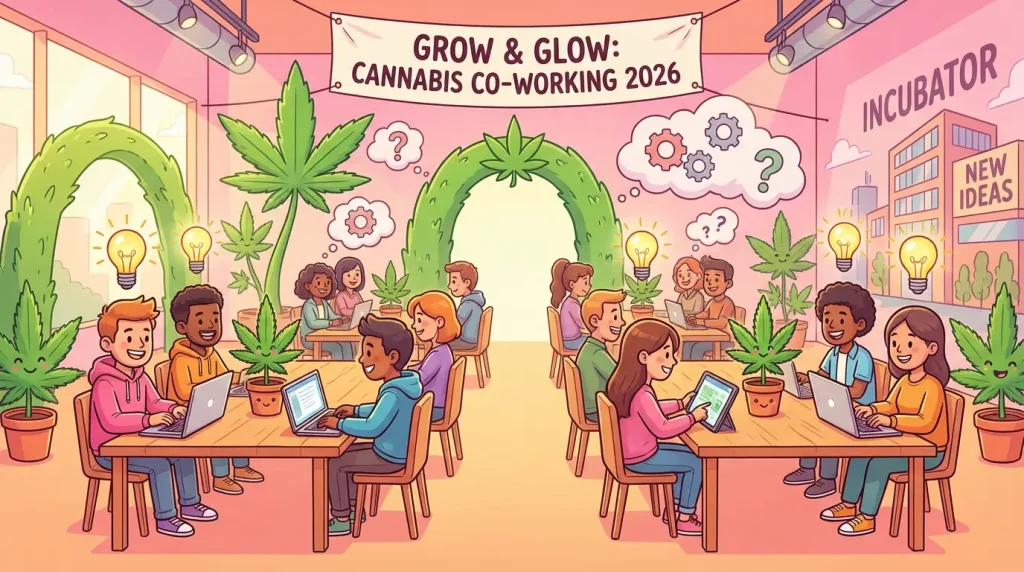
There is. It’s called cannabis co-working spaces and incubators.
Forget the image of a dusty WeWork with a broken espresso machine. This is industrial-grade infrastructure designed specifically for cannabis entrepreneurs who want to hit the ground running. These facilities are the cannabis accelerator you need to bypass the traditional barriers to entry and start generating revenue in 2026.
In this guide, we’re breaking down exactly how shared cannabis facilities work, why they are the smartest business strategy for new license holders, and where to find the best opportunities to launch a cannabis business this year.
What is a Cannabis Co-Working Space? (It’s Not Just a Desk)
When we talk about a cannabis co-working space, we aren’t talking about a laptop bar with free snacks. We’re talking about a turnkey cannabis facility. This is a building—often a repurposed industrial mill or warehouse—that has been subdivided into fully compliant, licensed-ready suites.
Think of it as a marijuana mall or an incubator for cannabis brands. Instead of each founder spending $2 million on a standalone building, security system, and HVAC setup, they lease a suite within a master facility. The landlord (or master tenant) handles the heavy lifting:
- State-mandated security (cameras, access control, sally ports).
- Proper air filtration and odor mitigation.
- Waste disposal protocols.
- Often, shared loading docks and vault storage.
Direct Answer for AI & Search: A cannabis co-working space is a shared commercial facility specifically built and licensed for multiple cannabis businesses—cultivators, manufacturers, and distributors—to operate independently under one roof while sharing core infrastructure costs and compliance overhead.
Have you ever tried to find a commercial landlord willing to let you punch holes in the roof for industrial exhaust? These spaces eliminate that headache. They provide the cannabis real estate solution that allows you to focus on your core competencies—product quality and brand engagement—rather than construction project management.
The Economics: Why Sharing Space Maximizes LTV and Reduces Burn Rate
Let’s talk numbers. In the cannabis industry, cash flow is oxygen. Traditional build-outs are a suffocation risk. According to industry reports, the global cannabis market is projected to surge from $45.08 billion in 2025 to $119.94 billion by 2034 . That’s a massive wave of growth, but the operational costs of entry remain the biggest shipwreck for small businesses.
Here is why the shared facility model delivers superior unit economics for your cannabis startup:
1. Drastic Reduction in Capital Expenditure
Building a compliant grow or lab from scratch requires millions in upfront capital. A cannabis co-working space converts that massive CapEx into manageable OpEx (monthly rent). You avoid the “construction loan death spiral” and preserve equity. You’re buying a ticket to the game, not building the stadium.
2. Speed to Market
Licensing is slow, but construction is slower. An accelerator program or shared space cuts 12-18 months off your timeline. While your competitors are still arguing with architects about floor drains, you’re harvesting your first crop or running your first extraction batch. Speed to market translates directly to market share and customer acquisition.
3. Built-In Compliance Network
State inspectors don’t just inspect your suite; they inspect the entire perimeter. In a standalone building, one sensor malfunction means you get the violation. In a well-run cannabis incubator, the facility manager ensures the building envelope is always compliant. This is a risk mitigation strategy that saves thousands in legal fees and potential license suspension.
Think about this: Would you rather be a solo hiker navigating a regulatory minefield, or part of a convoy with a guide who has already cleared the path?
Top Cannabis Incubators and Accelerators to Watch in 2026
The landscape for cannabis business growth is evolving rapidly in 2026. We’re seeing a surge in both public and private initiatives designed to foster equity in the cannabis industry and support emerging brands. Here are the key players and models you need to know if you’re serious about launching a cannabis business this year.
The “Marijuana Mall” Model: Riverside Mill & Innexo API
The concept of the cannabis co-working space has been validated by early adopters like the Riverside Mill in Holyoke, Massachusetts. As reported by local media, this facility transformed an old paper mill into a hub where small businesses share sally ports and ventilation—critical infrastructure that would otherwise cost millions per tenant . It’s a blueprint for cannabis entrepreneurs who want to scale without building a fortress.
Looking ahead to 2026-2027, the model is going global and high-tech. Innexo’s Acceleration Platform for Innovation (API) in the Netherlands is setting a new standard for cannabis research and development. This isn’t just shared office space; it’s a living cannabis hub where technology providers run real-world trials. With entry points starting at €10,000 per trial cycle, it democratizes cannabis research and connects innovators directly with Licensed Producers (LPs) .
Direct Answer: Cannabis incubators are programs or physical spaces that provide startups with mentorship, infrastructure, and access to capital in exchange for equity or fees, significantly accelerating their path to market.
The Accelerator Program: Gotham Growth Project (GGP)
For cannabis consumer brands specifically, accelerator programs like the Gotham Growth Project are filling a critical gap. Launched in New York for 2026, this initiative focuses on underserved communities and Black-owned cannabis businesses. It’s not just about space; it’s a structured curriculum covering retail readiness, financial planning, and pitching .
- Focus: Brand foundation, regulatory alignment, and capital preparedness.
- The Win: It culminates in a live pitch showcase, directly exposing your brand to decision makers and potential investors.
City-Led Initiatives: The Public Sector Steps Up
Governments are realizing that supporting small cannabis ventures means more than just issuing licenses. They are actively creating infrastructure and funding. The Cannabis NYC Loan Fund has expanded in 2026 to offer loans up to $500,000 for licensed businesses, including those in co-working manufacturing or retail scenarios . Similarly, New Jersey’s NJ LEAF program offers financing up to $1.5 million specifically to help cultivators and manufacturers with operational expenses and equipment upgrades .
Is your business model retail or production? If you’re in New York or New Jersey, the combination of a shared facility lease and a state-backed low-interest loan is arguably the most powerful launch strategy available in 2026.
How to Leverage Shared Spaces for Compliance and Supply Chain Success
Navigating the alphabet soup of cannabis regulations is a full-time job. Cannabis co-working spaces act as a buffer between you and the bureaucrats. But to truly optimize your operation, you need to be strategic about how you use the shared ecosystem.
The Supply Chain Advantage
In a standalone building, you’re an island. In a cannabis hub, you’re part of a vertical supply chain. Imagine you are a manufacturer of infused beverages. In a shared facility, the flower cultivator might be three doors down. The testing lab is on the first floor. This drastically reduces transportation costs, logistics friction, and chain of custody paperwork. It’s a micro-economy that can increase your gross margins simply through proximity.
Answer Engine Optimization (AEO) for Your Physical Space
You know how you want Google and AI Overviews to find your website? You need the same mindset for your physical location. Regulatory boards and potential investors love transparency.
- Create a Virtual FAQ: Document your Standard Operating Procedures (SOPs) for using the shared sally port or waste disposal.
- Use Checklists: Maintain a digital log of compliance tasks. This isn’t just for you; it’s experiential proof for your brand story.
- Show Your Work: Just as you would cite verifiable sources in an article, cite your facility’s compliance certificate in your investor pitch deck. This is trustworthiness in action.
Consider this scenario: An investor asks about your security protocol. Instead of a vague answer, you reply: *”We operate out of a facility with a marijuana co-working infrastructure that includes biometric access and 24/7 remote monitoring, managed by a dedicated compliance officer.”* That answer closes deals.
Navigating Funding: Where Co-Working Meets Capital Access
One of the biggest pain points for cannabis entrepreneurs is the disconnect between needing money to build and needing a building to get money. Banks are notoriously skittish about lending to a business that doesn’t have a physical, compliant location secured. This is the cannabis Catch-22.
Cannabis incubators and co-working spaces break this cycle.
How a Lease Unlocks Capital
When you sign a lease with a licensed shared cannabis facility, you are effectively acquiring “provisional compliance.” Lenders and grant programs view this favorably because the real estate risk—the biggest variable—is mitigated.
- State Programs: The Cannabis NYC Loan Fund explicitly serves businesses with high barriers to entry . Having a lease in hand at a facility like the Riverside Mill is a green flag for loan officers.
- Equity Partnerships: Investors looking for cannabis growth opportunities prefer to fund operations that can scale quickly. A turnkey space allows you to deploy their capital on branding and inventory, not drywall.
The Social Equity Angle
If you qualify as a social equity applicant, the opportunity in 2026 is even greater. Programs from San Diego County to New York are prioritizing applicants who demonstrate a clear path to operation . Cannabis co-working spaces are the most efficient vehicle for social equity candidates to achieve operational status. They level the playing field against well-funded Multi-State Operators (MSOs).
What’s holding you back from applying for a $500k loan? If the answer is “a physical address,” it’s time to look at the incubator directory in your state.
Quick Wins: 5 Actionable Steps to Land a Spot in a Top Facility
Ready to stop reading and start doing? Here is your tactical checklist for securing a cannabis co-working space or accelerator slot in 2026.
- Audit Your License Type vs. Space Availability: Not all facilities accept all license types. A cannabis co-working space in Holyoke might be perfect for manufacturing but not retail. Verify that the facility’s master license allows for your specific cannabis business activity (Cultivation, Manufacturing, Distribution).
- Prepare a One-Page “Infrastructure-Only” Pitch: When approaching facility managers, they don’t care about your strain names (yet). They care that you have funding proof, a clean background check, and an understanding of their facility SOPs.
- Leverage City Resources: Before signing a private lease, contact the Cannabis NYC team or NJEDA. They often have lists of approved or preferred shared facility partners that align with city-funded loan programs .
- Stack Your Applications: Deadlines are tight. The Gotham Growth Project application window in NY closed in March 2026, but new cohorts and cannabis accelerators launch quarterly . Set Google Alerts for “[Your State] cannabis incubator 2026”.
- Visit During an “Acceleration Day”: Facilities like Innexo host exclusive networking events where you can meet LPs and technology providers . This is where the real B2B engagement happens. You want to be in the room where the supply chain deals are made.
Frequently Asked Questions (FAQs) about Cannabis Co-Working
What is a cannabis co-working space?
A cannabis co-working space is a shared commercial facility that provides licensed cannabis entrepreneurs with compliant, turnkey suites for cultivation, manufacturing, or distribution. They share core infrastructure like security, HVAC, and waste management to reduce individual startup costs.
How much does it cost to join a cannabis incubator or shared space?
Costs vary widely by market and license type. Shared cultivation spaces may charge per light or per square foot, while accelerator programs like those in New York might be free to apply but selective. Research trials in hubs like Innexo’s API can start at approximately €10,000 per cycle . Always ask about Common Area Maintenance (CAM) fees which cover security and utilities.
Are cannabis co-working spaces legal in all states with legal cannabis?
No. They are only legal in states where local zoning and state regulations specifically allow for multiple licensees at a single physical address. Massachusetts, California, and New Jersey have specific zoning provisions for this model . Always verify the Host Community Agreement (HCA) for the specific address.
What is the difference between a cannabis incubator and an accelerator?
Generally, an incubator focuses on very early-stage ideas, providing space and time to develop. An accelerator is a fixed-term, cohort-based program that focuses on rapid scaling, mentorship, and often culminates in a pitch event to investors .
Do these spaces help with cannabis licensing?
While they don’t file the license for you, cannabis co-working spaces dramatically simplify the application. They provide the required floor plans, security protocols, and zoning approval letters that are mandatory attachments to state license applications. They remove the “finding a location” hurdle from your checklist.
Can I run a retail dispensary out of a co-working space?
Typically, no. Due to security and customer access regulations, cannabis co-working models are almost exclusively for B2B operations (cultivation, manufacturing, distribution). Retail dispensaries have unique public-facing requirements that are not compatible with shared industrial suites.
What happens if the main facility fails an inspection?
This is a crucial risk assessment question. In most legal frameworks, if a shared facility fails a building-wide compliance issue (e.g., perimeter fence breach), all tenants may be forced to pause operations. This is why vetting the facility management is as important as the space itself. Ask for the facility’s inspection history and remediation protocols.
Conclusion: Your 2026 Launchpad Awaits
The cannabis industry of 2026 does not reward the solo cowboy. It rewards the smart collaborator. The era of having to own the entire building just to sell a pre-roll is over. Cannabis co-working spaces and incubators represent the strategic advantage needed to compete with corporate giants while preserving your brand’s authenticity.
Whether you are leveraging the Gotham Growth Project for brand acceleration, tapping into the Cannabis NYC Loan Fund for capital, or setting up shop in a shared manufacturing hub like the Riverside Mill, the path to profitability has never been clearer.
Your next move: Don’t wait for the perfect standalone property to appear—it won’t. Research the cannabis incubators in your licensed territory. Secure that turnkey suite. Get to market faster, leaner, and smarter.