
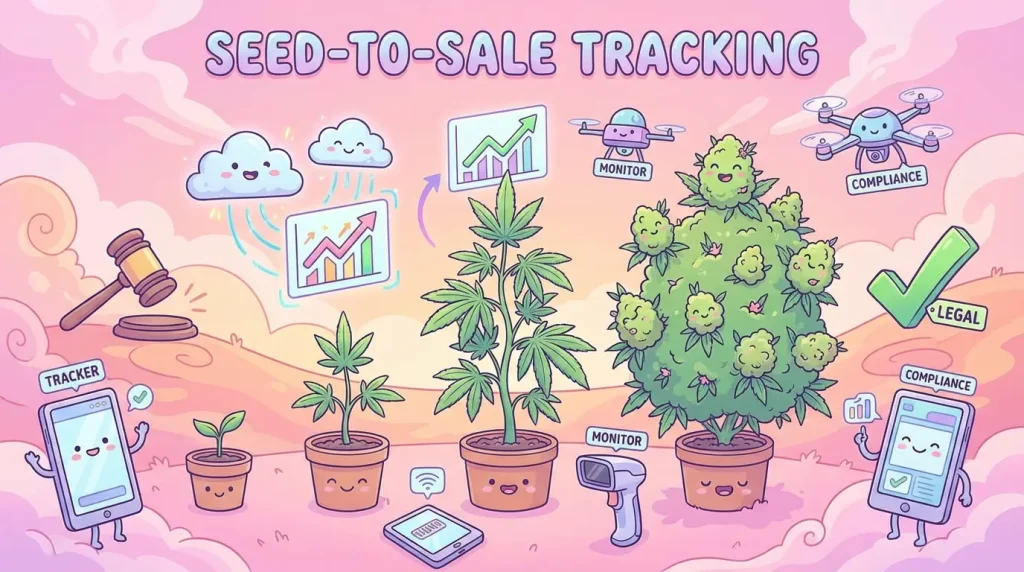
Imagine pouring your heart, soul, and capital into cultivating a premium cannabis harvest, only to have your entire batch quarantined—or worse, destroyed—because of a single data entry error on a compliance form. It’s the nightmare scenario that keeps every legal operator awake at night. You aren’t just fighting pests and powdery mildew; you are fighting data chaos that can cripple your bottom line.
The reality is, you can’t survive in this sector with a “don’t fix it if it ain’t broke” mentality. The regulatory environment is too fierce. This is why the digital transformation of cannabis isn’t a luxury; it’s a survival mechanism. Mastering your data flow from cultivation to the final point of sale isn’t just about avoiding fines—it’s the single biggest competitive moat you can build. In this deep dive, we’re stripping away the buzzwords and looking at the hardware, the cannabis technology solutions, and the strategic implementation that turns a state-mandated tracking system from a burden into a powerful business intelligence engine. We will map out exactly how the technology backbone of legal weed works so you can stop drowning in paperwork and start scaling your operational margins.
The High-Stakes Compliance Gamble: Why “Tracking” Is Non-Negotiable
Let’s cut straight to the chase. If you are operating a legal cannabis business without a robust seed-to-sale system, you are essentially running a charity, because the state will eventually shut you down and take your revenue. The legal cannabis market operates on a strict “closed-loop” philosophy. This is the fundamental strategy of legalization: every single gram produced must be accounted for to ensure it doesn’t leak into the illicit market.
But here is where many operators get it twisted, and where your strategy needs to shift.
Traditional businesses optimize for speed of service. A coffee shop wants to get the latte out as fast as possible. A cannabis dispensary, however, must optimize for cannabis regulatory compliance first, and speed second. If your point-of-sale system doesn’t instantly check a customer’s purchase limit against the state database before the budtender even opens the jar, you are non-compliant. This isn’t just inventory management; it’s a real-time regulatory reporting mechanism. The benefit of diving deep into this technology is a drastic reduction in human error. By automating the chain of custody, you eliminate the “he-said-she-said” of missing inventory, replacing it with a cryptographic trail of data. Are you currently cross-referencing your physical stock with your state API every 24 hours, or are you flying blind until audit day?
Decoding METRC: The Government’s Digital Ledger
When we talk about the technology backbone, we have to start with the central nervous system in most legal states: METRC (Marijuana Enforcement Tracking Reporting Compliance). Think of METRC not as a software you buy, but as a utility you plug into. It’s a state-contracted, cloud-hosted platform that acts as the “source of truth” for regulators. If you’ve ever wondered how blockchain works but found it confusing, look at METRC. It’s essentially a permissioned, centralized ledger.
But integrating with METRC is often where the funnel breaks down. The API (Application Programming Interface) that connects your in-house cannabis compliance platform to the state’s database is notoriously finicky. A “503 error” in your integration isn’t just a tech glitch; it’s a compliance violation waiting to happen. You must adopt a strategy of zero-latency data sync.
To achieve real engagement with the regulators (meaning they leave you alone because your data is flawless), you need to understand the “Tag Order.” Every immature plant batch and every harvested package gets a unique RFID (Radio-Frequency Identification) tag. This tag is the plant’s social security number. If a tag goes missing, you are explaining to an inspector that you lost track of a controlled substance. The conversion here is simple: flawless tag management equals an audit that lasts hours, not months.
The Full Lifecycle: How a Plant Moves Through the Digital Supply Chain
Let’s walk the walk. This is high-stakes action, not theory.
1. Propagation and Vegetation: It starts with a “Batch.” You create a digital batch in your cannabis grow software, logging the strain, mother plant source, and room location.
2. Harvesting: This is a critical control point. You cut the plants and immediately “harvest” the tags in the system. For a split second, the biomass exists in a limbo state. You must transition this weight into a drying room log before the end of the business day.
3. Processing and Testing: Here, the plant splits into various lots—trim, flower, and extraction material. A Laboratory Information Management System (LIMS) should ideally integrate here, automatically pulling test results for potency and contaminants into your compliance record, triggering a “Pass” that releases the batch for sale.
4. Product Manufacturing: This is where the cannabis production tracking becomes complex. You are converting raw, tested flower into pre-rolls, edibles, or vape carts. The system must calculate equivalency rates to ensure you aren’t accidentally “creating” mass. Did you know that creating a pre-roll requires “retiring” the original flower tag and “birthing” a new package tag? Mess this up, and your inventory variance spikes.
Hardware vs. Software: The Physical Components of a Digital World
You can’t execute a digital strategy without physical assets. When selecting commercial cultivation technology, you are looking at a marriage of industrial automation and enterprise-level IT.
RFID Scanners and Scales: You cannot use a $20 kitchen scale from Amazon. You require NTEP-certified (National Type Evaluation Program) scales that are calibrated and integrated directly into your hash tracking system. When processing extracts, precision down to the hundredth of a gram is required for the state-mandated waste logs.
Printers That Can Take the Heat: Thermal transfer printers are non-negotiable. The tags that go on a plant tray need to survive high humidity and UV light. If a barcode fades, that inventory is “ghost stock”—physically there, but legally unsellable. By investing in industrial-grade IoT devices, you increase your customer lifetime value (LTV) by building a reputation for consistent product availability. Nothing kills a brand faster than a dispensary buyer blacklisting you because your products wouldn’t scan at their intake dock.
Data-Driven Cultivation: Turning Compliance Data into Actionable Insights
Most rookies see seed-to-sale tracking as a cost center. A sophisticated operator sees it as the most honest feedback loop imaginable. This is what we call the “crossover pitch”—where compliance data fuels profit.
Your digital logbooks contain a goldmine: historical yield data correlated to environmental variables. Instead of relying on a “gut feel” grower, you can query your database. Which strain produced the highest terpene profile under the lowest electrical conductivity? That’s not just compliance; that’s a recipe for a premium retail shelf price. You are essentially leveraging your mandatory cannabis seed-to-sale software for business intelligence. Use this data to audit the performance of your head growers. Are they managing the vegetative cycle efficiently? The data doesn’t lie. It closes the gap between “effort” and “output,” ensuring your highest operational cost—labor—is delivering a tangible return.
The “Black Market” Deterrent: Protecting Your Inventory from Diversion
Beyond the risk of fines, there is a physical security benefit often overlooked. A systematic chain of custody provided by cannabis compliance software is your best defense against internal diversion. Let’s be blunt: the biggest threat of shrinkage isn’t a smash-and-grab; it’s an employee exploiting a gap in your SOPs.
With granular user permissions tied to biometric logins, every action—every scan, every weight adjustment—is logged against a specific employee ID. If you are managing a large-scale canopy, can you afford not to have this level of oversight? The cannabis technology solutions act as a psychological barrier. When your team knows that a “digital ghost” is watching every gram, the temptation for that product to “fall off the back of the trimming table” disappears. This protection of your assets directly secures your company’s valuation for future investment rounds.
Quick Wins: Optimizing Your Workflow for a Post-Harvest Audit
Let’s bullet-proof your audit process with a simple checklist. Implementing these cannabis supply chain software best practices immediately reduces your liability:
- The “Zero Adjustment” Day: Aim for days with zero manual weight adjustments. Manual overrides are red flags for auditors. If a scale is misreporting, fix the scale, don’t override the ticket.
- Separate Waste Logs by Type: Don’t just log “waste.” Log stems, failed extraction biomass, and destroyed failed batches in distinct streams. This demonstrates a mature, transparent quality assurance culture.
- Chain of Custody for Transfers: When moving material between your cultivation and processing licenses (even if they share a parking lot), treat it like an armored car delivery. Photograph the manifest, the driver, and the receiving documents. Attach these images directly to the transfer log in your cannabis compliance platform.
- Daily Plant Audits: Don’t wait for year-end. Use a handheld scanner every Friday to do a 10% spot-check of your vegetation rooms. You’ll catch tag death (fallen off/stolen tags) before it becomes a systemic problem that requires a “lost plant” report to the state.
The Future of Tracking: AI, Forecasting, and Answer Engine Optimization (AEO)
As we look toward the horizon, seed-to-sale tracking is evolving into a predictive command center. By feeding your historical harvest data into machine learning models, modern systems can predict crop steering outcomes with alarming accuracy.
AEO Strategy for Cannabis Tech:
In the near future, your internal knowledge base won’t just serve your staff; it will serve AI search engines. When a procurement manager asks an AI, “Which vendor had the highest consistent cannabinoid profile for Wedding Cake in Q3?”, your structured data—fed through an advanced cannabis compliance software platform—needs to be the answer. We are entering an era of “writing for the algorithm” internally. By structuring your data with clear, concise asset descriptions and testing metadata, you are effectively optimizing your brand for discovery in B2B wholesale marketplaces.
Moreover, imagine an Answer Engine Optimization (AEO) strategy for your own Standard Operating Procedures. Instead of a binder, a cultivation technician asks an AI assistant, “What is the PPM target for week 4, room B?” The system, linked to your live sensor data, answers verbally. This is not science fiction; it’s the integration of cannabis technology solutions with large language models that read your compliance data log as a map. Your ability to close the loop between physical growth and digital record-keeping will define the winners in an oversaturated market.
Frequently Asked Questions About Cannabis Tracking Systems
What is a seed-to-sale tracking system in cannabis?
A seed-to-sale tracking system is a regulatory and operational software platform that tracks the entire lifecycle of a cannabis plant. From the moment a seed is germinated or a clone is cut, through cultivation, harvest, testing, processing, and final sale to a consumer, the system records every weight change, location transfer, and transaction. This creates a “closed loop” inventory trail for cannabis regulatory compliance, preventing diversion into the illegal market.
What does METRC stand for?
METRC stands for Marijuana Enforcement Tracking Reporting Compliance. It is the most widely adopted state-mandated “track-and-trace” system in the United States. Think of METRC as a centralized digital ledger provided by the government where all licensed operators must report their inventory movements in real-time, often using unique RFID tags that are assigned to each plant.
How does RFID technology work in cannabis cultivation?
Radio-Frequency Identification (RFID) technology is the backbone of cannabis production tracking. Each plant and package is issued a unique tag containing an RFID chip. When a handheld scanner or fixed reader emits a radio wave, the tag responds with its encrypted data. This allows for instantaneous mass scanning of inventory without requiring a direct line of sight, which is critical for counting hundreds of plants in a cultivation room efficiently and eliminating manual counting errors.
Why is chain of custody important for my cannabis business?
The chain of custody is the chronological digital documentation that records the sequence of custody, control, transfer, and analysis of cannabis material. In the context of cannabis supply chain software, it is essential for defending your license. If a weight discrepancy occurs during a transport, a rock-solid chain of custody proves exactly when and where the discrepancy happened, protecting you from fines for inventory diversion or theft that occurred off-site.
Can I use my compliance software to increase crop yields?
Absolutely. This is the pivot from viewing cannabis grow software as just a reporting tool to viewing it as an analytics engine. By analyzing the historical data from your tracking system, you can correlate environmental data (like light intensity and humidity) with harvest yields and cannabinoid potency. This allows you to identify which specific vegetative room conditions produce the highest commercial value, turning mandatory compliance reporting into operational guidance that directly boosts your bottom line.
How does a Laboratory Information Management System (LIMS) integrate with tracking?
A Laboratory Information Management System (LIMS) integrates with seed-to-sale tracking via an application programming interface (API). When a testing lab finishes analyzing a sample for cannabinoid content, pesticides, or heavy metals, the LIMS posts the Certificate of Analysis (COA) directly to the state repository and the operator’s software. This integration automates the “pass/fail” status of a batch, automatically releasing compliant inventory for sale and locking out failed batches, which is critical for public safety and swift product transitions.
What is the most common compliance mistake during a cannabis audit?
The most frequent and avoidable mistake is “ghost inventory”—having physical product on a shelf that is not active in the tracking system, or conversely, showing digital inventory that doesn’t physically exist. This usually stems from failing to properly scan a tag during a split or merge of packages in the processing stage. A rigorous daily audit of high-value processing areas is the best defense against these devastating inventory variances.