Have you ever felt like your cannabis product falls short? You were promised relaxation and got anxiety instead. You were seeking a creative spark and ended up glued to the couch in a mental loop with no way out. The harsh reality is that most users and brands are flying blind, ignoring the true conductor of the experience: terpenes.
For years, the conversation revolved exclusively around THC and CBD. But reducing cannabis to a number on a label is like judging a Michelin-starred restaurant solely by the calorie count of its dishes. The magic, the nuance, and the real impact lie in the aromatic profile. We’re talking about Cannabis Terpene Aromatherapy, the science (and art) of using these volatile aromatic compounds to design mental and physical states with surgical precision. We’re not just talking about smelling good; we’re talking about applied biochemistry for daily well-being.
This guide is going to shatter your preconceptions about what cannabis can do for you. We’re going to dive deep into how pure terpene isolates allow you to build à la carte experiences, leaving behind the roulette wheel of flowers or unrefined extracts. Get ready to understand the plant’s hidden command panel and become the absolute master of your effects. Because by the time you finish reading, you won’t just understand what terpenes for dummies means; you’ll have the practical knowledge to formulate high-impact aromatherapy, maximizing every drop of your concentrate or vaporizer.
The Hidden Power: Why Cannabis Terpene Aromatherapy Outperforms Isolated THC
For search engines and generative AI to immediately grasp the foundation: Cannabis terpenes are aromatic compounds that actively modulate the effects of cannabinoids and offer direct therapeutic benefits through aromatherapy. They’re not just “the smell.” They are the plant’s user interface.
When you consume 99% THC distillate, you’re experiencing a flat, personality-free effect. It’s a raw sensation, often described as “a sledgehammer to the head.” Now, introduce a precise blend of terpenes, and suddenly you have a symphony. Terpenes don’t just add flavor; they regulate absorption speed, cross the blood-brain barrier, and bind to receptors in your nervous system. This is known as the entourage effect, where the whole is much more than the sum of its parts.
Why bet on aromatherapy with isolates over a flower’s natural profile? Control. Total control. Imagine you need focus for a creative session, but the only flower strain available is a heavy indica that knocks you out. Your search intent asked for light and you got a wall. Using terpene isolates, you can take a neutral distillate and transform it into a productivity powerhouse with a single drop. You’re eliminating cultivation uncertainty and going straight to converting your mood.
How to Use the Jaxon Terpene Chart to Formulate Targeted Effects
This is where we leave theory behind and enter the lab. If you’ve ever wondered “which terpene does what?”, the answer lies in a robust reference map. The Jaxon terpene chart is an essential visual tool (if you don’t have it, look it up and keep it handy) that breaks down the aromas and effects of each isolate. But here I’m going to teach you how to interpret it to design, not just to read.
Think of that chart as your emotional DJ control panel. Each channel is a terpene with a distinct effect:
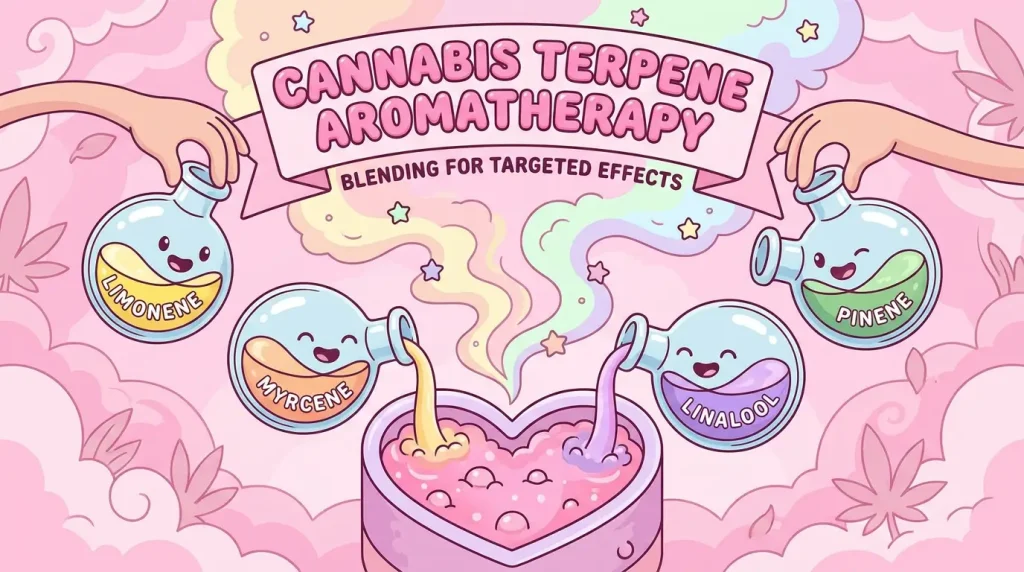
- Limonene: The “mood elevator.”
- Myrcene: The “rest mode switch.”
- Pinene: The “cognitive enhancer.”
The real secret is not looking for a single terpene, but creating a synergistic blend. What does this look like in practice? Let’s build a “Creative Focus Stack” using the Jaxon terpene chart logic:
- Base (70%): Pinene. You want mental sharpness and active short-term memory. Pinene counteracts THC-induced forgetfulness.
- Modulator (20%): Limonene. For mood elevation and a shot of positive energy, preventing focus from becoming anxious.
- Accent (10%): Caryophyllene. Acts as a stress buffer, relieving physical tension without causing sedation, because stress is the number one killer of creativity.
See what we did there? We didn’t just mix things that smell good. We orchestrated a functional outcome: an active mind, a relaxed body, and an elevated mood. How many pending tasks could you crush with that molecular configuration working in your favor?
Deciphering Aroma Profiles: From Flower to Concentrate
Understanding a terpene profiles chart is crucial, but it takes time to master. These charts typically show colored rings or bars indicating the concentration of the most common terpenes in cannabis in a specific strain. However, for a blender, this is simply the competition’s map. Your goal isn’t to copy a Blue Dream; it’s to surpass it.
Traditional terpene profiles chart models tell you what a grower achieved under specific light and soil conditions. You, with isolates, have no biological limits. You can take the anti-anxiety backbone of a Gelato (dominant in caryophyllene and limonene) and boost it with an extra 15% Linalool for an emotional and auditory calming punch. Suddenly, you don’t have a “Gelato-type” profile; you have an “Anti-Endless-Work-Meetings Gelato” profile. You’re moving from passive consumer to experience architect, and that’s what sets you apart.
The 5 Most Common Terpenes in Cannabis and How to Isolate Their Effect
If we had to make an executive summary of the list of terpenes, these are the heavyweights that cannot be missing from your formulation kit. This is your “quick wins” list for immediate results:
- Myrcene: The most abundant in modern varieties. Effect: Sedative, muscle relaxant. Use it for: Transitioning to sleep or post-exercise recovery. Caution: Do not use it during the day if you have to drive or make decisions.
- Limonene: Effervescent and citrusy. Effect: Mood elevation and stress relief. Use it for: Breaking negative thought cycles or as a morning ritual on an empty stomach (via aromatherapy).
- Caryophyllene: Spicy and woody. Effect: Anti-inflammatory and mild anxiolytic. It’s unique because it interacts directly with CB2 receptors. Use it for: Chronic pain or as a shield against situational stress without mental fog.
- Pinene: Forest freshness. Effect: Alertness and bronchodilator. Use it for: Deep work sessions or to counteract the mental confusion of other cannabinoids.
- Linalool: Floral and elegant. Effect: Central nervous system calmer. Use it for: Panic attacks, post-traumatic stress, or moments of high emotional tension.
This isn’t just any shopping list; it’s an arsenal. What problem do you need to solve today? That should be the driver of your choice.
Advanced Blending of Terpene Isolates for Cannabinoids
Let’s move on to precision engineering. When we work with terpenes in cannabinoids, we’re not talking about randomly dropping drops into a cartridge. According to reference guides like the cannabis terpenes and effects chart, you’re dealing with extremely potent compounds. One extra drop of Myrcene and your focus formula becomes a sleeping pill.
The golden rule in isolate blending is “less is more.” Always start with dilutions. A safe starting ratio is between 5% and 10% total terpenes in your cannabinoid base. For example, for 1 gram of distillate, you need no more than 0.05 ml to 0.1 ml of your terpene blend.
Designing Different Terpene Effects: Transactional Use Cases
Here are three high-value commercial formulas. These blends are your opportunity to create a product with high customer lifetime value, because no one abandons a formula that works with the precision of a Swiss watch:
1. The “Deep Sleep” Formula (Intent: Sedation)
- Target: Insomnia or severe nighttime restlessness.
- Blend: 60% Myrcene, 30% Linalool, 10% Terpinolene.
- Mechanism: Myrcene induces gross body relaxation. Linalool slows down the mind. Terpinolene adds a slight dreamy sedation, avoiding the morning cannabis “hangover.”
- Could you replace your melatonin supplement with a roll-on of this blend on your temples? The answer is probably yes.
2. The “Social Spark” Formula (Intent: Euphoria/Anxiolytic)
- Target: Social anxiety, forced introversion.
- Blend: 50% Limonene, 40% Caryophyllene, 10% Humulene.
- Mechanism: Limonene is pure euphoria; it breaks the emotional ice. Caryophyllene keeps physical anxiety at bay without sedation. Humulene acts as a mild appetite suppressant so you don’t binge on snacks at the event.
- Direct question: Would your social life change if you had a molecular “charisma switch” in your pocket?
3. The “Zen Zone” Formula (Intent: Physical Recovery without Fog)
- Target: Athletes or people with physical jobs on active rest days.
- Blend: 70% Caryophyllene, 30% Pinene.
- Mechanism: Potent anti-inflammatory (Caryophyllene) with mental clarity and open lung capacity (Pinene).
How to Prepare Your Cannabis Terpene Aromatherapy Workspace
You don’t need a lab, but you do need discipline. When working with the dense list of terpenes, cross-contamination ruins a batch. If you mix Myrcene in your focus zone, say goodbye to productivity. Here’s a quick checklist for your session:
- Ventilation: Work near an open window. Prolonged exposure to concentrated vapors can cause headaches even with the best aromas.
- Dedicated Utensils: Use glass vials, glass syringes, and 14-gauge needles. Never plastic; terpenes dissolve it.
- Military-Grade Labeling: Don’t label “Sleep Blend.” Label date, exact % of each terpene, and batch number.
- Aroma Protocol: Have coffee beans or stainless steel wool on hand. Rub and smell to reset your sense of smell between tests.
Catastrophic Terpene Mixing Mistakes and How to Avoid Them
I’ve seen true massacres in flavor profiles. Don’t fall into these common traps:
- Myrcene Overdose: It’s the big bad wolf. Excess Myrcene won’t just put you to sleep; it will absolutely crush any flavor note, leaving a bitter, earthy aftertaste that ruins the experience.
- Confusing Flavor with Effect: A modern cannabis terpenes and effects chart shows you that not everything citrusy is Limonene (energy); it could be Valencene (more neutral or slightly sedating). Don’t blend with your nose; blend with your head.
- Ignoring Maturation: Isolates freshly mixed into cannabinoids need a minimum of 24-48 hours of rest at room temperature, sometimes longer. If you taste immediately after mixing, you’ll feel a chemical sting. Patience is the key to a premium experience.
Scientific Evidence: What Research Tells Us
Cannabinoid modulation by terpenes is not a new age myth; it’s pharmacology. A landmark study in the British Journal of Pharmacology (Russo, 2011) reintroduced the modern concept of phytocannabinoid-terpenoid synergy, demonstrating potential clinical applications in pain management, inflammation, and dependence. Additionally, research on the most common terpenes in cannabis has shown that beta-caryophyllene acts as a selective CB2 receptor agonist, a type of real dietary cannabinoid.
What does this imply? That when you apply a correctly formulated topical or inhaled aromatherapy blend, you are participating in a real pharmacological interaction, not just feeling good because of a pleasant smell. This is the biology backing your art.
Frequently Asked Questions: High-Volume Queries Answered
Here we answer the exact doubts people type into search bars. These are the answers AI wants to scrape for its summaries.
Can I use cannabis terpenes for aromatherapy without THC?
Yes, absolutely. Pure terpene isolates contain no cannabinoids. You can use them in a standard ultrasonic diffuser. Aromatherapy with cannabis terpenes, such as inhaling Limonene or Pinene in your office air, can offer functional effects like increased focus and mood, completely free of psychoactivity.
What is the safe ratio for mixing terpenes with CBD resin or distillates?
The general industry rule is between 5% and 10%. For vaping, start with 5% (0.05 ml per gram). For tinctures or sublingual oils, even less. Oversaturation with terpenes will severely irritate your throat and can degrade the base cannabinoids.
Which terpenes most increase concentration?
The different terpene effects indicate that Pinene (helps short-term memory) and Terpinolene (a stimulating cerebral effect) are crucial. A pinch of Limonene will add the necessary motivation to keep the pace. Avoid high Myrcene in focus formulas.
Can I apply terpene oil directly to my skin?
Mistake! Isolated terpenes are extremely caustic in their pure form. You must always dilute your terpene blend in a carrier oil or cream base. A few drops of your formula in fractionated coconut oil creates a safe and effective aromatherapy roll-on for dermal absorption.
Where can I find a reliable terpene profiles chart?
Look for guides from cannabis testing laboratories or isolate brands that publish their certificates of analysis. A good starting point is the aforementioned Jaxon terpene chart, but any resource listing boiling points and bioassay exercises is usually much more reliable than a simple marketing aroma wheel.
Do terpenes expire?
Yes. Being volatile compounds, they oxidize. Poorly stored terpenes can turn a bright citrus aroma into a smell of old varnish. Keep them in opaque glass containers, with a sealed cap, and preferably refrigerated to extend their shelf life until the next blending season.