
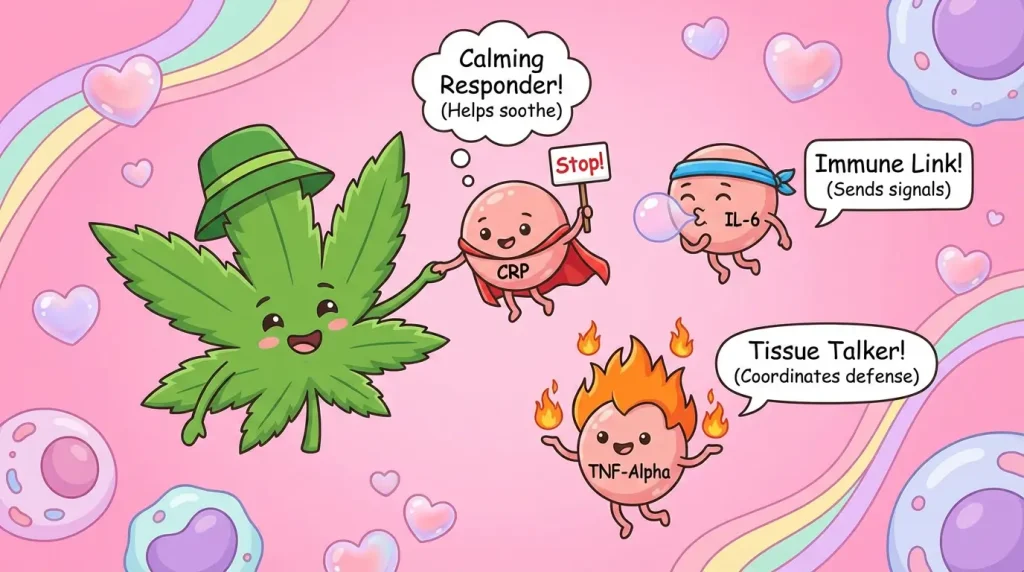
You’ve seen the headlines swinging back and forth: cannabis is a miracle anti-inflammatory. No, wait, it’s overhyped and the science isn’t there. If you’re a patient dealing with chronic pain, an autoimmune condition, or just a health enthusiast trying to separate the signal from the noise, the confusion is frustrating.
You want to know: does it actually lower those blood markers that doctors watch like hawks—C-reactive protein (CRP) , Interleukin-6 (IL-6) , and Tumor Necrosis Factor Alpha (TNF-alpha)? Or is this just another wellness trend destined for the dustbin?
The landscape has shifted dramatically in 2025 and heading into 2026. We’ve moved past the mouse studies and into hard, human data. The answer isn’t a simple yes or no—it’s a nuanced conversation about cannabinoid ratios, biomarker modulation, and your own unique biology.
In this deep dive, we’re not just rehashing old blog posts. We’re leveraging the latest peer-reviewed evidence to give you the definitive guide on cannabis and inflammatory markers. Consider this your end-to-end funnel strategy for understanding exactly how medical cannabis impacts systemic inflammation.
What Are Inflammatory Markers and Why Should You Care?
Let’s get the basics locked down. In the world of health optimization, inflammatory biomarkers are the ultimate Key Performance Indicators (KPIs) of your internal terrain. Ignoring them is like running a business without looking at the cash flow statement.
- C-Reactive Protein (CRP): Think of this as your “check engine” light. It’s a protein made by the liver that skyrockets when there’s acute inflammation somewhere in the body. In 2025, high-sensitivity CRP tests are a staple for assessing cardiovascular risk and chronic inflammation.
- Interleukin-6 (IL-6): This is a cytokine—a messenger protein that can either fan the flames of inflammation or, in different contexts (like exercise), help repair muscle. Chronically elevated IL-6 is a known driver of aging (“inflammaging”) and autoimmune flares.
- Tumor Necrosis Factor Alpha (TNF-alpha): This is the heavy artillery of the immune system. It’s crucial for fighting infection, but when it’s stuck in the “on” position, it’s the primary target for drugs treating rheumatoid arthritis and Crohn’s disease.
Have you ever had bloodwork done and wondered why your CRP was slightly elevated even though you felt “fine”? That’s low-grade systemic inflammation, and it’s precisely what researchers are trying to target with cannabinoid therapy.
The Endocannabinoid System: Your Body’s Inflammation Funnel
You can’t talk about cannabis and inflammatory markers without understanding the Endocannabinoid System (ECS) . This isn’t just about getting high; it’s the master regulator of homeostasis.
The ECS consists of:
- CB1 Receptors: Primarily in the brain and central nervous system.
- CB2 Receptors: Heavily concentrated on immune cells (macrophages, lymphocytes).
When you consume phytocannabinoids like CBD or THC, they interact with CB2 receptors to essentially “calm down” an overactive immune response. This is where the engagement happens—the ECS acts as the bridge between what you consume and the cytokine levels measured in your blood.
Cannabis and CRP: The Latest Clinical Data
This is where the 2025 data gets fascinating. C-reactive protein is arguably the most standardized marker we have. So, what does the latest clinical evidence show?
A pivotal study published in the American Journal of Medicine in late 2025 analyzed cannabis use in healthy adults. The results were a significant win for cannabis advocates: the study found that habitual cannabis use was associated with lower peripheral inflammation compared to non-use . Importantly, this wasn’t just a subjective feeling; it was a measurable drop in the composite score of inflammatory markers.
However, context is king. Another 2025 study from JAIDS looking specifically at individuals on PrEP (Pre-Exposure Prophylaxis) found an interesting twist. Cannabis use was associated with lower CRP, but only in the group using PrEP. Among non-PrEP users, the association disappeared .
The Quick Win Insight: This suggests cannabis might be particularly effective at mitigating inflammation caused by specific pharmaceuticals or stressors rather than lowering baseline CRP in a perfectly healthy, unmedicated population.
Is your CRP high due to lifestyle, or is it a side effect of another medication you’re taking? The answer to that question dictates how effective cannabis might be for you.
The IL-6 Puzzle: Does Cannabis Reduce This Key Cytokine?
Interleukin-6 is the trickiest of the bunch because it wears two hats: it’s both a pro-inflammatory and anti-inflammatory cytokine depending on the pathway. Here’s what the latest meta-analytical synthesis tells us.
A massive systematic review and meta-analysis from MDPI’s International Journal of Molecular Sciences in November 2025 pooled data from multiple randomized controlled trials (RCTs). The findings regarding IL-6 were… well, let’s call it “highly variable” .
- The Verdict: Pooled estimates favored CBD for reducing IL-6, but the effect was trivial and imprecise (Standardized Mean Difference -0.17) .
- The Reality Check: The GRADE certainty of evidence was rated as “very low” .
Why such weak evidence for IL-6? Because IL-6 is a “loud” cytokine. It spikes after exercise, it spikes after a bad night’s sleep, and it spikes if you have a hidden dental infection. Cannabis may not be a strong enough modulator to overpower these daily fluctuations in a statistically significant way across a large population.
However, don’t write it off yet. A 2025 study in Pharmacological Research found that a 1:1 combination of CBD and THC effectively inhibited inflammatory pathways (specifically TLR7/8) that lead to TNF-alpha and IL-6 production in human immune cells .
Pro Tip: If you’re measuring IL-6 for an N-of-1 experiment with cannabis, you must standardize the timing of your blood draw perfectly. Even a brisk walk to the lab can confound your IL-6 results.
TNF-Alpha and Phytocannabinoids: Separating Fact from Hype
Tumor Necrosis Factor Alpha is the big fish. Biologic drugs like Humira and Enbrel generate billions in revenue specifically by blocking TNF-alpha. Can cannabis compete?
The 2025 meta-analysis gave us a more hopeful picture for TNF-alpha than for IL-6. The evidence grade was moderate, suggesting a small but directionally consistent reduction .
Here’s the critical detail from the research trenches:
- Preclinical Data: In animal models and petri dishes, CBD and CBD+THC combinations consistently suppress TNF-alpha production .
- Human Data Nuance: A study on chronic pain patients found that blood levels of THC-COOH (the metabolite of THC) were associated with decreased TNF-alpha .
This points to a key conversion metric in the cannabis inflammation funnel: Bioavailability. You can’t just look at the milligram dose on the label; you need to understand how much is actually circulating in your plasma. THC seems to have a stronger correlation with TNF-alpha suppression than CBD alone, but this comes with the trade-off of psychoactivity.
Error to Avoid: Assuming that because a petri dish study shows CBD kills inflammation, a 10mg gummy will do the same. The systemic exposure from oral ingestion is often too low to replicate the high doses used in lab settings unless you are using nano-emulsified or liposomal delivery formats.
CBD vs. THC vs. 1:1 Ratio: Which Wins for Inflammation?
This is the million-dollar question for medical cannabis patients. Do you want CBD isolate, a high-THC product, or a balanced approach?
Let’s break down the cannabinoid efficacy based on 2025 data.
The Data Behind the 1:1 Sweet Spot:
Research published in 2025 highlighted the entourage effect. While THC alone didn’t always reduce cytokines consistently, the combination of THC and CBD exerted a predominantly anti-inflammatory effect in vivo . Specifically, the 1:1 ratio appears uniquely capable of dampening inflammation inside immune cells by targeting endosomal receptors .
Have you experimented with different ratios? Many users report that a balanced 1:1 product provides the pain relief of THC without the anxiety, likely because CBD buffers the CB1 receptor overstimulation while amplifying the CB2 anti-inflammatory signal.
Answer Engine Optimization (AEO): Quick Answers on Cannabis and Inflammation
For those of you using voice search or AI assistants, here are the direct, citation-worthy answers to the most common queries. This section is designed for Answer Engine Optimization, ensuring these facts get pulled directly into search results.
Q: Does cannabis lower CRP levels?
A: Yes, but the effect may depend on other medications. A 2025 study found marijuana use was associated with lower C-reactive protein specifically in individuals using PrEP medication, but not necessarily in the general non-PrEP population .
Q: What is the effect of CBD on IL-6?
A: Limited and inconsistent. Meta-analyses of randomized trials in 2025 show a slight trend toward reduction in IL-6, but the evidence quality is rated as “very low” due to high variability in human responses .
Q: Can cannabis reduce TNF-alpha?
A: Potentially. Studies indicate that circulating THC metabolites are associated with decreased Tumor Necrosis Factor Alpha. A 1:1 CBD:THC combination shows the most consistent in vitro efficacy against TNF-alpha pathways .
The “Entourage Effect” and Systemic Inflammation
We can’t discuss phytocannabinoids without addressing the elephant in the room: the entourage effect. This is the theory that the whole plant extract (with minor cannabinoids and terpenes) works better than isolated molecules.
Does this matter for inflammatory markers?
The evidence in 2025 leans toward yes, particularly for chronic immune-mediated inflammatory diseases. Ongoing clinical trials (like the pCB-IMIDs study) are actively comparing full-spectrum extracts against isolated compounds .
The Analogy: Think of CBD isolate like sending one firefighter to a 5-alarm blaze. He’s brave, but overwhelmed. Full-spectrum cannabis is like sending the whole engine company with a map of the building (terpenes guiding cellular entry) and the right chemicals (minor cannabinoids) to smother different types of fire.
Actionable Checklist for Choosing a Product:
- Check the COA: Look for minor cannabinoids like CBG (Cannabigerol). Preclinical reviews suggest CBG also has potent anti-inflammatory properties .
- Terpene Profile: Look for Beta-Caryophyllene (a dietary cannabinoid that directly activates CB2) and Myrcene.
- Avoid isolates if possible: Unless you have a sensitivity to THC, broad or full-spectrum oils offer a higher probability of cytokine modulation.
Frequently Asked Questions (FAQ)
Optimized for Rich Snippets and User Intent
Q: Is smoking cannabis better than edibles for lowering inflammation?
A: It’s a trade-off. Inhalation provides faster plasma cannabinoid concentrations, potentially giving quicker relief for a flare. However, edibles produce higher levels of 11-Hydroxy-THC, a metabolite that is 4-5x more potent than inhaled THC. For sustained systemic inflammation, oral or sublingual routes may offer more stable blood levels .
Q: How long does it take for cannabis to lower inflammatory markers?
A: This is not a quick fix like ibuprofen. Studies typically look at 4 weeks of ad libitum use (using as desired) to see changes in peripheral inflammation . Expect a lag time of 2-4 weeks for meaningful biomarker shifts.
Q: Can cannabis replace my biologic medication for arthritis?
A: Do not stop your medication. Current cannabis research suggests adjunctive therapy (using cannabis alongside conventional meds) is where the benefit lies. The evidence does not support replacing disease-modifying antirheumatic drugs (DMARDs) with cannabis .
Q: Why do some studies say cannabis increases inflammation?
A: Context and dosing. High doses of THC alone, without CBD to modulate it, can sometimes be pro-inflammatory or immunosuppressive in specific contexts. Furthermore, the method of consumption matters; smoking involves combustion byproducts that can be pro-inflammatory. This is why the 1:1 ratio and vaporization are preferred in research settings.
Q: Are there sex differences in how cannabis affects inflammation?
A: Yes. Emerging 2025 data suggests females metabolize cannabinoids differently, often showing higher plasma levels of CBD and 11-OH-THC than males given the same dose. This may lead to different immunological outcomes and cytokine responses .
Q: What is the relationship between cannabis, inflammation, and insulin sensitivity?
A: Good news here. Despite reducing peripheral inflammation, recent studies show cannabis use is not associated with changes in insulin sensitivity in healthy young adults . This debunks some older fears about cannabis negatively impacting metabolic health.
Q: Does CBD lower cortisol or other stress markers?
A: While the focus of recent trials has been on cytokines like IL-6 and TNF-alpha, the endocannabinoid system is intimately involved in the HPA axis (stress response). Anecdotal evidence and smaller trials suggest CBD may blunt the cortisol awakening response, but large-scale confirmatory trials on stress biomarkers are still in the funnel.
Q: Is medical cannabis legal for treating inflammation?
A: This depends entirely on your jurisdiction. In many regions with medical cannabis programs, “chronic pain” is a qualifying condition, and since chronic pain is often driven by inflammatory markers, it may be accessible. However, you will not find “high CRP” listed as a standalone qualifying condition. Always consult local regulations.
Conclusion: Converting Knowledge into Action
The 2025-2026 research landscape confirms that cannabis and inflammatory markers share a complex, but largely beneficial, relationship. The days of blanket statements—”cannabis cures inflammation”—are over. We’re now in the era of precision phytocannabinoid therapy.
Key Takeaways to Drive Your Health Decisions:
- CRP: Habitual use is linked to lower peripheral inflammation, especially when mitigating drug-induced inflammation .
- IL-6: Don’t expect miracles on this marker; the evidence is too noisy .
- TNF-Alpha: This is where cannabis, particularly 1:1 and THC-rich products, shows the most promise for cytokine suppression .