
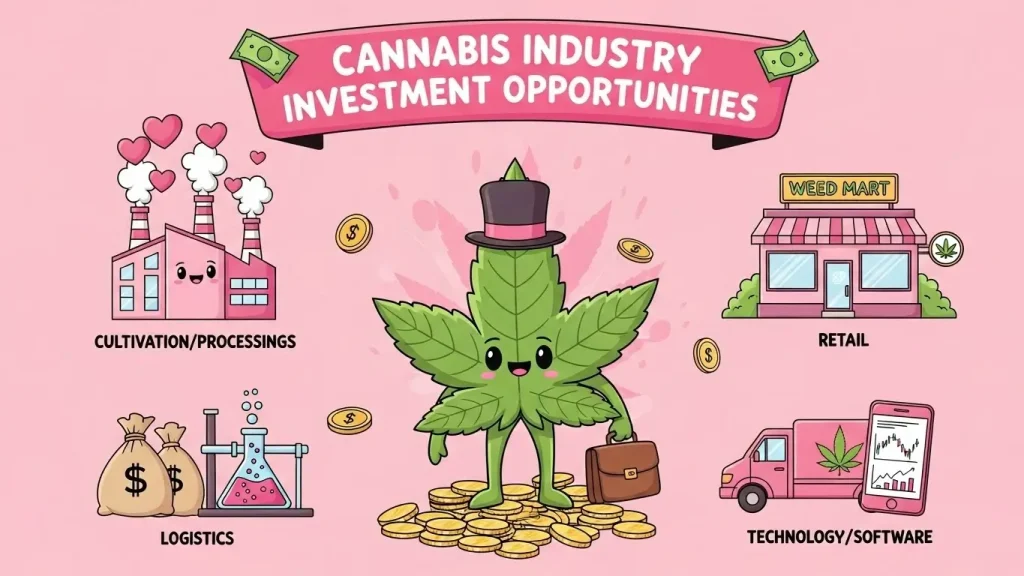
The cannabis industry stands at a pivotal threshold in 2026. Following years of regulatory stagnation and market volatility, a confluence of political momentum, financial restructuring, and emerging global markets is creating what many analysts believe is the most constructive investment setup in nearly a decade . For investors, this presents a unique asymmetric opportunity: stocks are priced for continued failure, yet the potential catalysts for a fundamental re-rating have never been stronger.
This guide will unpack the cannabis industry investment opportunities in 2026, providing a data-driven roadmap for navigating this complex, high-potential sector. We’ll analyze the top cannabis stocks positioned to benefit, evaluate the potential for a sustained recovery, and outline actionable strategies, including the role of cannabis stocks ETFs, for building a resilient portfolio.
Introduction: The Contrarian Opportunity in a Beaten-Down Sector
If you’ve followed cannabis stocks over the past few years, you’re likely familiar with the narrative of disappointment. After the initial euphoria following legalization in Canada and parts of the U.S., the sector entered a prolonged “green winter” characterized by oversupply, crushing tax burdens, and stalled federal reform in the United States. Investor fatigue became palpable.
However, the close of 2025 marked a potential inflection point. A historic executive order initiated the process to reschedule cannabis in the U.S., a move that could dismantle the single largest financial obstacle for operators . Yet, in a classic “sell the news” reaction, stock prices sank further, trading near yearly lows . This paradox—improving fundamentals paired with depressed sentiment and valuations—is precisely where savvy investors look for opportunity. As Lale Akoner, global market analyst at eToro, notes, “2026 offers the most constructive setup in years” for cannabis stocks .
This guide is designed for the investor asking: “Will cannabis stocks recover, and how can I position myself if they do?” We’ll move beyond the hype and headlines to analyze the concrete regulatory, financial, and market forces that will define 2026. You’ll get a clear view of how to invest in cannabis stocks, a detailed cannabis stocks list to research, and an understanding of which cannabis stocks with dividends or growth profiles might fit your strategy.
The 2026 Investment Thesis: Three Pillars for a Sustainable Recovery
The case for cannabis industry investment opportunities in 2026 doesn’t rely on a single miracle. Instead, it’s built on three interconnected pillars that together could create a virtuous cycle of improving valuations, financial health, and institutional participation.
1. The Regulatory Catalyst: Rescheduling and the End of 280E
The centerpiece of the 2026 outlook is the expected administrative move of cannabis from Schedule I to Schedule III under the U.S. Controlled Substances Act .
- The 280E Tax Burden: Currently, U.S. cannabis companies are hamstrung by IRS Code Section 280E. This rule, designed for illicit drug traffickers, prohibits businesses dealing in Schedule I or II substances from deducting ordinary business expenses (rent, payroll, marketing) . The result? Effective corporate tax rates can exceed 70%, devastating cash flow and preventing profitability .
- The 2026 Impact: Rescheduling to Schedule III eliminates 280E . Overnight, it acts as a massive corporate tax cut. Companies could deduct expenses, transforming their financial models from cash-burning operations to potential generators of sustainable free cash flow. This isn’t just about symbolism; it’s about survival and growth. As one analysis puts it, this “could reset stock valuations” across the board .
2. The Financial Clean-Up: Leaner Companies and Stronger Balance Sheets
The brutal bear market of the early 2020s forced a painful but necessary corporate discipline. To survive, leading companies engaged in significant restructuring:
- Asset-Light Models: Firms like Canopy Growth divested capital-heavy cultivation facilities to preserve cash and reduce overhead .
- Cost Reduction: Aggressive cost-cutting programs have been implemented across the sector. Canopy Growth, for example, realized approximately $21 million in annualized savings from its program .
- Balance Sheet Repair: Companies have used equity raises and asset sales to pay down debt and term out maturities. While dilutive in the short term, this creates stronger, more investable entities for the long term .
This forced austerity means the sector is entering 2026 in its leanest and most operationally focused state in years, better positioned to capitalize on regulatory tailwinds.
3. The Liquidity and Institutional Gateway: SAFER Banking and Broader Access
Rescheduling alone won’t trigger a moonshot. Sustained recovery requires institutional capital—pensions, mutual funds, and insurance companies—which has been largely sidelined due to legal and compliance risks .
- The SAFER Banking Act: Momentum is building for complementary banking reform that would provide a true safe harbor for financial institutions serving cannabis businesses .
- The Positive Feedback Loop: The sequence is critical. Rescheduling improves fundamentals and valuations. Improved valuations and banking reform attract institutional investors. Institutional investment provides deeper market liquidity and stability, which supports further valuation gains. This “reinforcing positive feedback loop” is key to a lasting recovery .
How to Invest in Cannabis Stocks: A Strategic Framework
Before looking at specific tickers, you need a plan. How to invest in cannabis stocks requires a different mindset than investing in established tech or consumer staples. Here is a strategic framework, synthesized from expert advice .
Table: Strategic Approaches to Cannabis Investing
| Approach | Description | Best For | Key Risks/Considerations |
|---|---|---|---|
| Direct Stock Picking | Buying shares of individual companies. | Investors with high risk tolerance who want concentrated exposure to specific company strategies. | High volatility, company-specific failure risk, requires deep due diligence. |
| Cannabis ETFs | Buying shares of an exchange-traded fund that holds a basket of cannabis stocks. | Investors seeking immediate diversification and reduced single-stock risk. | Management fees, potential over-diversification, fund-specific strategy. |
| Ancillary Companies | Investing in businesses that support the industry (tech, packaging, hydroponics) but don’t “touch the plant.” | Investors wanting cannabis exposure with less direct regulatory risk. | Success is still tied to the health of the core cannabis market. |
Key Investment Principles:
- Think Long-Term: This is not a sector for day-trading. The transformation will play out over quarters and years, not days .
- Prioritize Fundamentals: Look for companies with a path to profitability, strong management, and clean balance sheets. The era of investing in stories alone is over.
- Diversify: Given the sector’s volatility, diversification is crucial. This can be achieved either through a carefully built portfolio of individual stocks or, more simply, through a cannabis stocks ETF.
- Stay Informed: Regulatory news will drive short-term sentiment. Have a plan to avoid reactive trading based on headlines.
Top Cannabis Stocks to Watch in 2026: A Focus on Strategy
While countless companies operate in this space, a few large-cap players often dominate trading volume and analyst attention due to their distinct strategies . Here, we examine what are the top 3 cannabis stocks to invest in based on different strategic archetypes.
1. The U.S.-Focused Aggressor: Canopy Growth (NASDAQ: CGC)
Canopy is making a binary, all-in bet on the U.S. market through its “Canopy USA” structure. This allows it to hold economic interests in leading U.S. multi-state operators (MSOs) like Acreage Holdings, Jetty, and Wana Brands. The thesis is simple: the moment U.S. federal law permits, Canopy can fully acquire these assets, instantly becoming a major player . Recent acquisitions, like MTL Cannabis, also secure its supply chain for international markets . It’s a high-risk, high-reward play for investors seeking pure regulatory upside.
2. The Diversified Fortress: Tilray Brands (NASDAQ: TLRY)
Tilray offers a stark contrast in strategy. It’s built on three pillars: Cannabis, Beverage Alcohol (it’s the 5th largest craft brewer in the U.S.), and Wellness . This diversification provides a crucial safety net. If U.S. cannabis reform is delayed, the company’s cash flow from brands like SweetWater Brewing and Green Flash provides stability. Simultaneously, it maintains a leading position in the European medical cannabis market, particularly in Germany . For investors, it’s a way to gain cannabis exposure with built-in downside protection.
3. The U.S. Multi-State Operator (MSO) Pure-Play: Green Thumb Industries (OTC: GTBIF) / Curaleaf (OTC: CURLF)
For direct exposure to the profitable U.S. market, the largest MSOs are essential research. These companies, like Green Thumb Industries and Curaleaf, operate cultivation and retail dispensaries across multiple legal states . They are the current engines of the U.S. industry and stand to benefit most immediately from the removal of 280E, which would flow directly to their bottom lines . The catch? They primarily trade on U.S. over-the-counter (OTC) markets or the Canadian Securities Exchange (CSE), which can mean lower liquidity and higher volatility than Nasdaq-listed peers like Tilray and Canopy.
Navigating the Market: ETFs, Dividends, and FAQs
Cannabis Stocks ETF: The Power of Diversification
For most investors, a cannabis stocks ETF is the most prudent entry point. It mitigates the risk of a single company’s failure while capturing the sector’s overall growth. Key options include:
- AdvisorShares Pure U.S. Cannabis ETF (MSOS): The largest cannabis ETF, it focuses exclusively on U.S. multi-state operators (MSOs) through swap agreements, offering pure exposure to the American market’s potential .
- Amplify Alternative Harvest ETF (MJ): One of the first U.S.-listed cannabis ETFs, it provides broader global exposure, with significant holdings in Canadian licensed producers like Tilray and Canopy Growth .
- AdvisorShares Pure Cannabis ETF (YOLO): A globally focused fund that offers a mix of U.S. and international cannabis equities .
Do Any Cannabis Stocks Offer Dividends?
While most cannabis companies reinvest all cash flow into growth and survival, there are exceptions. Innovative Industrial Properties (IIPR) is a unique play. It’s a real estate investment trust (REIT) that purchases cultivation facilities and leases them back to operators. This model generates stable rental income, which it pays out as a dividend, making it one of the few options for investors seeking cannabis stocks with dividends .
Frequently Asked Questions (FAQs)
- Will cannabis stocks recover in 2026?
While past performance is no guarantee, the fundamental setup for 2026 is the strongest it has been in years. Recovery depends on the execution of rescheduling, improved company fundamentals, and broader institutional investment. Analysts are cautiously optimistic for a gradual, sustainable re-rating rather than a speculative spike . - What is the single biggest risk to cannabis stocks in 2026?
Regulatory failure or delay. If the process to reschedule cannabis stalls, is reversed by legal challenge, or is not accompanied by banking reform, the current investment thesis would weaken significantly. The sector remains highly politically sensitive . - I’m a beginner. What’s the safest way to start investing?
Begin with a small position in a diversified cannabis stocks ETF like MSOS or MJ. This allows you to learn about the sector’s movements with lower risk than picking a single stock. Always ensure this investment fits within the speculative portion of your overall, well-diversified portfolio . - Are Canadian or U.S. cannabis stocks a better investment?
They offer different exposures. U.S. MSOs (often OTC-listed) offer direct exposure to the world’s largest cannabis market but with higher regulatory complexity. Canadian LPs (Nasdaq/TSX-listed) offer more liquidity and stability through diversification (like Tilray’s beverage division) but have largely saturated their domestic market. Many investors choose to hold both through an ETF. - How does the potential federal crackdown on hemp-derived THC products affect the market?
A planned restriction on intoxicating hemp products (like delta-8 THC) by November 2026 could benefit regulated cannabis companies by removing a segment of low-cost, less-regulated competition. This could help restore pricing power in certain markets .
Conclusion: Positioning for the Green Wave
The cannabis industry investment opportunities in 2026 are defined by a transition from speculative hope to tangible execution. The sector is sobering up—companies are leaner, the regulatory path is clearer, and valuations reflect deeply pessimistic expectations.
For the disciplined, long-term investor, this creates a compelling moment. The question is no longer if the regulatory environment will improve, but when and how completely. By focusing on companies with sound fundamentals, employing diversification through stocks or ETFs, and maintaining a timeline measured in years, you can construct a portfolio positioned to capitalize on what may be the beginning of the cannabis sector’s most sustainable growth phase yet.
Ready to conduct your own due diligence? Start by researching the ETFs and companies mentioned here, paying close attention to their latest quarterly financials and management commentary. The green wave may be building more slowly than some initially hoped, but for prepared investors, its momentum in 2026 could be all the more powerful.