
Let’s be real for a second: if you believe everything you hear about cannabis, you probably think your backyard bird feeder is a ticking time bomb for a DEA raid, or that the government secretly wants to patent your stash. The world of weed is clouded by decades of propaganda, late-night dorm room debates, and headlines that prioritize clicks over clarity.
Whether you are a seasoned connoisseur, a curious newbie exploring medical marijuana pros and cons, or someone just trying to separate cannabis myths and facts, the noise can be overwhelming. We’ve all heard the wild ones: “It kills brain cells,” “It’s a gateway drug,” or “You can’t get addicted.” But how much of that is ancient history, and how much is actually backed by science?
In 2026, the conversation has shifted. With the FDA on medical marijuana taking new stances and research pouring in from institutions like the NIH and JAMA, we finally have the data to put these tales to rest. We’re going to break down five of the craziest urban legends about weed, dissect them with hard evidence, and give you the truth.
Ready to have your mind blown (without the paranoia)? Let’s dive in.
1. The “Bird Seed = Weed” Myth
The Tale: You’ve probably heard this one while laughing with friends: if you throw out birdseed in your backyard, you might accidentally grow a cannabis plant. It sounds like a suburban legend designed to get grandmas arrested.
The Truth:
Believe it or not, this is one of the few urban legends about weed that has a kernel of truth to it—though not in the way you might think. It is possible for a cannabis plant to sprout under your bird feeder, but you won’t get high from it.
Here’s the science: some commercial birdseed mixes contain hemp seeds. Hemp is the same species as cannabis, but it is bred specifically to contain less than 0.3% THC (the stuff that gets you high). While these seeds are usually sterilized to prevent growth, every now and then, an unsterilized seed slips through.
There’s a famous case of a pensioner in England who had a “rude shock” when a plant sprouted under her feeder . The plant was harmless hemp, but because she didn’t have a license, she had to destroy it. So, while you might get a plant, you aren’t going to get a free stash. Cannabis myths and facts often collide here; the plant looks the part, but it won’t play the part.
2. The “Government Patent” Conspiracy
The Tale: This is a favorite among conspiracy theorists: the U.S. government holds the patent on cannabis, proving they’ve known it’s medicine for decades but kept it illegal to suppress the population.
The Truth:
Let’s look at the cannabis myths and facts regarding the government’s involvement. It is true that the U.S. Department of Health and Human Services holds a patent—specifically, US Patent 6630507. However, the context is everything.
This patent, issued in 2001, does not cover the plant Cannabis sativa. It covers the use of cannabinoids (specifically CBD) as neuroprotectants—meaning they might help protect the brain from diseases like Alzheimer’s or Parkinson’s . The government wasn’t trying to own your weed; they were trying to protect a scientific discovery regarding the therapeutic use of cannabis and cannabinoids.
Critics are right to point out the hypocrisy: the government spent decades funding the War on Drugs while simultaneously patenting the medical benefits of the plant’s components. It highlights a confusing era where politics and science were at odds. But believing the government is hiding your stash in Area 51? That’s a myth.
3. The Halloween Edibles Panic
The Tale: Every October, the warnings pop up on Facebook: “Check your kids’ candy! Marijuana edibles look exactly like Snickers and gummy bears, and they’re putting them in trick-or-treat bags!”
The Truth:
This is a perfect example of a real-world risk ballooning into a full-blown urban legend. Cannabis myths and facts regarding edibles are tricky because there is a danger, but the scale of the “Halloween panic” is largely fabricated.
First, the fact: cannabis edibles made to look like popular candies are a real problem in terms of accidental ingestion by children. This is why most legal markets require childproof packaging and strict labeling laws. It is incredibly dangerous when commercial products mimic the look of common treats.
However, the myth that strangers are secretly lacing Halloween candy with THC to poison children is largely unfounded. High-profile cases of children eating THC-laced candy on Halloween exist, but they are often disputed or turn out to be isolated incidents involving family members rather than random neighbors .
The takeaway? If you consume edibles, use your common sense. Keep them in a secure spot, out of reach, and avoid buying the varieties that look like candy if kids are around. The risk is real, but the myth of the Halloween “candy man” is largely just that—a myth.
4. The “Gateway Drug” Theory
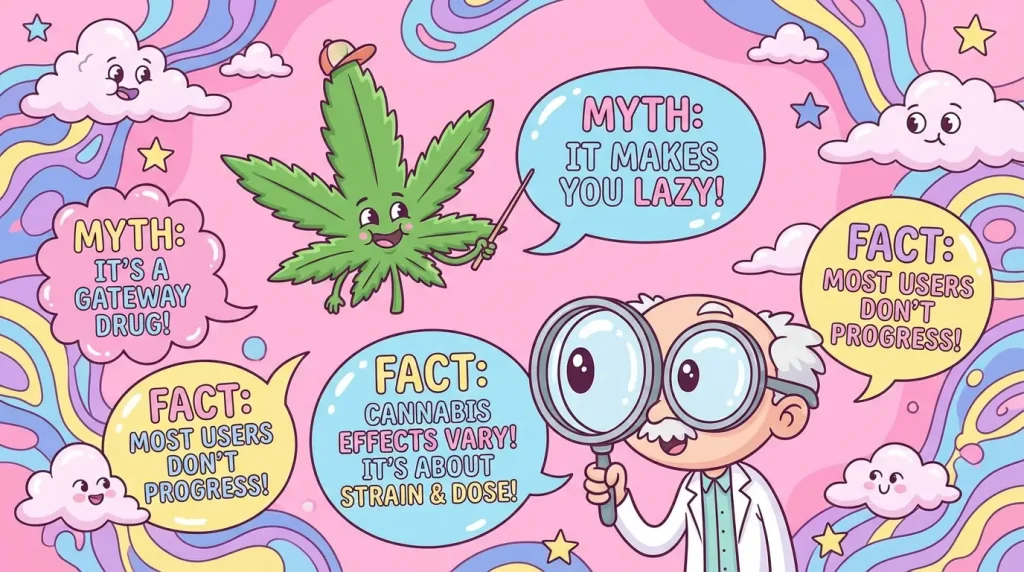
The Tale: This is the grandfather of all cannabis myths and facts. “Smoke weed, and you’ll inevitably end up on heroin.” For decades, this was the cornerstone of anti-drug education (think Reefer Madness).
The Truth:
The gateway drug theory has been systematically dismantled by modern science. The argument that cannabis use causes the use of harder drugs confuses correlation with causation.
Recent research published by the NIH revisiting this hypothesis suggests that while there is an association between early cannabis use and later polysubstance use, it is not a simple one-way street. The “common liability model” suggests that people who try cannabis might already have a genetic predisposition or environmental risk factors (like social circles or impulsivity) that make them more likely to try other substances .
Think of it this way: most people who drink coffee or tea will never try cannabis. But most people who try heroin probably drank coffee first. Does that make coffee a gateway to heroin? Of course not.
The progression from cannabis to other drugs has more to do with social availability, individual personality traits, and socio-economic factors than with some chemical property of the plant itself . The idea that marijuana is a “gateway” is less about pharmacology and more about correlation and circumstance.
5. The Myth of “No Withdrawal”
The Tale: “You can’t get addicted to weed; it’s not physically addictive.” This is a common refrain among users who want to believe their habit is completely harmless.
The Truth:
While cannabis is not as physically dependence-forming as opioids or alcohol, cannabis withdrawal is a very real, clinically recognized syndrome.
According to health guidelines, if you are a heavy, regular user and you stop suddenly, symptoms can start within 24 hours. These include insomnia, irritability, anxiety, anger, and restlessness . You might feel shakiness or a loss of appetite. The peak usually hits around 2-3 days, and it can last one to two weeks .
This doesn’t mean you’re “addicted” in the stereotypical sense of the word, but it does mean your body has adapted to the presence of THC. The risks of cannabis use disorder are real. Studies published in JAMA estimate that a significant percentage of those who use cannabis for medical purposes may meet the criteria for a use disorder .
How to Manage Use
If you’re looking to cut back, harm reduction strategies are key:
- Titrate down: Don’t go cold turkey. Reduce your intake gradually.
- Delay first use: If you usually smoke as soon as you wake up, try to push it back an hour, then two.
- Hydrate: During detox, dehydration is a risk. Drink plenty of water .
Understanding cannabis withdrawal is crucial for anyone looking to use the plant responsibly.
Bonus: The Science of “Less is More”
As we bust these myths, a new trend is emerging that challenges the “bigger is better” culture: THC microdosing.
Many are discovering that you don’t need to be completely obliterated to get the benefits. THC microdosing involves taking small amounts (usually 1-5 mg) to achieve focus, creativity, or pain relief without the psychoactive “high” .
This practice is gaining traction for:
- Anxiety: Low doses can reduce stress, while high doses can actually trigger paranoia .
- Pain management: Studies suggest that low-dose THC, when combined with the endocannabinoid system, can help with chronic pain without the heavy sedation of opioids .
- Neuroprotection: Emerging research hints that low doses might support brain health, potentially helping with neuroplasticity .
This flies in the face of the “reefer madness” myth that any amount of THC turns you into a zombie. Instead, it paints a picture of a nuanced tool that requires respect and precision.
Conclusion: The Verdict on Weed Tales
So, where does that leave us? For decades, the conversation around cannabis has been stuck between absurd propaganda and equally absurd counter-culture myths. The reality, as usual, lies in the nuanced middle ground.
We’ve learned that while your birdseed won’t get you high, the government really did patent your cannabinoids. We’ve seen that while it’s not a physical “gateway,” it’s also not free from cannabis withdrawal symptoms. As we move further into 2026, the call for responsible, evidence-based conversation is louder than ever.
Whether you’re using it for chronic pain, anxiety, or just to unwind, understanding the cannabis myths and facts allows you to make smarter choices. Have you ever fallen for one of these myths? Or do you have a crazy weed tale we missed? Drop your thoughts in the comments below—let’s keep the conversation going.
Frequently Asked Questions (FAQ)
Q: Is it true that the FDA has approved marijuana as medicine?
A: The FDA on medical marijuana is specific. They have not approved the whole plant, but they have approved drugs based on cannabinoids, such as Epidiolex (for seizures) and Marinol (for nausea) .
Q: Can you overdose on cannabis?
A: You cannot fatally overdose in the way you can with opioids. However, you can take too much, leading to “greening out”—severe anxiety, paranoia, vomiting, and panic attacks.
Q: Is CBD actually effective?
A: There is strong evidence for CBD in treating specific forms of epilepsy. For other uses like anxiety or pain, evidence is mixed. Be wary of studies with conflicts of interest, as the industry is largely unregulated .
Q: Does marijuana kill brain cells?
A: This is one of the oldest cannabis myths and facts. While heavy, long-term use in adolescents can affect cognitive development and neural networks, the idea that it kills cells in adults is largely overstated. Some studies suggest low doses might even be neuroprotective .
Q: What are the legal risks in 2026?
A: Legality varies wildly. While many states have legalized medical or recreational use, it remains a Schedule I substance federally in the U.S., which creates a complex legal landscape . Always check your local laws.