
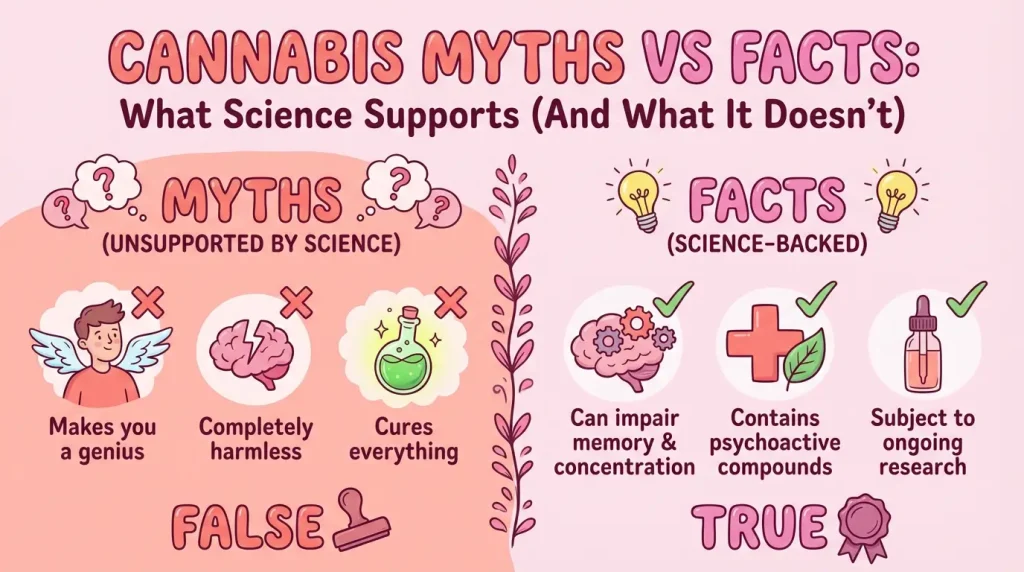
Let’s be real for a second. Walk into any dispensary or scroll through social media, and you’ll hear two extreme stories about cannabis. One side tells you it’s a harmless plant that cures everything from anxiety to cancer. The other side warns it’s a dangerous gateway drug that will ruin your life. With 40 states having legalized medical marijuana and a handful allowing recreational use, the noise is louder than ever . But if you are trying to make a smart decision—whether for chronic pain relief or to unwind on a Friday night—you need more than just anecdotal advice from a friend or a budtender.
The gap between public perception and actual science is wider than ever. In fact, researchers point out that the loudest voices in the debate often have “political or financial skin in the game,” leaving the average consumer confused . So, how do you navigate the murky waters of cannabis myths vs facts?
In this guide, we aren’t going to tell you what to think. We are going to show you what the evidence actually says. We will look at where the FDA has approved cannabis-based medicines, where the science falls short, and what the real risks are—including the often-ignored reality of cannabis use disorder. By the end, you’ll have a clear roadmap to separate the hype from the help.
The Endocannabinoid System: Why Cannabis Affects Us Differently
Before we dive into the myths, you need to understand why this plant interacts with us at all. It’s not magic; it’s biology.
In 1988, scientists at the St. Louis University Medical School made a groundbreaking discovery: the rat brain has receptor sites that are activated by THC . We now know this as the endocannabinoid system (ECS) . Think of the ECS as your body’s master regulator. It helps control pain, mood, sleep, appetite, and immune response. Your body even produces its own cannabis-like molecules, called endocannabinoids, to keep things running smoothly.
When you consume cannabis, the phytocannabinoids (plant-based compounds) like THC and CBD interact with these receptors. THC primarily binds to CB1 receptors in the brain, which is why it gets you “high.” CBD, on the other hand, is more of a modulator; it interacts indirectly, which is why it offers therapeutic benefits of CBD without the intoxication . Understanding this system is the first step in realizing that the effects of cannabis aren’t just “in your head”—they are rooted in complex biology. But just because we have receptors for it doesn’t mean more is always better.
What Science Actually Supports: The “A-Team” of Evidence
Let’s start with what we know works. Despite the federal restrictions that have slowed research for decades, there are a few areas where the evidence is strong enough to make even the skeptics nod in agreement.
The FDA-Approved Heavy Hitters
First and foremost, we have to look at the gold standard of medicine: FDA approval. Currently, the agency has given the green light to specific cannabis-based medications.
- Epidiolex: This is a purified form of CBD, and it’s a game-changer. It’s approved to treat severe, rare forms of epilepsy like Lennox-Gastaut syndrome and Dravet syndrome . This is the only plant-derived cannabis drug that has gone through the rigorous FDA approval process, proving it is safe and effective for these specific conditions.
- Synthetic THC (Marinol, Syndros): These are lab-made chemicals that mimic THC. They are proven to combat nausea and vomiting caused by chemotherapy and to stimulate appetite in AIDS patients suffering from wasting syndrome .
Why does this distinction matter? Because walking into a dispensary and buying a gummy is not the same as getting a prescription for Epidiolex. Dispensary products are not regulated by the federal government, meaning there is no guarantee of purity, potency, or consistency . You might be hoping for a medical effect, but you are playing a different ballgame than clinical medicine.
Chronic Pain and Neuropathy: Small Benefits, Real Risks
The most common reason people seek out medical marijuana is for pain. A massive “living” systematic review from the AHRQ, updated as recently as April 2025, provides the most current look at this . So, what does it say about cannabis for pain relief?
For patients with chronic neuropathic pain (nerve pain), there is moderate evidence that specific cannabis products—specifically those with a comparable THC-to-CBD ratio (like an oral spray)—can lead to a small improvement in pain severity. We are talking about a reduction of about half a point on a 10-point scale .
However, there is a catch. The same review found that these benefits come with trade-offs. There is a “large increased risk of dizziness and sedation” and a moderate risk of nausea. For high-THC products, the dizziness is even more pronounced. So, while there is relief to be found, it’s not the “no-side-effects” miracle some claim. It is a pharmaceutical trade-off, just like any other medication.
The “Wild West”: Where the Science Falls Short
Now we get to the part that might frustrate you if you are a fan of CBD gummies for anxiety or pot brownies for sleep. For most of the conditions people actually use cannabis for, the science just isn’t there yet.
Anxiety, Depression, and Mental Health
This is the most complex area. The anecdotal reports are everywhere: “It calms my mind.” “It helps me shut off.” But the clinical data is a mixed bag. A 2024 study of 80 veterans with PTSD found no difference between cannabis and a placebo .
While some studies show minor benefits for social anxiety with CBD, researchers warn that THC can actually worsen anxiety and depression over time, especially in heavy users . There is even a link between high-THC use and an increase in psychotic symptoms in those predisposed to mental illness. Dr. Kevin Hill from Harvard Medical School notes that while he wouldn’t recommend whole-plant cannabis for anxiety, dismissing patients who use it is a missed opportunity to engage them in proven treatments like cognitive behavioral therapy . It’s a delicate balance, and more research is needed to understand who benefits and who is harmed.
Sleep: The Withdrawal Trap
“What knocks you out better?” is a common question at dispensaries. But the relationship between cannabis and sleep health is tricky. Initial use of THC-heavy strains might help you fall asleep faster because it knocks you out. However, long-term, regular use can fragment your sleep architecture, reducing the amount of restorative REM sleep you get.
Here is the trap that researchers point out: If you use cannabis to sleep every night and then stop, you will likely experience a rebound of insomnia and vivid nightmares as part of withdrawal. Most people interpret this as “See? I really do need it to sleep!” But in reality, you might just be experiencing the withdrawal from the substance. As one expert noted, if people quit for a month, they might find their natural sleep improves, but few make it past those first few rough nights .
Acute Pain and Most Other Conditions
What about a pulled muscle or a headache? The evidence doesn’t support cannabis for acute pain. Cancer pain guidelines from 2024 also found insufficient evidence to recommend it as a frontline treatment . The bottom line? If you have a specific medical condition, using cannabis is an experiment—and you are the guinea pig.
The Risks: The Reality of Cannabis Use Disorder
Let’s tackle the elephant in the room. For years, advocates have claimed it’s impossible to get addicted to cannabis. That is simply untrue. The reality of cannabis use disorder is well-documented.
It’s Not as Addictive as Opioids, But It’s Addictive
Research consistently shows that about 3 in 10 people who use cannabis may develop some form of cannabis use disorder . For those who start young (before 18) or use it daily, the risk is significantly higher. Recent 2024 and 2025 analyses have found that roughly 29% to 34% of medical cannabis users show symptoms of the disorder .
What does this look like in real life? It’s not about physical sickness like heroin withdrawal, which is a key distinction in the cannabis myths vs facts debate. It’s the psychological and lifestyle impact. Dr. Kevin Hill describes patients who have lost multi-million dollar careers because they chose cannabis over work and relationships . Symptoms include:
- Craving cannabis.
- Using more than you intended.
- Giving up important social activities to use instead.
- Continuing to use even when it causes problems at home or work .
The “Dose” Determines the Poison
Why the confusion? Because unlike alcohol, where the risks of binge drinking are well-known, people assume that because cannabis is “natural,” it’s harmless. But as one Harvard psychiatrist points out, the harms—like an 8-point IQ drop in adolescents—are linked to heavy marijuana use, specifically daily or near-daily consumption . That 16-year-old using once a week is in a different risk category than the 26-year-old smoking four times a day.
Potency is Skyrocketing
We aren’t smoking the same weed our parents did. The concentration of THC in cannabis products has increased dramatically. High-potency extracts, vape carts, and dabbing concentrates can deliver massive amounts of THC quickly. This surge in potency is linked to a higher risk of developing cannabis dependence and triggering adverse psychological effects .
Health Effects: Lungs, Heart, and Brain
Beyond addiction, there are physical considerations. Remember, smoking anything involves inhaling carcinogens. While a direct link to lung cancer is harder to prove than with tobacco (partly because tobacco users smoke much more frequently), secondhand cannabis smoke contains many of the same toxins .
Is cannabis bad for your lungs? If you smoke it, yes. Chronic bronchitis is a known risk. Vaping, often touted as safer, isn’t risk-free either. The 2019 outbreak of EVALI (e-cigarette or vaping use-associated lung injury) was linked primarily to THC vaping products containing vitamin E acetate, resulting in thousands of hospitalizations and dozens of deaths .
And for the developing brain, the evidence is clear: adolescents and young adults are at the highest risk for long-term cognitive deficits from regular use.
Navigating the Law and Your Health
Here is a critical fact that many miss: just because it’s legal at the state level doesn’t mean it’s safe, and it doesn’t mean it’s regulated by the FDA.
- No Federal Oversight: The cannabis flower, gummies, and vapes at your local dispensary are regulated by the state. There are no universal federal standards for testing for pesticides, mold, or heavy metals . You might not be getting what you think you are.
- Drug Interactions: Cannabis can interact with other medications, including blood thinners and antidepressants . Always talk to your doctor. If you don’t feel comfortable telling your doctor you use cannabis, that is a red flag. You should be able to have an open conversation about all substances you are putting into your body.
Legal vs. Medical: A Crucial Distinction
Just because a product is sold in a store doesn’t mean it has proven medical efficacy. The passage of the Hemp Farming Act of 2018 legalized hemp, but it also led to a flood of CBD products making unsubstantiated health claims . Be a savvy consumer. If a product promises to cure a disease, run the other way.
Frequently Asked Questions (FAQs)
Q: Is CBD alone effective for pain?
A: According to the latest evidence, probably not. Systematic reviews show that purified CBD alone is not associated with decreased pain intensity compared to a placebo . Most of the evidence for pain relief points to a combination of THC and CBD.
Q: Can you overdose on cannabis?
A: A fatal overdose solely from cannabis is extremely unlikely. However, you can definitely take too much. Overconsumption can lead to extreme confusion, anxiety, paranoia, panic attacks, rapid heart rate, and severe nausea or vomiting . This is especially common with edibles, where the effects are delayed, leading people to eat more than they should.
Q: Does cannabis cause schizophrenia?
A: This is a classic case of correlation vs. causation. While there is an association between cannabis use and schizophrenia, scientists debate the direction. It is possible that people at risk for schizophrenia use cannabis to self-medicate early symptoms. Furthermore, if cannabis caused schizophrenia, rates of the illness would have skyrocketed as cannabis use increased, which has not happened . The current consensus is that it may trigger psychosis in those already predisposed, but it doesn’t “create” it out of nowhere.
Q: Is it safe to use cannabis during pregnancy or while breastfeeding?
A: Doctors strongly advise against it. Chemicals from cannabis, including THC, can be passed to the baby through breast milk and can cross the placenta. Because THC is stored in body fat, it can be released over time, exposing the baby long after the mother stops using .
Q: What is the difference between Indica and Sativa?
A: While consumers often use these categories to predict effects (Indica = “in da couch” for relaxing, Sativa = energetic), the scientific evidence for this distinction in store-bought products is weak. The actual effects are more dependent on the specific cocktail of cannabinoids and terpenes in that particular plant. Your budtender might help you choose a strain based on these profiles, but the effects can still vary widely from person to person due to your unique biology .
Q: Are there any proven medical benefits for cannabis?
A: Yes, there are. The most robust evidence supports its use for specific conditions: chronic neuropathic pain, chemotherapy-induced nausea and vomiting, and for improving appetite in wasting diseases. The FDA has also approved a CBD drug for severe epilepsy. However, these proven benefits are for a much smaller number of conditions than what people are actually using it for .
Conclusion: Finding Your Middle Ground
So, where does that leave us in the great cannabis debate? The truth, as usual, lies somewhere in the middle of the myths and realities.
Cannabis is not a harmless cure-all, and it is not a deadly menace. It is a complex plant with real therapeutic potential for specific conditions like chronic pain, and it carries real risks, including addiction potential and mental health side effects for vulnerable individuals. The difference between medicine and poison often lies in the dose, the frequency, and the individual.