
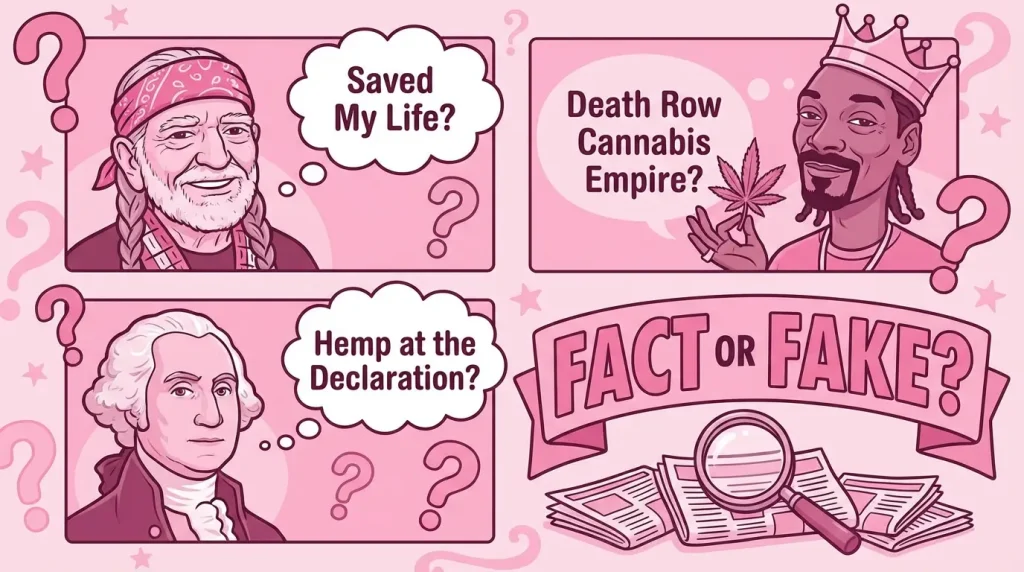
The cannabis industry has always had a touch of glitz and glamour, but lately, it feels more like a Hollywood thriller than a trip to the dispensary. We see icons like Willie Nelson with his own reserve, Snoop Dogg turning Death Row Records into a cannabis empire, and legends like Mike Tyson stepping into the ring—not to box, but to sell pre-rolls. These celebrity cannabis stories dominate our feeds and our shelves, but they leave us with a burning question: Is this the real deal, or are we just buying into a perfectly rolled myth?
You’ve probably found yourself scrolling through social media, seeing a famous face holding a jar of THC gummies or a sleek vape cartridge, and wondered: “Do they actually use this stuff, or is it just another paycheck?” It’s a fair question. With the market projected to grow exponentially, the line between authentic passion and opportunistic branding is getting blurrier by the day. We’re here to pull back the curtain, separate the fact from the fiction, and give you the unvarnished truth about what happens when fame meets the cannabis plant. Get ready to look beyond the headline-grabbing celebrity endorsements and discover the real impact these ventures have on your rights, your wallet, and the industry as a whole.
Did Willie Nelson Really Credit Marijuana with Saving His Life?
When you think of Willie Nelson, the image is almost inseparable from a cloud of smoke on his tour bus. He is the undisputed godfather of cannabis culture in country music. But is his advocacy just part of the persona, or is there a deeper, more personal story?
The “Willie Nelson” Strain: More Than Just a Name
There’s a popular cannabis strain named after the red-headed stranger himself, and for good reason. On platforms like Leafly, the “Willie Nelson” strain—a sativa known for its high THCV content—receives rave reviews not just for its “euphoric” and “energetic” highs, but for its practical effects . One reviewer noted it’s “better than a cup of coffee” and crucially, unlike other strains, “it does not make you hungry” . For a man who has spent decades on the road, the creative and energetic boost aligns perfectly with his lifestyle. While Willie hasn’t explicitly credited the plant with “saving his life” in a single, viral quote, his entire career arc suggests a profound reliance on it for health, wellness, and creativity.
The Science Behind the Smoke: Health Benefits for Aging Icons
As he aged, Nelson became more vocal about the health benefits of cannabis. He faced serious respiratory issues, and in interviews, he hinted that smoking marijuana was part of his regimen for staying young at heart and managing the physical toll of touring. This isn’t just anecdotal; it reflects a growing body of research on cannabinoids and their impact on inflammation, pain, and even neuroprotection .
So, is the story fact or fake? Fact. While it might be a poetic exaggeration to say cannabis “saved” him, it’s undeniable that Willie Nelson’s relationship with the plant is deeply authentic. He didn’t just slap his name on a product; he launched Willie’s Reserve, a brand built on his actual farming principles and advocacy for legalization. His story is the gold standard of how a celebrity endorsement should feel: organic, earned, and consistent.
Is Snoop Dogg’s Death Row Cannabis Launch a Real Empire Builder?
If Willie is the godfather, Snoop Dogg is the CEO of celebrity cannabis. He has transcended music to become a ubiquitous presence in the corporate world, and his latest move—acquiring Death Row Records and transforming it into a Death Row Cannabis brand—is his most ambitious yet. But is this a real business empire, or just a clever marketing stunt?
The Business Model: How Snoop Built a Dynasty
This is where the “fact” side of the argument gets a heavy dose of financial reality. Snoop isn’t just a pitchman; he’s a strategic investor. He brought in Tiffany Chin, a veteran from his early Leafs By Snoop days, to run Death Row Records Cannabis as CEO . They aren’t just selling weed; they are building an experiential lifestyle brand. From the S.W.E.D. (Smoke Weed Every Day) store in Los Angeles to a partnership with Iconic Tonics for hemp-derived THC beverages like “Do It Fluid” and “Doggy Spritz,” the strategy is about vertical integration and market penetration .
The move into beverages is particularly smart. As the industry faces regulatory uncertainty, hemp-derived THC products offer a loophole for wider distribution. By launching via DoorDash and in major retailers like Total Wine, Snoop’s empire is reaching consumers in states where recreational cannabis isn’t even legal yet .
From Leafs By Snoop to Death Row: A Case Study in Long-Term Value (LTV)
This isn’t Snoop’s first rodeo. Leafs By Snoop, launched in 2015, was one of the first major celebrity cannabis brands. While its initial rollout had growing pains, it established Snoop as a first-mover. Now, with Death Row, he’s applying those lessons. He owns the intellectual property, the music catalog, and the distribution channels.
So, fact or fake? Fact, with a caveat. The empire is real, but it’s built on the back of a massive corporate apparatus. It’s a testament to smart business, but it also highlights the “corporate capture” of a culture that was once underground. The question for you, the consumer, is: Does the corporate machine change how you feel about the product, or is quality all that matters?
Did George Washington Smoke Hemp While Drafting the Declaration?
Now, let’s dive into the internet’s favorite founding father fan fiction. You’ve seen the memes: George Washington, with a glowing spliff in one hand and the Constitution in the other. It’s a hilarious image, but how much of it is actually rooted in history? This is one of the most persistent celebrity cannabis stories involving historical figures.
The Truth About Washington’s Diaries
The “proof” often cited is an entry from Washington’s diary where he writes about “separating the male from female plants” . To the modern cannabis connoisseur, this sounds like a high-level grow-op tactic to prevent pollination and increase THC potency. But historians and researchers at Mount Vernon have a much more boring—yet logical—explanation .
Washington was a farmer, first and foremost. He grew hemp as a cash crop. The fibers were used for rope, canvas, and clothing. His meticulous notes about separating plants were most likely about harvesting practices: male plants were pulled for their fibers, while female plants were left to seed for the next season’s crop . The idea that he was meticulously breeding for higher THC content in the 18th century is a massive anachronism.
The Hemp Paper Myth vs. Reality
And what about the Declaration of Independence? Was it written on hemp paper? According to the Library of Congress, the final version of the Declaration is written on parchment (treated animal skin) . While rough drafts may have been on paper, that paper was likely made from flax or linen rags imported from Holland, not hemp . While Ben Franklin did own a paper mill, historical records point to him using cotton and linen rags, not hemp .
So, fact or fake? Fake. While both Washington and Jefferson absolutely grew hemp, they did it for industrial purposes. It’s a classic case of taking a small truth (they grew hemp) and stretching it into a much cooler, but entirely fictional, story (they were secret stoners).
Revealing the Truth Behind These Celebrity Cannabis Facts
So, we have icons like Willie and Snoop representing the “authentic” end of the spectrum, and historical myths representing the “fake” end. But the most shocking stories live in the messy middle, where the business of celebrity cannabis turns into a bare-knuckle brawl. This brings us to the most dramatic legal drama in the industry today.
The Mike Tyson and Ric Flair Lawsuit: A $50 Million Cautionary Tale
In late 2025, boxing legend Mike Tyson and wrestling icon Ric Flair filed a federal lawsuit in Illinois that pulls back the curtain on the dark side of celebrity endorsements . The 76-page complaint accuses former executives of Carma, a branding company, of a “brazen conspiracy” involving wire fraud, embezzlement, and money laundering .
The allegations are staggering:
- Unauthorized Deals: Executives allegedly sold the celebrities’ likenesses to vape manufacturers and cannabis cultivators without permission, pocketing the fees .
- Personal Piggy Banks: The suit claims executives paid themselves exorbitant salaries and bonuses, using the company as their personal bank.
- Inflated Valuations: Investors were allegedly told Carma was worth $120 million when it was actually worth $80 million, allowing executives to sell their shares for massive profits .
- The “Rolex” Scheme: Instead of routing standard licensing fees through the company, executives allegedly solicited personal gifts—including $50,000 Rolex watches—from business partners .
The defendants’ lawyers have fired back, calling the lawsuit a “shakedown” and “pure fiction dressed up as a lawsuit,” promising to fight it in court . But regardless of the outcome, the damage is done. This isn’t just a legal squabble; it’s a warning shot to every celebrity and entrepreneur entering this space.
The LGNDS Connection and Supply Chain Secrets
Adding another layer to the story is the involvement of LGNDS, a Miami-based hemp company that joined the suit . They allege that while trying to launch hemp-derived verticals (like delta-8 and delta-9 THC products), they were cut out of revenues. This part of the story highlights a critical issue in the industry: supply chain transparency. When you buy Mike Tyson cannabis products, you might assume Tyson himself is intimately involved. But this lawsuit suggests that the distance between the celebrity and the actual product can be vast, filled with middlemen who may not have the celebrity’s—or your—best interests at heart.
What Do These Celebrity Cannabis Facts Actually Mean for Regular People?
Okay, so Willie is legit, Snoop is a mogul, George Washington wasn’t a stoner, and Mike Tyson is caught up in a $50 million legal battle. Why should you care? Because these celebrity weed stories directly impact your experience as a consumer.
Why Authenticity is the New Premium
The modern consumer is savvy. Studies show that authenticity is a critical factor for 88% of consumers when deciding which brands to support . You can smell a fake endorsement from a mile away. When a celebrity just cashes a check, it shows. The product feels lifeless, and it usually underperforms.
Conversely, when a brand feels authentic—like Snoop’s deep dive into the culture or Willie’s genuine advocacy—it builds trust. It tells you that the person with their name on the jar probably wouldn’t put their name on garbage. When you walk into a dispensary, do you reach for the famous name, or the one with the best lab results? Increasingly, the smart money is on both.
The Regulatory Tightrope: Hemp, THC, and You
The story of celebrity cannabis is also a story of regulatory navigation. The industry is plagued by uncertainty, especially the split between marijuana (regulated by states) and hemp (regulated federally by the Farm Bill) . When you see celebrities promoting CBD Gummies or hemp-derived THC seltzers, you are witnessing a direct result of this legal gray area.
This is where you have to be your own advocate. While some celebrities like Melissa Etheridge have powerfully shared how medical marijuana helped her during cancer treatment , others have been called out for making unsubstantiated health claims about CBD products . Always look for third-party lab testing and verify the claims a product makes.
FAQs: Your Burning Questions on Celebrity Cannabis Answered
1. Do celebrities actually use the cannabis products they sell?
It varies wildly. Some, like Willie Nelson and Snoop Dogg, have a decades-long history with the plant that predates their business ventures. Their involvement feels organic. However, the recent lawsuit involving Mike Tyson and Ric Flair suggests that in some cases, the celebrity may be distanced from the day-to-day operations, and their likeness can be used in ways they don’t approve of.
2. Are THC gummies and vapes from celebrities better quality?
Not necessarily. A famous name doesn’t guarantee quality. In fact, the price point of some celebrity-branded products is often lower due to larger funding and operational efficiencies, which can attract budget-conscious buyers . You should always prioritize products with transparent lab testing over brand recognition.
3. What is the difference between hemp and marijuana in these celebrity products?
This is crucial. Marijuana contains high levels of THC (the psychoactive compound) and is regulated at the state level. Hemp, by legal definition, contains very low THC (0.3% or less). However, the 2018 Farm Bill legalized hemp-derived THC products like delta-8, which is how you see Snoop Dogg selling THC beverages in states where cannabis isn’t fully legal .
4. Was George Washington really the first U.S. president to grow weed?
Yes, he grew hemp on his plantation at Mount Vernon. However, it was industrial hemp used for making rope and cloth, not for getting high. The myth that he smoked it or was a “stoner” is not supported by historical evidence .
5. Why are there so many celebrities selling CBD products?
It’s a combination of destigmatization and business opportunity. For some, like Melissa Etheridge, it’s a genuine belief in the medical benefits of cannabis . For others, it’s a lucrative endorsement deal in a booming market. The key is to be wary of outlandish health claims, as some celebrities have been reprimanded for suggesting CBD can “cure” diseases .
6. What is the biggest risk for a celebrity launching a cannabis brand?
The biggest risk is losing control. The Tyson/Flair lawsuit perfectly illustrates this danger—allegedly losing control of your own likeness and being cut out of financial deals by unscrupulous partners. Trust and contract transparency are everything .
Conclusion: Don’t Just Inhale the Hype
The world of celebrity cannabis is a fascinating mirror of the industry at large: full of opportunity, creativity, danger, and deception. We’ve seen the authentic pioneers like Willie Nelson, whose life is genuinely intertwined with the plant. We’ve witnessed the empire-building of Snoop Dogg, proving that celebrity endorsements can translate into massive, diversified business ventures. And we’ve watched the ugly side, where the promise of millions leads to lawsuits alleging fraud, reminding us that where there’s money, there’s always risk.
The next time you see a headline about a famous face launching a new strain or a line of THC gummies, don’t just take it at face value. Dig a little deeper. Ask yourself: Is this authentic? Does this person actually represent this plant? By staying informed, you don’t just become a better consumer—you become a part of the movement that values transparency over hype.