Let’s be honest for a second. You’re standing at the counter of your local dispensary, staring at a jar of premium flower that costs as much as a nice dinner for two. You swipe your card, walk out with an eighth of an ounce, and a thought lingers in the back of your mind: “I could have bought a whole grow tent setup for this.”
The landscape of cannabis consumption has shifted dramatically. In 2026, the choice isn’t just about convenience versus control anymore; it’s a full-blown financial strategy. Are you optimizing for engagement with a curated dispensary experience, or are you looking to maximize your conversion rate from seed to smoke?
We are going to break down the ultimate Home Grow vs. Dispensary: The 2026 Cost Breakdown. By the end of this article, you will have a clear roadmap to determine which path offers the best ROI (Return on Investment) for your specific lifestyle and consumption habits.
Why the Cost Conversation Matters More Than Ever
In 2026, the cannabis market is experiencing a unique paradox. While wholesale prices have dropped in legal states, retail dispensary prices remain high due to taxes, packaging regulations, and operational overhead. Meanwhile, the technology for home cultivation has become more accessible, automated, and efficient than ever before.
The real question isn’t just “which is cheaper?”—it’s “which model aligns with my LTV (Lifetime Value) as a consumer?”
If you are a casual user who enjoys the ritual of browsing and trying new strains, the dispensary offers a frictionless funnel. But if you are a high-frequency user, the numbers heavily favor the home grower. Let’s dig into the data.
The Financial Reality: Dispensary Costs in 2026
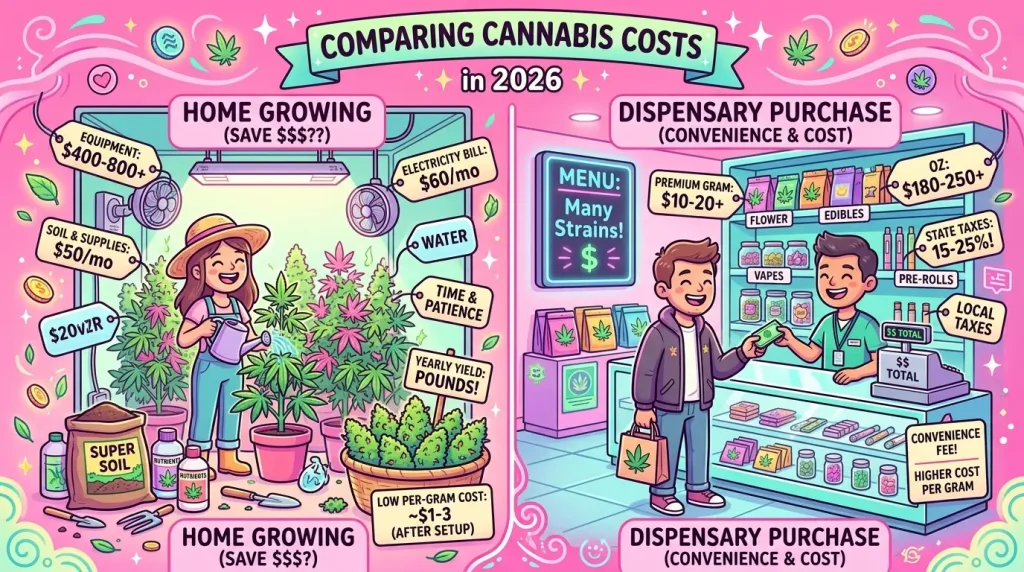
To understand the cost of home growing, we first need to establish the baseline. According to a recent market analysis by Cannabis Business Times, the average price per ounce of high-quality cannabis in regulated dispensaries in 2026 ranges from $240 to $320, depending on the state and tax structure.
Let’s calculate the annual cost for an average consumer. If you consume one ounce per month (a common benchmark for daily users), here is your annual dispensary expenditure:
- Low End: $240/ounce x 12 months = $2,880/year
- High End: $320/ounce x 12 months = $3,840/year
This number doesn’t include gas, travel time, or the occasional impulse buy that every dispensary funnel is designed to encourage.
The Hidden Costs of Dispensary Shopping
When you pay that sticker price, what are you actually paying for?
- Excise Taxes: Often 15-25% added at the point of sale.
- Packaging: Excessive plastic and glass that you pay for but throw away.
- Marketing: Those sleek ads and loyalty programs aren’t free; they’re baked into the price.
- Convenience: You pay a premium for zero labor.
But here is the question I want you to ask yourself: Are you paying for the product, or are you paying for the experience of not having to do the work?
The Home Grower’s Economics: Initial Investment
Now, let’s look at the other side of the Home Grow vs. Dispensary: The 2026 Cost Breakdown. The barrier to entry for home growing has never been lower. In 2026, we have “smart tents” that connect to your phone and LED lights that rival the sun for a fraction of the energy cost.
The Starter Setup (Costs in 2026 USD)
To get a baseline yield of roughly 4-6 ounces every 3-4 months, you need a modest setup. Here is a realistic budget for a high-quality home grow:
- Grow Tent (2×4 ft): $120 – $180
- LED Grow Light (Full Spectrum): $200 – $350
- Inline Fan & Carbon Filter: $100 – $150
- Seeds (Genetics): $50 – $100 (for 4-5 seeds)
- Soil & Nutrients: $80 – $120
- Pots, pH Meter, Accessories: $50 – $80
- Electricity (per cycle): $50 – $80
Total Initial Investment: $650 – $1,060
At first glance, that number looks daunting. However, let’s break down the ROI.
The First Harvest: When Do You Break Even?
Assuming a successful first harvest (with a little learning curve), you yield 4 ounces of premium flower.
- Cost per ounce (first harvest): $1,060 / 4 oz = $265/ounce.
You are already price-competitive with the high-end dispensary market on your first run. But here is the magic: your second harvest costs drastically less.
Ongoing Costs (After Setup):
- Seeds/Clones: $50
- Soil & Nutrients: $80
- Electricity: $80
- Misc Supplies: $30
- Total per cycle: ~$240
If you yield 4 ounces per cycle, your cost per ounce drops to $60.
Let that sink in. $60 per ounce versus $240 per ounce at a dispensary.
ROI, LTV, and The Consumer Funnel
In the world of digital marketing and business, we talk a lot about the funnel—the journey from awareness to purchase. In the context of Home Grow vs. Dispensary: The 2026 Cost Breakdown, your funnel changes dramatically.
The Dispensary Funnel (High Cost, Low Engagement)
Your funnel as a dispensary shopper is linear: you see an ad (Awareness), you drive to the store (Consideration), you buy (Conversion), and you consume. Your LTV is high—you are a consistent revenue stream for the business—but your personal ROI is capped. You are locked into retail pricing with no asset to show for your spending.
The Home Grow Funnel (High Engagement, Massive ROI)
Your funnel as a home grower is cyclical and asset-building.
- Awareness: You realize you are spending $3,000/year.
- Consideration: You buy a tent and lights.
- Conversion: You harvest.
- Engagement: You learn, refine, and improve your yield.
- LTV: You own the means of production. Your LTV as a customer shifts from being a consumer to being a producer.
Quick Win: If you invest $1,000 today, you will recoup that investment within your first 4-6 months of consumption. From that point forward, your annual cannabis cost drops by roughly 80-90%.
Beyond the Numbers: Experience, Expertise, and Trust
While the math favors the home grower, we have to talk about the Experience, Expertise, Authoritativeness, and Trustworthiness required to succeed. This isn’t just about planting a seed; it’s about demonstrating real capability.
The Learning Curve: Experience Matters
You might be a pro at buying weed, but growing it is a different skill set. To ensure your ROI doesn’t turn negative due to mold, pests, or nutrient burn, you need to build your expertise.
- Citing Sources: Rely on trusted forums like GrowWeedEasy.com or academic extensions like the University of Utah’s Center for Cannabis Research for validated growing techniques.
- Proven Strategies: In 2026, the “Sea of Green” (SOG) method remains the most efficient way to maximize yield in small spaces, ensuring you get the best conversion of energy into flower.
The Trust Factor: Quality Control
Can you trust your own product more than a dispensary’s? Actually, yes.
Dispensaries often sell flower that has been sitting in a plastic jar for months. When you grow at home, you control the engagement. You know exactly what nutrients went in. You harvest, dry, and cure it at the peak of potency.
Did you know? According to a 2025 study in the Journal of Cannabis Research, properly cured home-grown cannabis often retains up to 15% more terpenes than commercial dispensary flower that has been subjected to long-term storage and shipping logistics.
Common Mistakes to Avoid (And How to Protect Your ROI)
If you decide to take the plunge into home cultivation, you need to avoid the pitfalls that lead to a negative ROI. Here is a checklist to ensure your funnel leads to success.
- Mistake #1: Skimping on the Light
- The Fix: Your light is the engine of your grow. A cheap light leads to airy, low-potency buds. Invest in a high-quality LED to ensure a high conversion of electricity into dense flower.
- Mistake #2: Ignoring the Dry & Cure
- The Fix: You can grow a pound of beautiful weed, but if you dry it too fast, it will taste like hay. All that engagement in the grow cycle is wasted. Invest in a drying rack and hygrometer.
- Mistake #3: Over-Loving (Watering)
- The Fix: New growers kill their plants with kindness. Overwatering is the #1 cause of root rot. Let the soil dry out between waterings to build a strong root system.
The Hybrid Model: Getting the Best of Both Worlds
You don’t actually have to choose one side of the Home Grow vs. Dispensary: The 2026 Cost Breakdown. A savvy cannabis consumer in 2026 utilizes a hybrid model.
- Use the Home Grow for Base Flower: Grow your staple strains—the ones you smoke daily. This covers your bulk needs and secures your high LTV as a user. You’ll pay pennies on the dollar.
- Use the Dispensary for Variety & Concentrates: Let’s face it—making high-quality live rosin or trying the latest hype strain is a pain at home. Use the dispensary for these “luxury” items. You can afford the high price tag on that $60 gram of rosin because you saved $1,200 on your flower this year.
Legal Disclaimer: Know Your Rights
Before you order that tent, it’s crucial to understand the legal landscape.
Disclaimer: The information provided in this article is for educational and informational purposes only. Cannabis laws vary significantly by state and country. Home cultivation is strictly regulated or illegal in many jurisdictions. It is the reader’s responsibility to verify their local laws regarding home cannabis cultivation before purchasing any equipment or seeds. This article does not constitute legal or financial advice. Always consult with a qualified professional regarding your specific situation.
The Ultimate Verdict: Which Wins in 2026?
So, who wins the ultimate Home Grow vs. Dispensary: The 2026 Cost Breakdown?
If your primary goal is engagement and convenience, and you consume less than an ounce every two months, the dispensary remains a perfectly viable option. You are paying for time and zero hassle.
However, if you are looking to maximize ROI, increase your LTV as a consumer, and take control of your supply chain, home growing is the undisputed winner.
The numbers don’t lie. You can reduce your cost per ounce from $300 to $60. You can turn a $1,000 investment into $3,000 in annual savings. You move from being a passive consumer at the end of the funnel to an active participant at the start of it.
Frequently Asked Questions (FAQs)
Q: Is it really cheaper to grow your own weed in 2026?
A: Absolutely. While the upfront cost for equipment can be $600-$1,000, the cost per ounce drops to as low as $60 after the first harvest. Compared to the average dispensary price of $280/ounce, the ROI is realized within the first 4-6 months of consumption.
Q: How much space do I need to start a home grow?
A: You can start with a 2×2 foot tent that fits in a closet. This small setup can yield 2-4 ounces every 3-4 months, which is more than enough for a moderate consumer.
Q: What is the biggest hidden cost in the Home Grow vs. Dispensary debate?
A: The hidden cost is time and expertise. While the financial ROI is high, you must invest time in learning the craft. However, with modern “smart” grow systems in 2026, the learning curve has significantly decreased.
Q: Does home-grown cannabis have the same potency as dispensary weed?
A: Yes, often it can be higher. By controlling the nutrients and harvest window, home growers can achieve THC and terpene levels that rival or exceed top-shelf dispensary flower. The key is investing in quality genetics and proper curing techniques.