
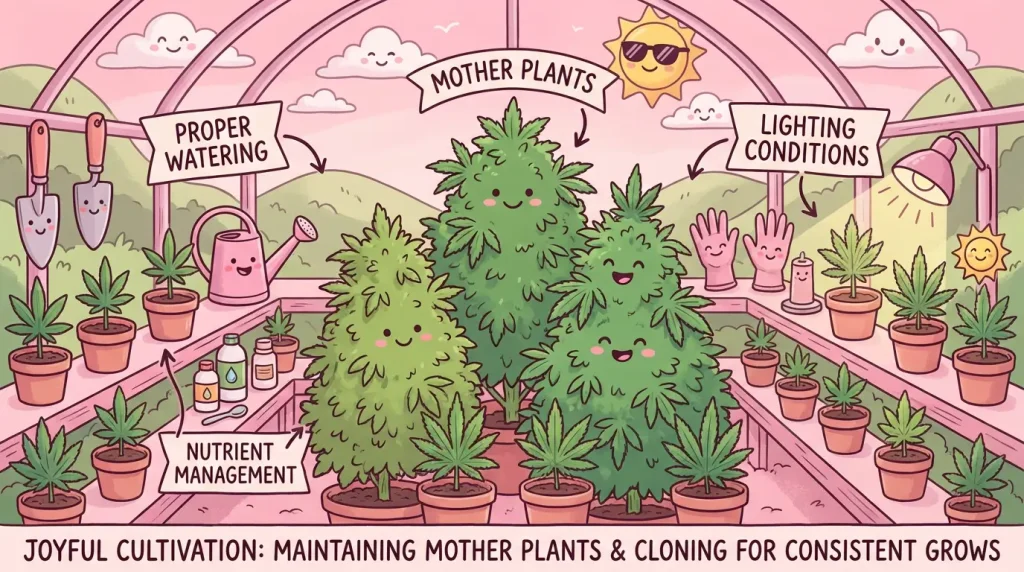
Imagine harvesting the exact same top-shelf flowers, with identical potency, flavor, and bag appeal, cycle after cycle. No surprises. No genetic drift. Just pure, predictable performance. For many growers, inconsistency is the silent killer of a successful perpetual harvest. You pop a new seed, and it’s a gamble—different internodal spacing, varied nutrient sensitivity, or a flowering time that throws your entire production schedule into chaos.
This is where mastering the art of the mother plant becomes your highest-leverage skill. It transforms your operation from a guessing game into a precision system. Learning how to maintain mother plants and clone cannabis isn’t just about saving money on seeds; it’s about locking in a phenotype that converts browsers into loyal customers. By reading this guide, you will move beyond basic gardening and step into the realm of genetic curation, ensuring every single cannabis clone you produce is a carbon copy of your champion.
We’ll walk through selecting genetic stock, maintaining a bonsai parent, executing high-success-rate propagation, and troubleshooting common failures. Let’s dive into the blueprint for a flawless, continuous growth cycle.
The Strategic Advantage of a Stock Plant
Before we touch a scalpel, we need to shift our mindset from growing a plant to managing a genetic library. A mother plant is a single female cannabis plant kept in a perpetual vegetative state, whose sole purpose is to provide cuttings (clones). But why go through the hassle?
Phenotype Hunting vs. Phenotype Keeping
When you buy a pack of seeds, each seed is a sibling with distinct traits. One might stretch too much, while another produces incredible resin but lacks terpenes. By taking cloning stock from all your seed-grown plants before flipping them to flower, and labeling them meticulously, you create a backup. Once you harvest and identify the “unicorn”—the one with the perfect yield, oil profile, and resistance—you then promote its corresponding backup to mother plant status.
The Efficiency Funnel
Think of your grow space as an e-commerce funnel. Unstable genetics cause friction, leading to uneven canopy heights and wasted light. By maintaining a dedicated stock plant, you remove the variable of genetic randomness. This consistency allows you to fine-tune your environment, pushing light intensity and nutrient strength to the absolute limit without burning sensitive plants. This directly impacts your yield per square foot and, ultimately, your bottom line. Have you ever calculated how much revenue you lose from a single runt plant in a commercial row?
Selecting the Genetic Goldmine
Not every plant is worthy of being a stock donor. To select a mother plant, you should grow out a batch of regular or feminized seeds. Take two or three clone cuttings from each seedling before moving the seedlings to the flowering room. Keep strict labels. After harvesting the original seedlings, analyze the data: growth vigor, resistance to mold, rooting speed, and final terpene profile. Only then do you cull the inferior backups and designate the winner as your long-term parent plant.
The Space-Saving Bonsai Mother
You don’t need a massive room to maintain mother plants for years. A small, dedicated tent with low-intensity lighting (T5 fluorescents or a dimmed LED at 150-200 PPFD) is perfect. The goal is not to push rapid photosynthesis but to keep the plant in a state of stasis—slow, healthy, and stress-free. By continuously root-pruning and topping the cannabis mother, you can keep a dozen different cultivars alive in a 2×4 foot space. This is crucial for genetic preservation without sacrificing operational footprint.
Environmental Control: The Key to Longevity
Keeping a mother plant alive for years requires different environmental discipline than flower production. You are nurturing the engine of your operation; if the engine sputters, the entire assembly line stops.
Why do mother plants eventually fail? Often, it’s a drainage issue. Root-bound plants in stagnant, anaerobic media invite fungal pathogens like Fusarium. To avoid this, treat your cannabis mother plant care like caring for a prized orchid. Air-pruning pots or fabric containers are non-negotiable; they prevent root circling and create a dense, fibrous root mass hungry for nutrients.
Light Cycles and Nutrient Protocols
To grow a mother plant that stays vegetative indefinitely, you must disrupt the hormonal signal to flower. This requires a strict vegetative light cycle, typically 18 hours of light and 6 hours of darkness. Any interruption in the dark cycle can cause cellular confusion, occasionally triggering hermaphroditism or pre-flowering in sensitive equatorial strains.
Nutrient-wise, nitrogen is the backbone. However, many growers over-feed at this stage, leading to nitrogen toxicity—dark, clawing leaves that produce weak, woody cuttings that struggle to root. For a robust cannabis mother plant, you need a balanced feeding regimen. Incorporate micronutrients like calcium and boron, as these are critical for cell wall integrity in the new shoots you will eventually cut. Have you checked your runoff PPM this week? If it’s soaring above 2.0 EC, you’re likely salting her out.
The Reset Rejuvenation
Even the best-maintained bonsai mother can stall after donating dozens of cuts. She needs a metabolic reset. Every 6 to 12 months, drain the reservoir or flush the soil aggressively to remove salt build-up. Severely prune the canopy back by 50% and root-prune the bottom third of the root ball, repotting with fresh, charged coco coir or living soil. This “hard reset” triggers an explosive flush of fresh shoots that root with incredible vigor. It’s the equivalent of pressing the refresh button on your genetic browser.
Step-by-Step: How to Clone Cannabis for Perfect Roots
Now, let’s address the conversion point: turning a cutting into a thriving plant. The journey from a severed branch to a rooted clone plant is a race against dehydration. Mastering how to clone cannabis reliably means focusing on aeration, hydration, and pathogen prevention.
1. Preparation and Tool Sanitation
Your scalpel or razor blade must be sterile. We are performing vascular surgery on a plant. Use isopropyl alcohol (70% or higher) to kill any latent bacteria or viroid particles. Many seasoned cultivators flare the base of a drinking cup with a lighter to create a mini humidity dome, ensuring structural rigidity for the cutting.
2. Taking the Perfect Cutting
Select a lower or middle branch that snaps audibly when bent—this indicates a woody firmness that resists damping-off. Cuttings with a rigid stem produce better cannabis clones than soft, leggy apical shoots. Cut the branch at a 45-degree angle to maximize surface area for water uptake. Immediately immerse the cut end in purified water to prevent an air embolism from entering the xylem tissue.
3. The Scarification Method
To drastically increase strike rate, gently scrape the outer epidermal layer of the bottom inch of the stem. This exposes the cambium layer (the undifferentiated cells capable of turning into roots). Dip the scarified stem into a rooting gel containing Indole-3-butyric acid (IBA). This hormone tricks the plant cells into switching from photosynthetic leaf production to root cell differentiation.
4. Rooting Environment
Insert the cutting into an inert plug—rockwool or peat pellets are standard. However, high-aeroponic cloners often produce cannabis clones with roots visible in just 5-7 days. The absolute critical factor isn’t the medium; it’s the leaf surface temperature. It must stay around 72-75°F. If the dome temperature spikes above 80°F, the cutting tries to transpire moisture faster than it can absorb it, leading to wilting.
Advanced Vectoring and Genetic Preservation
We aren’t just gardening; we are stewards of genetics. A core component of maintaining mother plants is biosecurity. Hop Latent Viroid (HLVd) is a silent yield robber that can infect an entire strain library without showing obvious visual symptoms until it’s too late. Symptoms like brittle stems, horizontal branching, and a 20-30% yield reduction are tell-tale signs of dudding.
To protect your genetic library, you must implement a tissue culture protocol or, at the very least, an aggressive integrated pest management (IPM) strategy. Never bring a new plant into proximity with your stock plant without a 30-day quarantine. Use different tools for each mother plant or sterilize between handling different cultivars. Do you clean your trimming scissors with a flame or bleach between cuts? If not, you are potentially vectoring disease across your entire genetic library faster than you can say “crop loss.”
Water Chemistry and Uptake
If you are using cannabis nutrients for mothers, pay close attention to your water’s alkalinity. High bicarbonate levels in tap water can buffer the pH upward over time, locking out phosphorous even in a heavy-nitrogen feed program. For long-term health, using reverse osmosis water allows you to build the mineral profile from scratch. A mother plant with a phosphorus deficiency will display purple petioles and red stems, and critically, her cuttings will be lethargic, often failing to emit roots before composting themselves.
Rooting Protocols for Different Cloning Media
When deciding how to clone cannabis plants, you must match the technique to the medium.
- Rockwool Method: Pre-soak your cubes in 5.5 pH water to neutralize the limestone nature of the stone. Squeeze the excess water out to maintain a 50/50 air-to-water ratio.
- Coco/Perlite Method: Mycorrhizae inoculation is your best friend here. Dusting the moistened stem with mycorrhizal powder significantly increases the water absorptive surface area of the new roots.
- The Mist Chamber: For those building a turnkey production line, a high-pressure aero cloner removes the “human error” variable. By spraying a fine droplet size (30-50 microns) directly onto the basal stem, you maintain 100% humidity without waterlogging the tissue.
Transitioning Clones into High-Yielding Production
Once your clone plant has a robust root zone (visible white tips curling at the base of the plug), it’s time to transplant. This is a stage where many growers drop the ball by over-lighting the fragile transplant. For the first 48 hours in the new pot, maintain a high humidity veil (70% RH) and a dimmed light source. This allows the cannabis clone to transition from its water-based breathing mechanism (cuticular respiration) back to the stomatic rhythm needed in the vegetative room.
Observe the fresh cutting’s response carefully. A cannabis clone that has successfully transitioned will display vibrant, upward-pointing petioles and a noticeable lime-green color at the growth center. This is the moment to gradually introduce supplemental CO2, if available. The consistency of your cannabis clones directly correlates to the uniformity of your canopy. When every plant is an identical genetic copy, you can execute a precision irrigation schedule that every single plant responds to identically, maximizing nutrient conversion efficiency.
Frequently Asked Questions About Cannabis Cloning and Mothers
Do clone plants produce less than seed plants?
No, a well-rooted and healthy clone plant is biologically identical to its parent, possessing the same age and potential. In fact, because it bypasses the fragile seedling stage of 2-3 weeks, a clone often produces a higher biomass in a shorter cultivation window compared to a seed of the same harvest date.
What is the optimal light cycle for a mother plant?
The standard and safest strategy to maintain mother plants is an 18/6 light cycle. While some commercial operations use 24-hour light to push physical growth of cutting material, the 6-hour dark period allows for proper respiration and root growth, building long-term health reserves in the cannabis mother.
How do you prevent cloning disease in mother plants?
Prevention is the only cure for cloning stock diseases like HLVd. This involves regularly testing your stock plant leaf tissue through a lab (like TUMI Genomics), never using saliva to moisturize your razor, and ensuring zero-contact between the mother’s media and the floor, which can harbor soil-borne pathogens.
How deep should I insert cannabis clones?
When placing the cannabis clone into the plug, never push the stem so deep that it pokes through the bottom. The cutting should stop just before exiting the base of the rockwool cube or peat puck. This ensures the callus (the white buildup of undifferentiated cells) forms in the moist, dark environment of the interior, rather than drying out at the edge of the media.
How often do you need to replace a mother plant?
A vigorous cannabis mother can live for years, but commercially, many growers replace her with a fresh clone from herself every 6 to 12 months. This is because the repeated stress of taking clone cuttings can accumulate epigenetic stress or latent pathogen loads over time, slowly reducing rooting vigor in the cannabis mother plant.
What is the ideal temperature for cloning cannabis?
The media temperature is more critical than the air temperature. The rooting zone should be steady at 74-78°F. Using a controlled cloning cannabis heat mat with a thermostat prevents condensation rot and encourages the enzymatic activity needed for cell division.
Conclusion: Your Genetics Are Your Legacy
Mastering how to maintain mother plants and clone cannabis changes everything. It moves you away from the randomness of seeds and toward a manufacturing model of growth. By focusing on the health of the cannabis mother, controlling the environment of your cloning stock, and executing the cutting process with surgical precision, every cycle becomes a predictable, high-conversion success story.
Your genetics are the core asset of your operation—treat them as such. Start your pheno-hunt today, label those cuttings, and commit to giving your parent plant the strict care regimen she deserves. The moment you smoke a flower that is identical to the legendary batch from last year, you’ll realize that genetic preservation isn’t just farming; it’s time travel through flavor.