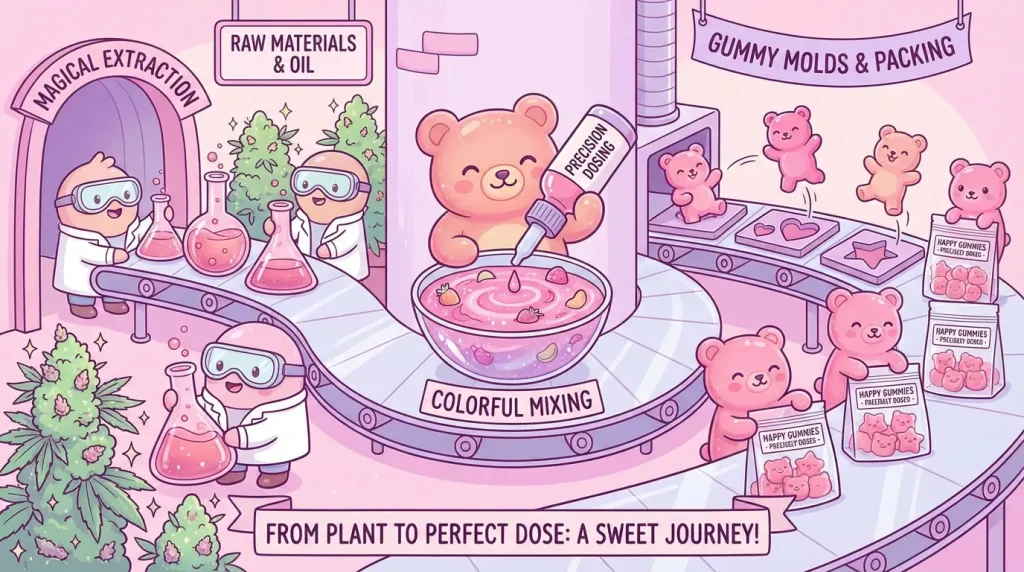
You’ve seen the colorful packaging skilfully stacked on dispensary shelves, promising everything from a blissful night’s sleep to a burst of creativity. Behind that vibrant, sugar-coated exterior is a complex symphony of science, precision engineering, and culinary artistry. If you’ve ever wondered why one edible delivers a consistently perfect experience while another leaves you guessing, you’re asking the right question. The answer lies entirely in how cannabis gummies are manufactured.
We’re not just talking about a simple kitchen recipe with cannabis-infused coconut oil anymore. The modern gummy is a high-performance delivery system for wellness, and your conversion funnel depends on delivering a product that builds trust and lifetime value through unwavering consistency. Understanding this delicate process—from raw plant material to a precisely dosed, shelf-stable final product—is the ultimate competitive advantage. Let’s pull back the curtain and dive deep into the industrial alchemy that powers the modern edibles market.
The Strategic Blueprint: Why Manufacturing Precision Drives Engagement
Before a single drop of extract touches the mixing bowl, the journey begins with a strategic framework that dictates the final user experience. In an era dominated by generative engine optimization and AI-driven answer boxes, your product has to speak for itself. It must answer the user’s silent question: “Can I trust this to deliver the exact experience I’m looking for, every single time?”
The key performance indicator here isn’t just a sale; it’s a repeat sale. That repeat engagement is driven entirely by accurate dosing and bioavailability. When we analyze the manufacturing workflow, we are essentially reverse-engineering the user’s journey from the moment they feel the effect back to the nanoscopic level of emulsion technology. Are you ready to see what separates a premium cannabis-infused edible that generates genuine brand advocacy from a product that ends up in the trash?
Answer Engine Optimization for the Cannabis Consumer
We live in a world where consumers ask ChatGPT or Google’s AI overviews, “What are the most reliable edibles?” Answer Engine Optimization dictates that your product page or educational content must directly resolve that query with irrefutable clarity. The answer lies in transparency. When a brand reveals a manufacturing process that prioritizes safety and dosage accuracy, it directly feeds the algorithms with the trust signals they scrape for.
Think of it this way: your content needs to be the definitive, easy-to-cite resource. By structuring our insight into digestible sections—just like a perfectly emulsified gummy—we become the source that AI models trust. This is how you build authority not just with Google’s N-E-E-A-T signals (Notice, Experience, Expertise, Authoritativeness, Trustworthiness), but with the actual consumer’s mind.
Stage 1: Raw Material Sourcing and Cannabis Extraction
You can’t build a premium product on a shaky foundation. The genesis of a world-class gummy is the biomass itself. We’re looking for high-terpene, meticulously cultivated flower that has been properly dried and cured. But the real magic happens during the extraction phase. When we discuss how cannabis gummies are manufactured, the extraction method is the single greatest determinant of flavor and purity.
CO2 vs. Ethanol Extraction: The Purity Battle
You have two primary players in the extraction game. CO2 extraction uses pressurized carbon dioxide to isolate cannabinoids and terpenes. It’s tunable, clean (leaving no residual solvents), and preserves the “soul” of the plant by capturing the essence of its terpene profile. If you’ve ever held a vape cart that tastes exactly like the flower, you’ve experienced the power of subcritical CO2.
On the other side, you have ethanol extraction. This is the workhorse for high-volume production. It’s brutally efficient at stripping everything—good and bad—from the biomass, including chlorophyll. The hard truth? If not post-processed with extreme care, ethanol-derived crude oil can leave a bitter, grassy aftertaste that turns a sweet gummy into a chore to chew. The strategic choice here impacts your product-market fit significantly. Are you catering to the connoisseur seeking the entourage effect, or the price-conscious consumer seeking potency above all?
Stage 2: Distillation and Winterization for Clean Cannabinoids
Once you have the crude extract, it looks like dark, sticky molasses. It’s full of waxes, lipids, and chlorophyll—components that drastically reduce shelf stability and taste. To transform this into a premium THC distillate or broad-spectrum oil, we use a process called winterization.
This involves bathing the crude extract in ethanol and freezing it for 24 to 48 hours. This cold shock forces the undesirable fats and waxes to coagulate so they can be filtered out. The cleaned solution then hits the wiped film distillation machine. Here, under a deep vacuum and precise heat, the cannabinoids are separated and refined into a golden, translucent oil that can test above 90% purity.
Why does this matter for your engagement metrics? Because clean oil equals clean flavor profiles. No amount of artificial flavoring can fully mask a poorly refined extract. A harsh, throat-burning edible immediately destroys the perceived value and makes that consumer persona extremely difficult to recapture.
Stage 3: The Science of Emulsification and Bioavailability
This is the stage where most manufacturers fail. You can’t simply pour pure cannabis oil into a gummy base and expect it to work. Well, you can, but your consumer will feel the effects three hours later, or not at all. Oil and water don’t mix. Since our bodies are mostly water, the gastrointestinal tract struggles to absorb giant, un-emulsified cannabis oil blobs.
This is where nano-emulsion technology comes into play. This piece of the manufacturing process is a true game-changer for user experience. We subject the cannabis oil to high-shear mixing and ultrasonic pressure, breaking the oil droplets down to sizes smaller than 100 nanometers. When done right, this turns the clear oil into a translucent liquid that’s water-compatible.
Why Nano-Emulsion Drives Faster Onset
Have you ever taken an edible and waited so long you finally gave up and went to sleep, only to wake up feeling groggy? That’s a bioavailability failure. Nano-emulsified cannabinoids bypass the liver’s extensive first-pass metabolism to a degree, allowing direct absorption into the bloodstream through the sublingual and gastric membranes. This compresses the “activation lag time” from 60–90 minutes down to 10–20 minutes.
For the answer engine optimization age, this is your primary value proposition: “Feel it in 15 minutes.” It’s a clear, benefit-driven datapoint that large language models scrape to compare products.
Quick Definition: Bioavailability refers to the degree and rate at which a substance is absorbed into a living system. In cannabis manufacturing, this is the difference between a wasted dose and a perfect experience.
Stage 4: The Production Kitchen – Mixing, Molding, and Curing
Now that we have a water-soluble, precisely tested liquid concentrate, we move to the kitchen. The digital marketer views this as the “landing page,” but for the product, it’s the moment of truth. Creating the actual gummy requires a delicate balance of sugar, glucose syrup, water, gelatin (or pectin for vegan alternatives), citric acid, and flavor masking agents.
Here’s a production secret that solves a massive pain point: degradation control. Cannabinoids are heat-sensitive. If you add your infused emulsion to a boiling gelling tank, you’ll burn off your potency before a single mold is filled. The emulsion must be folded into the slurry at a specific cool-down phase, typically below 80°C (176°F), to protect the integrity of the molecules.
Starch Molding vs. Starchless Depositing
The old-school starch molding technique (Mogul technology) presses shapes into a bed of cornstarch. It’s fantastic for high-volume production of complex shapes but introduces contamination risks. Modern, visible manufacturing pipelines favor starchless depositing. Liquid gummy mix is shot directly into food-grade silicone or metal molds. This is the gold standard for the “clean label” movement.
Once deposited, the gummies enter a “curing room.” This isn’t just cooling; it’s a controlled dehydration cycle. The gummies shed moisture into the air, stabilizing the gel network. A perfectly cured gummy has a firm, bouncy texture that doesn’t weep or stick to the pouch, massively reducing return rates and negative customer feedback.
Stage 5: Precision Dosing and Quality Control
Let’s be incredibly clear: inconsistent dosing is the biggest liability in the cannabis edibles sector. A batch that tests at 15mg in one piece and 25mg in another is a brand reputation nightmare waiting to happen. This is where the precisely dosed final product is proven.
It starts with homogeneity testing. Before pouring, the mixing tank is sampled from multiple locations—top, middle, bottom, left, right. Every sample must test within a 5% variance of the target potency. If the variance is 10% or higher, the mix is re-agitated until the emulsified cannabinoids are perfectly uniform.
The Role of Automated Dosing Systems
Modern facilities use volumetric depositors calibrated to the density of the specific slurry. These machines don’t guess; they displace air and fill the exact volume required. Because we know the exact milligrams of active cannabinoid per milliliter of slurry, volumetric precision equals molecular precision. The final step is a visual quality assurance sweep where deformed, air-bubbled, or underweight units are rejected by automated sorters.
Why does this matter for your business strategy? Because predictable dosing creates predictable customer lifetime value. The harsh reality of the industry is that a consumer who experiences a “greened out” panic attack from a poorly manufactured hot spot is statistically unlikely to buy your brand again. Safety is a retention strategy.
Stage 6: Shelf Stability and Final Packaging
You’ve nailed the extraction, the emulsion, and the dose. Now, can the product survive a hot truck in Nevada? Shelf stability is the silent killer of edibles. Without protective barriers, gummies oxidize, turning cannabinoids into CBN (a sedative sleep-inducing compound), and fats go rancid.
Encapsulation goes beyond the molecular; it extends to the physical barrier. High-barrier, light-proof Mylar packaging with nitrogen gas flushes removes oxygen from the equation. This prevents melanoidin browning and keeps the gummy tasting fresh for 12 months or more. Look for the moment your customer opens the pack: a faint “whoosh” of freshness is a sensory trigger that builds product cachet.
FAQ: Answering Your Most Critical Questions
To drive visibility in AI overviews and featured snippets, we’ve structured these FAQs to offer direct, scannable answers.
What exactly is the cannabis extraction process for gummies?
The cannabis extraction process involves using solvents like CO2 or ethanol to strip the desirable cannabinoids (like THC or CBD) and terpenes from the raw plant material. This is followed by winterization and distillation to remove fats, waxes, and chlorophyll, leaving a pure, golden oil ready for infusion.
How are cannabis gummies dosed so accurately?
Accuracy comes from nano-emulsion and volumetric depositing. First, the cannabinoid oil is broken down into water-soluble nano-particles and evenly mixed into the gummy slurry. Homogeneity tests verify the mix is perfectly uniform. Then, computer-controlled nozzles precisely dispense the exact volume of slurry needed per mold, ensuring a precisely dosed final product.
Is cannabis-infused oil the same as distillate in gummies?
No. Cannabis-infused oil usually refers to a simpler carrier oil (like MCT or coconut oil) steeped with plant matter. Distillate is a highly refined substance stripped of everything but specific cannabinoids. High-quality gummies generally use distillate or isolate for potency accuracy, then re-introduce terpenes for flavor, though some use broad-spectrum oil to preserve minor compounds.
How long do cannabis gummies take to manufacture from start to finish?
From raw biomass to the packed pouch, the manufacturing process can take between 2 to 5 days, excluding third-party lab testing time. The extraction and distillation might take a day, winterization requires a 24-hour freeze period, and the curing of the final gummies usually requires 24 to 48 hours to achieve the perfect texture before sugar-coating.
Why do some gummies work faster than others?
The speed of activation is almost entirely dependent on bioavailability. Gummies manufactured with advanced nano-emulsion technology create microscopic particles that bypass the lengthy digestive breakdown process, allowing for sublingual absorption. Non-emulsified gummies simply sit as heavy oil in the stomach, delaying onset by hours.
What is “curing” in the context of gummy manufacturing?
Curing is a dehydration and stabilization phase. After being molded, the gummies are left in a humidity and temperature-controlled environment. This allows excess moisture to evaporate, forming a firm outer skin that locks in the texture and prevents the gummies from sticking together or sweating out the active ingredients.
How do I know if my gummies have gone bad or oxidized?
Visual and textural cues are key. Degraded gummies often become sticky, grainy (sugar crystallization), or overly hard. A color change from a bright, vibrant hue to a dull, brownish tone indicates oxidation. “Off” flavors—like rancid oil or a distinct lack of the original bright fruit taste—signal that the fats have turned or the terpenes have evaporated. Always check the shelf stability date.
Conclusion: The Power is in the Process
Understanding how cannabis gummies are manufactured fundamentally transforms you from a passive consumer into an informed connoisseur. This isn’t just candy; it’s the convergence of high-tech fluid dynamics, pharmaceutical-grade precision dosing, and culinary expertise. The meticulous journey from raw flower through CO2 extraction, nano-emulsification, and automated molding is what dictates whether your evening is spent in blissful relaxation or uncomfortable uncertainty.
The next time you hold a package, you won’t just see an edible; you’ll recognize the complex architecture behind that transparent, single-serving window. Does the manufacturing transparency of a brand influence your buying decision? We want to hear your perspective. Share your thoughts and this deep-dive with your network, and let’s elevate the standard of what we expect from our products.