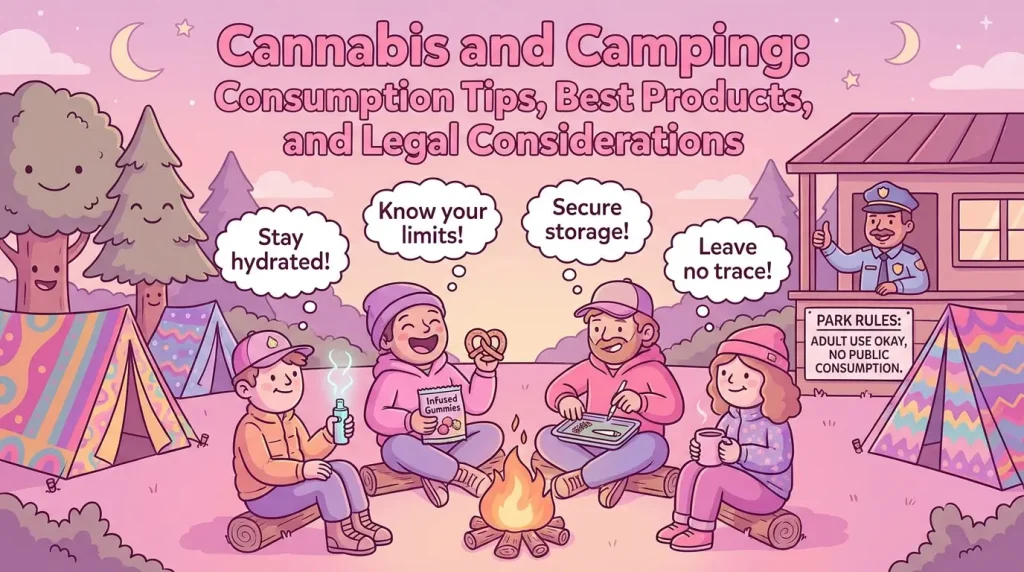
Let’s be honest—there’s something almost spiritual about sitting by a crackling fire, staring at a pine-tree horizon, with your favorite strain in hand. But the difference between a magical memory and a night in a holding cell often comes down to planning. If you typed “cannabis and camping” into a search bar, you probably already know the magic we’re talking about. But you might also have that knot in your stomach asking: “Is this actually legal where I’m going? How do I keep this stuff fresh without a fridge? What if a park ranger walks by?”
You’re in the right place.
This isn’t just a puff-piece list of products. We’re going to analyze the deep legal traps that can ambush you on federal land, the engineering behind smell-proof gear, and the psychological nuance of dosing in the wilderness. We’ve dug through public land regulations, fire-safety codes, and product schematics to bring you the only guide to consuming cannabis outdoors you’ll ever need. By the time you finish reading, you won’t just have a packing list—you’ll have a complete operational safety brief for an elevated adventure.
The Legal Landscape: Why Your Destination Dictates Everything
Before we talk about products or vibes, we have to face the brutal reality of jurisdiction. The most critical consumer tip for cannabis and camping is understanding that the ground beneath your tent dictates the law, not your driver’s license.
The Federal Landmine
Most epic camping spots—Yosemite, Yellowstone, the Grand Canyon—fall under federal jurisdiction. And here’s the kicker: federal law classifies cannabis as a Schedule I controlled substance. It doesn’t matter if you bought it legally at a boutique dispensary in Denver. The second your hiking boot touches National Park soil, you are subject to federal law enforcement, not the friendly local sheriff.
Many campers make a massive, trip-ending mistake here. They assume “legal state” means “legal campfire.” It doesn’t.
Quick Win: If you are on land managed by the National Park Service (NPS), the Bureau of Land Management (BLM), or the US Forest Service (USFS), possession is technically a federal offense. Enforcement varies, but rangers have zero tolerance for impaired driving or disruptive behavior. Is the view worth a court date? Always ask yourself that.
State Parks vs. Private Campgrounds
State parks generally follow the specific laws of their state. If you’re camping in California or Oregon, the state law permits adult recreational use. But—and this is a big but—public consumption bans are universal. You can’t light up on a crowded beach or a family-friendly trailhead. Enforcement is often handled via citations for “public consumption,” which are treated similarly to open-container alcohol laws.
Private campgrounds are the Wild West (figuratively). It’s the owner’s call. Rule of thumb? If you didn’t see a “420-friendly” badge on the site’s booking page, assume “don’t ask, don’t tell” applies. Always look for cannabis-friendly camping sites on platforms like Hipcamp, where hosts openly advertise tolerance.
Crossing State Lines
This is non-negotiable: never travel across state lines with cannabis. Even between two legal states (say, California to Oregon), crossing the border introduces federal interstate commerce laws. You are now a trafficker in the eyes of the law. Buy local at your destination, or go without.
Consumption Tips: Finding the Right Headspace for Altitude
Using cannabis products outdoors is a different beast than your home setup. At home, you control the temperature, the snacks, and the anxiety level. In the backcountry, the environment controls you. Your consumption method needs to adapt.
The Microdosing Advantage on Steep Trails
If you’re hiking, a massive bong rip that sends your heart rate to 160bpm isn’t just unpleasant; it’s a safety hazard on exposed ridgelines. Microdosing—consuming small, sub-psychoactive or lightly psychoactive amounts—is your “quick win” for trail performance.
- The 2.5mg Rule: Start with a 2.5mg THC edible or a single small puff from a vape pen. Wait 90 minutes (for edibles) or 15 minutes (for inhalation) before considering more.
- Why this works: Altitude can amplify the effects of THC. At 8,000 feet, less oxygen means a more pronounced cerebral effect. By keeping your dosage low, you maintain motor control and situational awareness (bear safety, cliff edges) while enjoying the sensory enhancement.
Smoke-Free Inhalation: Why Vaporizers Dominate the Forest
Combustion and forests are a terrible mix. We’ll cover fire safety next, but from a pure consumption standpoint, flower burns unevenly in windy conditions, creates ash, and the smell announces your presence to everything within a mile radius.
Vaping cartridges or portable dry herb vaporizers offer precision temperature control. You extract the terpenes without the smoke cloud. It’s cleaner, your lungs work better at elevation, and no one mistakes the smell for a forest fire.
Edibles: The Logistics of Waiting
Edibles are stealthy and long-lasting, perfect for a long, slow sunset by the lake. The engineering challenge is timing.
- Case Study: You eat a 10mg gummy, then realize the storm clouds are rolling in fast. Now you’re peaking while tying down guylines in 40mph gusts. Bad scene.
- Actionable Step: Always set up your tent, secure your bear canister, and finish your “chores” before dosing with an edible.
The Essential Pack: Best Products for the Trail
You need a kit that fights the elements—heat, cold, and crushing backpack pressure. These are the product categories where spending extra cash yields massive quality-of-life gains.
1. The “Indestructible” Vape Battery
Standard 510-thread batteries break in your pack or die before breakfast. You need a camping-optimized battery.
- Look for: IPX-rating (water and dust resistance) and pass-through charging (so you can hit it while charging from a solar pack).
- Why: You’re paying for uptime. A dead battery when you’re 15 miles from an outlet is a total failure of the experience.
2. The Burst-Proof Pre-Roll Case
Joints get crushed to dust in backpacks. A proper doob tube—preferably made of heavy-duty, smell-proof aluminum or plastic—keeps your roll intact.
- Design Hack: Get one with a keychain loop. Clip it to the side of your pack for instantaneous access without digging through a “black hole” bag.
- Quick Specification: The best smell-proof tube for hiking has an engineered gasket. If the O-ring isn’t thick, humidity gets in, and your joint burns unevenly. Look for thermal-lock technology.
3. The Pocket-Sized Portable Safe
You aren’t keeping your stash in a sock anymore. A small, hard-shell combination-lock case is non-negotiable if there are children or curious rangers around. It shows a commitment to responsibility.
- Tech features: Vacuum-sealed pouches aren’t just for food. They reduce volume and lock out oxygen, preserving potency. Pack your flower in a vacuum bag, and the terpene profile stays locked for the entire trip.
4. The Task Light, Not a Phone Flashlight
Rolling in the dark with a phone destroys your night vision and usually results in spilled flower. Get a red-light LED headlamp. Red light doesn’t bleach your rods and cones, meaning you can look back up at the stars immediately after packing a bowl.
Is your current gear as rugged as your itinerary demands? If you can’t answer “yes” confidently, that’s a bottleneck you need to fix before you lace up your boots.
Playing with Fire: Burn It Down, Don’t Start One
Let’s get blunt: smoking flower on a campfire site is the highest-risk activity you can engage in regarding cannabis and camping. Western states are tinderboxes. A single ash ember from a poorly rolled joint can fly 20 feet and ignite dry grass.
Skip the Blunt
Wraps made from tobacco leaves burn at a higher temperature and retain embers longer than thin rice paper. A cigar wrap is essentially a freestanding fire-starter. If you must combust, use ultra-thin papers and “pack” the end so no loose plant matter falls out.
The “Ash Can” Method
Don’t tap your ash into the fire pit, especially if you’re cooking over it later. Nobody wants residue in their s’mores, and wind gusts whip ash out of the pit. Carry a mint tin as a portable ashtray. Pack out what you pack in. Leave No Trace rules apply to green material just like granola wrappers.
Stealth Mode: Engineering a Scent-Free Pack
Bears aren’t attracted to flower the way they are to bacon grease, but raccoons, skunks, and particularly nosy neighbors are. More importantly, a scent-free pack is a legal shield in areas where you’d rather attract zero attention.
The technology behind smell-proof gear relies on two materials: activated carbon linings and TPU (Thermoplastic Polyurethane) zippers. You’ve seen the “dime bag” style ziplocks; those fail within hours in high heat. You need a rigid container with a carbon-fiber liner.
- The Onion Method: Don’t just throw everything in one bag. Vac-seal the raw flower, then place that bag into a carbon-lined pouch, which then goes into your bear canister.
- The Real-World Benefit: The value of buying a $30 premium bag isn’t the bag itself—it’s avoiding the social friction and potential legal security check that destroys your trip’s momentum. A single avoided conversation with a ranger justifies the price.
Frequently Asked Questions (FAQs)
Can I legally take cannabis to a campsite in a National Park like Yosemite?
No. Even if you hold a valid medical card in California, Yosemite is under federal jurisdiction. Rangers enforce federal law, where possession can lead to citations, mandatory court appearances, or even a federal misdemeanor charge.
What exactly is “public consumption” and how do I avoid it while camping?
Public consumption is ingestion in any space accessible to the general public. Even in a legal state, a campsite or trail is public. To avoid citations, consume inside a locked RV or a tent with an opaque rainfly, well away from trails.
Why do edibles feel stronger when I’m hiking at high elevation?
High altitude reduces atmospheric pressure, which can lower your blood oxygen saturation. Since THC affects the central nervous system’s oxygen regulation, the feeling of being “high” often becomes more pronounced. Standard doses can feel 20-30% more intense above 8,000 feet.
What is the absolute best consumption method to prevent forest fire risks?
Vaporizer cartridges or tinctures carry zero combustion risk. If there is a fire ban (Stage 1 or 2) in effect, any open flame—even a lighter—is illegal. Battery-powered vaporizers keep you compliant and safe.
How do I find 420-friendly campgrounds near me?
Avoid generic booking sites. Use Hipcamp or specialized “Bud and Breakfast” directories. Search for keywords like “cannabis-friendly camping” or “420-friendly campsites” and always message the host directly to clarify the policy before booking.
Does smelling like cannabis attract bears or other predators?
The strong, skunky aroma of raw cannabis is not a proven bear attractant like meat or fruit. However, a bear’s primary sense is smell, and any strong novel scent can make them curious. It’s safest to treat your stash like any other food-item: sealed and stored in a bear-proof container outside your tent.
How long does the smell last in my tent after vaping?
Unlike smoke, vapor dissipates particulate matter quickly—usually within 10-15 minutes with proper ventilation. However, the terpenes can cling to fabric. Open your rainfly for a full air exchange before sleeping to avoid lingering odors sinking into your sleeping bag.
What should I do if a park ranger approaches me while I have cannabis?
Stay calm and be polite. Never reach quickly into pockets or your bag. Listen to the ranger’s instructions. Know your rights but do not argue on the trail. If you are on federal land, understand you may face a federal charge. It’s always better to save any legal defense for a courtroom rather than risking an additional charge like obstruction.
Can I bring a glass bong camping, or is that a bad idea?
It’s generally a bad idea. Glass is heavy, fragile, and dangerous if it shatters inside your pack or at a rocky campsite. Opt for silicone or metal alternatives designed for rugged outdoor use. These are practically indestructible and much lighter.
Are there any specific strains recommended for hiking versus stargazing?
Yes, generally. For hiking and daytime activities, many users prefer sativa-dominant strains associated with energy and focus, often high in terpenes like limonene. For stargazing and evening relaxation, users often reach for indica-dominant strains that promote a calm “body high.” However, with modern hybrid genetics, it’s better to ask your dispensary for activity-specific effects rather than relying purely on “indica” or “sativa” labels.