Let’s cut through the noise. If you’re reading this, you’re likely tired of the throbbing pain, the nausea, the sensitivity to light that kills your productivity, and the brain fog that ruins your engagement with life. You’ve probably asked yourself a desperate question: Is there a natural alternative that actually converts pain into relief? The answer isn’t just a stoner myth anymore. We are now navigating a new frontier of pain management backed by clinical data, and the funnel is quickly filling with patients who are done with traditional pharmaceuticals that tank their energy levels.
But here is the problem: Walking into a dispensary without a strategy is a recipe for wasting money. You can’t just grab any flower off the shelf and expect it to stop a neurological storm. You need a precise strategy. In this guide, we’re not just talking about getting high; we’re talking about biohacking your endocannabinoid system to shut down migraine pathways. We’ll break down the hard science, settle the indica or sativa for migraines debate once and for all, identify the best gummies for migraines, and give you a dosing blueprint that even a non-expert can execute.
The Clinical Evidence: Can You Really “Smoke Away” a Migraine?
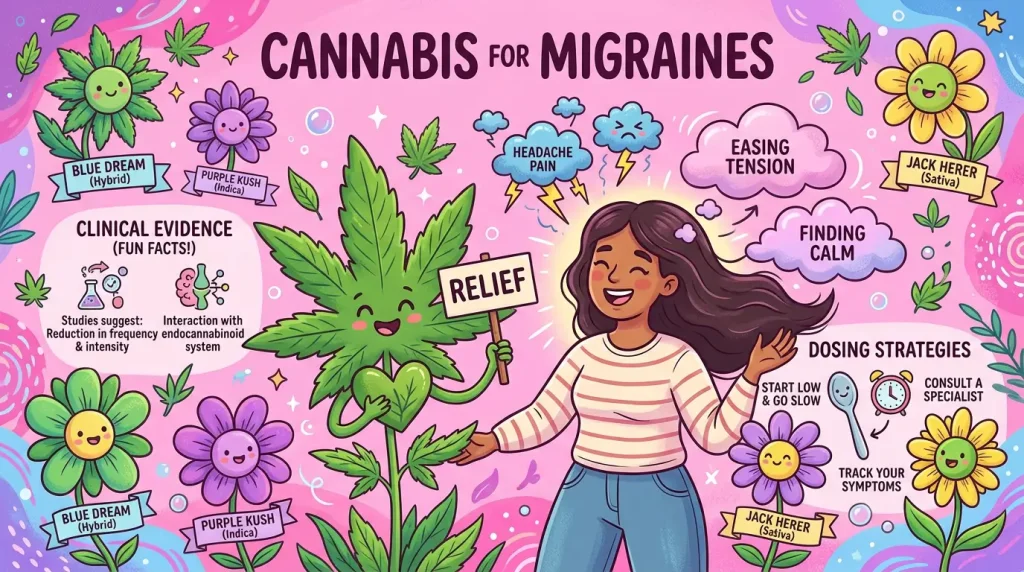
Before we talk strains, we need to talk credibility. For years, the medical community dismissed cannabis as a recreational vice, but the shift in clinical evidence over the last five years has been monumental. We are seeing data that suggests cannabis doesn’t just mask the pain; it may actually disrupt the cortical spreading depression that triggers the migraine aura.
A 2021 study published in the journal Brain Sciences explored the role of the endocannabinoid system in migraine pathology, noting that a deficiency in endocannabinoid tone might be a primary driver of chronic headaches. By supplementing with medical cannabis for migraines, patients are essentially fixing a deficiency, much like taking a vitamin for a nutritional gap.
So, does it actually work in a clinical setting? Let’s look at the stats. A retrospective study analyzing data from the Strainprint app, which tracked nearly 2,000 patients, found that inhaled cannabis reduced migraine severity by nearly 50%. More importantly, the study highlighted a critical metric for users: time-to-relief. The rapid onset of inhalation proved significantly more effective in aborting an active attack compared to slower-acting edibles. However, the tolerance build-up was a noted friction point. Users had to be smart about cycling their usage to maintain efficacy, a key component we’ll tackle in our dosing strategy.
Have you ever tried treating a migraine hours after the pain started, only to find nothing works? Timing is the ultimate conversion trigger for migraine relief. Cannabinoids seem to be most effective during the prodrome phase—that weird, subtle shift in mood or energy before the pain hits.
Indica or Sativa for Migraines: Debunking the Binary Myth
This is the million-dollar question in every online forum and dispensary line: Indica or sativa for migraines? The industry has done us a disservice by dumbing this down to “indica for sleep, sativa for energy.” When you are dealing with a neurological firestorm, this binary thinking falls apart. The real differentiator isn’t the plant’s morphology (skinny vs. fat leaves), but its chemotype—the specific mix of cannabinoids and terpenes.
However, if we have to play the binary game to give you actionable guidance, here is the quick win: Hybrids with an indica lean often win the battle.
Why? Pure sativas tend to be high in limonene and pinene, terpenes that elevate mood and alertness. For some, this can exacerbate the hyper-sensitivity to light and sound. Pure indicas, rich in myrcene and linalool, provide the “couch-lock” sedative effect that forces the nervous system to downshift. But the sweet spot? Look for high-CBD hybrids. CBD acts as a potent anti-inflammatory and counteracts the anxiety that high THC can induce during a painful episode. In terms of user experience, starting with a 1:1 THC-to-CBD ratio is the highest-probability play for immediate relief without psychoactive panic.
Are you mistakenly reaching for a high-energy strain to power through the pain? That logic might be tanking your recovery speed. We want to reduce neural excitability, not increase it.
Best Strain for Tension Headache vs. Migraine: Spotting the Difference
Many people confuse a severe tension headache with a migraine, but the treatment strategy in the cannabis world differs dramatically. A tension headache is typically a band of pressure around the forehead, caused by muscle contraction and stress. A migraine is a vascular and neurological event.
If you are specifically hunting for the best strain for tension headache, you are looking for heavy muscle relaxant properties. Here, the terpene caryophyllene is your best friend. Caryophyllene is unique because it directly activates CB2 receptors, reducing muscle inflammation and tension without a heavy cerebral high.
Top strain recommendations for tension headaches:
- Girl Scout Cookies (GSC): High in caryophyllene, provides full-body relaxation without immediate sedation. Great for daytime stress knots.
- Sour Diesel: While technically a sativa, it’s rich in humulene and caryophyllene, offering powerful anti-inflammatory effects that release muscle tension while keeping the mind focused.
Now, for migraines, you need vascular dilation and neural calm. Medical cannabis for migraines requires a different terpene profile—specifically, high myrcene to cross the blood-brain barrier efficiently.
Top strain recommendations for migraines:
- ACDC: A high-CBD strain that provides clarity while calming the electrical activity in the brain. It’s the ultimate precision tool.
- OG Kush: A classic that balances myrcene and limonene. It pressures the pain pathway without putting you to sleep immediately.
Edibles for Neurological Pain: Finding the Best Gummies for Migraines
Inhalation gives you instant data, but edibles offer sustained relief. If you’re looking for the best gummies for migraines, you need to stop looking at candy and start looking at delivery mechanisms.
The problem with traditional gummies is the delayed onset. Eating a gummy during a migraine attack often fails because gastric stasis (the slowing of digestion during a migraine) prevents proper absorption. This is a critical bottleneck. To solve this, you need nano-emulsified gummies or fast-acting water-soluble edibles. These bypass the liver’s slow metabolism and hit your bloodstream in 15-20 minutes, mirroring an inhalable funnel but with a longer-lasting impact.
When sourcing the best gummies for migraines, look for these non-negotiables on the label:
- Nano-emulsion technology: This is non-optional for a rescue dose.
- CBG inclusion: Cannabigerol (CBG) is the “mother cannabinoid” and emerging clinical data suggests it is brilliant for pain and inflammation, often targeting the physical pressure point of a headache better than CBD.
- Anti-inflammatory botanicals: The best brands are now pairing THC with turmeric or ginger, creating a compound synergy that fights the nausea and the pain simultaneously.
Case in point: Many users report that a low-dose 2.5mg THC paired with 5mg CBG gummy acts as a “shield” against afternoon cluster headaches, providing background engagement with the endocannabinoid system without cognitive impairment.
The Dosing Strategy: Micro-Dosing for Macro Impact
The old-school methodology of “smoke until you forget the pain” is dead. The modern strategy is about finding the “sweet spot”—the minimum effective dose. Overconsumption leads to THC-induced hyperemesis or simply a tolerance wall that renders medical cannabis for migraines useless when you actually have a severe attack.
The 3-Step Dosing Funnel:
- Prevention (The Daily Buffer): If you suffer from chronic migraines, a nightly 5mg THC/5mg CBD capsule can stabilize your nervous system. This isn’t about feeling intoxicated; it’s about raising your pain threshold.
- The Prodrome Hit (Rescue Inhaler): At the very first sign of aura or mood change, use a vaporizer pen. A 3mg micro-dose of a high-mycene indica hybrid can often abort the migraine before the pain phase begins. This is the highest-conversion action you can take.
- The Acute Stage (The Knockout): If the pain has fully set in, you missed the prevention window. You now need sedation. A 10-20mg dose of a heavy indica, combined with a cold compress and dark room, is not about productivity; it’s about hard-shutting the system down.
A critical mistake to avoid: Do not chase the high. Increasing your dose daily erodes your CB1 receptor sensitivity. We refer to this as a tolerance tax. You’ll end up consuming more and getting less relief, crashing your body’s natural pain-management system.
Quick Answers for Instant Relief
What is the fastest way to use cannabis for a migraine?
Inhalation via a vaporizer offers a 90-second to 3-minute onset. This rapid engagement with the bloodstream is vital for aborting a migraine in the prodrome phase.
Can I use cannabis if I have a headache but not a migraine?
Yes. Look for the best strain for tension headache, usually one high in caryophyllene like Girl Scout Cookies, to address muscle tension rather than the neurological sedation required for migraines.
How do I decide between Indica or Sativa for Migraines?
Forget pure sativas during an active complex migraine; they can heighten sensory sensitivity. Opt for an indica-leaning hybrid or a 1:1 ratio. This is the standard benchmark for neural inflammation.
Decoding the Cluster: Clinical Evidence That Shifts the Debate
Skeptics often ask, “Is this just a placebo for stoners?” The data from cannabis migraine studies says no. We are moving away from anecdotal Reddit threads and into robust peer-reviewed data that demands attention.
A landmark study published in Pharmacotherapy analyzed the effects of inhaled cannabis. The results were a game-changer for the pain management funnel: participants reported a 47.3% reduction in migraine severity and a 49.6% reduction in headache severity across the board. Notice the language: this wasn’t just about stopping the pain entirely; it was about de-escalating the severity from a “10” to a manageable “4.”
Furthermore, a retrospective study in the Journal of Pain tracked long-term users. Instead of building a massive tolerance (a common fear), many patients found their headache frequency decreased over time when using cannabis for migraines strategically. This suggests that, unlike opioids, cannabinoids might be repairing the underlying neurological storm rather than just muting it.
However, let’s address the “bounce rate” in the data. There is a phenomenon known as Medication Overuse Headache (MOH), and yes, you can trigger this with cannabis if your dosing strategy is aggressive and erratic. If you consume high doses of THC daily, the ECS receptors can down-regulate, leaving you in a worse cycle of inflammatory pain. Does the clinical data support daily use? It supports consistent micro-dosing, not macro-dosing. The goal is to convert the pain signal, not burn the circuitry.
Terpene Optimization: The Bioavailability Hack You’re Ignoring
Stop staring at the THC percentage on the label. If you are optimizing for migraine relief, the cannabinoid content is just the headline; the terpenes for migraine relief are the fine print that closes the deal. Terpenes are aromatic compounds that dictate how cannabinoids interact with your blood-brain barrier—this is the “entourage effect” in action.
If you want to achieve a high-impact user experience, your strain selection must be dictated by these three primary terpenes:
- Beta-Caryophyllene (BCP): The only terpene known to directly bind to CB2 receptors. It’s a dietary cannabinoid that acts as a potent anti-inflammatory. Think of BCP as your body’s natural spam filter, blocking inflammatory proteins like cytokines.
- Myrcene: This is the transport molecule. High levels of myrcene allow for faster absorption, creating a rapid onset of action. If you have an acute migraine, myrcene-dominant strains provide that quick win you need in under 15 minutes.
- Linalool: Found in lavender, this terpene modulates the neurotransmitter glutamate, which is often spiked during a migraine aura.
Why are terpenes the true key to high-value relief? Because a strain with 25% THC and zero myrcene might be useless, while a 10% THC strain loaded with BCP could offer a complete abortive response. You aren’t buying weed; you’re buying a specific chemical extraction profile.
Top Cannabis Strains for Migraines: A Tier List for Pain Management
Now, let’s translate the science into action. When curating cannabis for migraines, you need to categorize your tools by symptom type. You wouldn’t use the same strategy for an early-morning tension headache as you would for a full-blown vestibular migraine. Here is the tier list of cannabis strains for migraines based on symptomatology, not just popularity.
Acute Abortive Agents (The Rescue Strains)
You feel the aura starting. You have a 30-minute window before you’re incapacitated. You need speed and vasodilation.
- Harlequin (75% Sativa / 25% Indica): A high-CBD strain with a 5:2 CBD to THC ratio. This is the precision scalpel. It clears the brain fog without launching you into an anxiety-ridden high. The myrcene content here drives the medicine in fast.
- Blue Dream (60% Sativa): This is the heavy hitter for the “classic” migraine. It creates a sensory “buffer zone” between your consciousness and the pain. However, watch the dosing; too much Blue Dream increases blood flow to the temples, which can backfire if you overshoot.
Prophylactic Powerhouses (The Preventatives)
These are low-THC, high-terpene options taken nightly to lower your baseline electrical activity.
- ACDC (50/50 Hybrid): With a 20:1 CBD to THC ratio, this is the ultimate anti-inflammatory background program. It hardly impairs cognition, making it ideal for professionals who need to log in to work without the “stoned” lag.
- Cannatonic: A classic for a reason. It cools the brainstem through high linalool content. Think of this as lowering your server’s CPU temperature to prevent a meltdown.
The “No-Fly” List
Avoid strains high in Pinene if you are sensitive to rapid thought acceleration. Pinene is a bronchodilator and memory sharpener, which can severely exacerbate anxiety during a migraine, turning your pain into a panic attack.
What’s the biggest mistake people make when choosing strains? They buy Sativa for energy and Indica for sleep, ignoring the terpene testing. Always ask for the Certificate of Analysis (COA) to verify the terpene content.
Dosing Strategies: The Micro-Gram Protocol for Maximum Conversion
Dosing cannabis for migraines requires military precision. You cannot “smoke till you feel better” because the therapeutic window for THC and pain relief is surprisingly narrow. Too little, you get no effect. Too much, you get a paradoxical increase in pain and heart rate.
The Inhalation Protocol (Acute Attack)
For immediate relief, inhalation (vaporizing flower or oil cartridges) is your top-of-funnel tool. However, don’t rip a bong. Follow the “One Hit Reset.”
- Take a single 2–3 second draw from a vape at a low temperature (below 365°F to preserve terpenes).
- Wait 10 minutes.
- Did you feel a 20% reduction in pressure? If not, take a second small draw.
The objective isn’t euphoria; it’s the feeling of a cold washcloth being laid over your frontal lobe. If you feel “high,” you’ve likely overshot the pain relief and activated the brain’s stress receptors.
The Sublingual Micro-Tincture (Systemic Reset)
For long-term engagement and reducing the frequency of attacks, the dosing cannabis for migraines strategy shifts to a steady-state metabolic approach.
- Start with a 1:1 THC/CBD tincture.
- Dose: 2.5mg of each cannabinoid, dropped under the tongue, held for 60 seconds.
- Timing: Nightly, at the same time, regardless of whether you have a headache.
This isn’t about treating the attack; it’s about raising your threshold for an attack. A study in Frontiers in Molecular Neuroscience suggests that consistent, low-dose cannabinoid exposure can restore the plasticity of the endocannabinoid system, reversing the deficiency state over a 6–8 week period.
The Edible Trap
Beware of edibles for acute attacks. Your gastric motility stops during a severe migraine (gastroparesis). If you eat a gummy, it will sit in your stomach for hours without hitting your liver, offering zero relief. When it finally digests hours later, you might wake up from a nap with an overwhelming, uncomfortable high that defeats the purpose.
Structuring Your Relief Plan for Quick Wins
To ensure this becomes your most valuable asset in your health kit, we need to structure the knowledge for immediate retrieval, almost like an answer engine. When pain hits, you don’t have time to read a novel. You need a checklist.
Immediate Symptom Attack Checklist
- Identify the Phase: Is this a Prodrome (yawning, irritability)? If yes, micro-dose a high-CBD vape immediately. Don’t wait for the pain.
- Dark Room Protocol: A 10mg dose of a broad-spectrum CBD oil combined with an ice cap on the neck activates the “diver’s reflex,” cooling the carotid artery.
- Avoid Audio Triggers: Put down the phone. The blue light will antagonize the visual cortex.
Why do I feel worse after consuming cannabis? You likely triggered a transient spike in blood pressure. This is common with strains too high in THC and too low in CBD. Always have a high-CBD “antidote” cart nearby. A 2:1 ratio of CBD to THC will neutralize the paranoia by blocking the CB1 receptor’s over-excitation.
Building a Sustainable Tolerance Strategy
You cannot pour unlimited resources into a leaky funnel. If you ignore tolerance, cannabis for migraines loses its value proposition within two weeks. You must implement a “Tolerance Holiday” but not in the way you think.
A rigid “28-day break” is often unrealistic for chronic pain patients. Instead, implement a cyclic rotation:
- Week 1 & 2: High-CBD oil daily. Use THC only as a rescue (max 3 times a week).
- Week 3: Switch to CBG (Cannabigerol) dominant products. CBG is the “mother cannabinoid” and acts on the adrenergic system, offering a clean break for your CB1 receptors without sacrificing pain relief.
- Week 4: Re-introduce the micro-dosing protocol.
This strategy keeps your receptor sites fresh and your engagement high. It prevents the dreaded situation where your medicine works against you.
Have you mapped out your receptor reset schedule? If not, you are basically just managing symptoms reactively instead of building a long-term health asset.
Navigating the Legal and Safety Landscape
Before you rebuild your wellness stack, let’s talk risk management. While medical cannabis for migraines is gaining legal ground, it remains a Schedule I substance federally in many regions. The legal landscape is a patchwork, and driving under the influence of cannabis is illegal and dangerous, carrying severe legal penalties.
Furthermore, cannabis can interact with triptans and SSRIs through the cytochrome P450 liver pathway. The synergy between cannabis and sumatriptan, a common migraine rescue medication, can lead to excessive serotonin levels. Always consult a healthcare provider specializing in cannabinoid medicine to avoid bad actor interactions. Self-prescribing without medical oversight is a high-risk move.
Final Takeaway: Your Blueprint for Action
We’ve navigated the clinical evidence, settled the indica or sativa for migraines debate, identified the best gummies for migraines, and zeroed in on the best strain for tension headache. The knowledge is yours.
But knowledge without execution is just trivia. Your next migraine is likely already scheduled on your body’s calendar. Will you be caught unprepared, or will you have the micro-dose rescue pen in your bag? The goal isn’t just to treat pain; it’s to optimize your bandwidth, reclaim your lost productive hours, and increase your quality of life. The data shows that medical cannabis for migraines works, but only for those who treat it like a science, not a slot machine.
What’s the first low-dose product you’re going to try to break your pain cycle today?
Frequently Asked Questions (FAQs)
1. Is medical cannabis for migraines just a placebo effect?
No. The current clinical consensus is that cannabinoids modulate the 5-HT1A serotonin receptors and reduce the inflammatory calcitonin gene-related peptide (CGRP) levels heavily implicated in migraine genesis. A reduction in perceived pain correlates with measurable physiological changes.
2. Does taking the best gummies for migraines work faster than smoking?
Generally, no. Traditional gummies take 45-90 minutes. However, nano-emulsified fast-acting gummies can work in 15 minutes, offering a smoke-free rescue option that rivals inhalation.
3. Can I use the best strain for tension headache to treat a full-blown migraine?
It’s suboptimal. Tension headache strains often focus on muscle relaxation. A true migraine strain usually requires more potent anti-emetic and neural-sedative properties found in high-mycene indicas.
4. If I want to stay functional, should I pick indica or sativa for migraines?
You should choose a high-CBD hybrid. This allows you to stay functional and alert while the CBD counter-inflammation works, without the cerebral fog or sensory amplification that a high-THC sativa might produce.
5. Why does medical cannabis for migraines sometimes make the headache worse?
This is often a “rebound” effect from overconsumption or dehydration, or it could be a sensitivity to vasodilatory terpenes like pinene. If you feel a rapid heart rate alongside a worsening headache, you’ve likely triggered a panic response, spiking your blood pressure. Always start with 1-3mg THC, especially if you are a novice.
6. Are there any long-term risks to using cannabis for headaches?
Yes, medication overuse headache (MOH) is a risk. If you use THC concentrates daily, you risk developing cannabinoid hyperemesis syndrome or a cyclic vomiting profile that mimics severe migraines. Routine cycling—such as a two-day tolerance break every week—is essential to maintain efficacy.