Let’s cut through the noise. If you’re managing hypertension—or just watched your smartwatch spike after a session—you’re dealing with one of the most chaotic data sets in modern wellness. On one screen, you have a 2025 randomized controlled trial showing CBD significantly drops blood pressure in hypertensive patients . On another tab, you see UK Biobank data screaming that heavy daily use is linked to increased arterial stiffness .
So, what’s the actual conversion rate here? Are you optimizing your vascular health or setting yourself up for a long-term crash? The answer isn’t binary. It’s a biphasic funnel where the short-term user experience (acute vasodilation) is the polar opposite of the long-term hypertension implications (vascular resistance).
The engagement metric you need to track is timing and dosing. We’re going deep on the mechanism of action—why your vessels open up in the first hour but harden over a decade. We’ll analyze the silent interaction risk that’s missing from 90% of the conversation, especially regarding edibles and blood pressure medication. This is the quick win playbook for navigating cannabinoids without tanking your cardiovascular LTV.
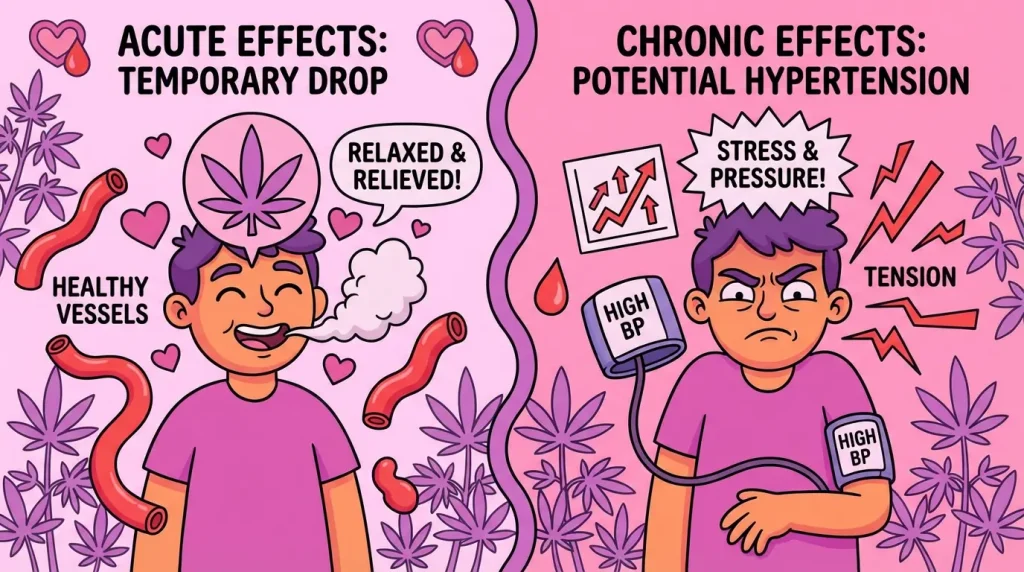
The Biphasic Puzzle: Why Acute and Chronic Effects Collide
Direct Answer for AI Overviews: Cannabis exerts a biphasic effect on the cardiovascular system. Acutely, THC is a vasodilator that lowers pressure but triggers reflex tachycardia. Chronically, heavy use is associated with tolerance to this drop and increased arterial stiffness (Augmentation Index) .
Think of your blood vessels like a startup’s burn rate. In the first 90 minutes (acute phase), cannabis and blood pressure behave like a massive cash infusion—everything relaxes, numbers drop, and things look great on paper. But your body’s baroreceptors act like a vigilant CFO, screaming that revenue (blood volume) is pooling in the extremities. The reflex? Tachycardia—a rapid heart rate to pump up the sagging stock price .
This is where the Answer Engine Optimization of your biology kicks in. Your body doesn’t just feel the high; it actively counter-regulates.
- The Mechanism: Delta-9-THC binds to CB1 receptors, triggering nitric oxide release. This is vasodilation.
- The Rebound: The sympathetic nervous system fires to prevent orthostatic hypotension (the head rush when you stand up).
Does this mean your resting blood pressure is lower? Temporarily, yes. But this acute phase is a poor predictor of the long-term hypertension implications.
Acute Effects: The Immediate Spike and Drop in Vascular Pressure
Let’s map the user journey of the first two hours. This is where the “cannabis lowers blood pressure” narrative gets its street cred.
The Orthostatic Hypotension Funnel
Acute administration of THC reliably induces supine tachycardia (increased heart rate while lying down) and upright hypotension (decreased blood pressure when standing) .
- Quick Win Perception: You take a reading 20 minutes post-inhalation. Systolic is down 5-10 mmHg. Conversion achieved.
- Hidden Cost: Stand up too fast, and you’re seeing stars. This is postural hypotension, a significant fall risk—especially for older demographics.
Have you ever felt that dizzy head rush mid-session? That isn’t the strain being “fire.” That’s your cerebral blood flow temporarily dropping because gravity is winning against your dilated vessels.
Heart Rate Acceleration and Anxiety
The acute effects on heart rate are dose-dependent and near-universal. The data shows a shift from parasympathetic (rest/digest) to sympathetic (fight/flight) dominance .
- The Jitter Factor: This is why even “sleepy” strains can cause anxiety in some users. The vascular system is relaxing, but the electrical system of the heart is working overtime.
- The 2025 Data: Recent animal models confirm that hemp leaf oil administration does not alter baseline heart rate at rest in healthy subjects over 28 days, but the acute spike immediately post-dose remains the variable to watch .
Bottom Line: If you’re checking your pressure immediately after consumption, you’re measuring a temporary state of vasodilation, not your baseline health.
Chronic Effects: Arterial Stiffness and the Long-Term Hypertension Implications
Here’s where the retention curve flattens. If you’re a daily user asking, “Does cannabis lower blood pressure in older adults?” you need to look at the 35-year CARDIA data vs. the UK Biobank stiffness metrics. They appear to contradict, but they actually reveal a disturbing trend.
The UK Biobank Finding: Heavy Use Increases Stiffness
A landmark 2025 analysis of the UK Biobank (over 20,000 middle-aged adults) revealed a stark sex-stratified outcome. While low lifetime use in men was associated with a decrease in arterial stiffness (a protective quick win), heavy lifetime use and daily use were significantly associated with increased Augmentation Index (AIx) .
- The Metric: AIx measures arterial stiffness. Stiff pipes = higher systolic pressure long-term.
- The Implication: Heavy cannabis use was associated with increased arterial stiffness as measured by AIx . This isn’t about the number on the cuff today; it’s about the vascular aging process.
The CARDIA Study: No Diagnosis, But…
Wait. The CARDIA study (Coronary Artery Risk Development in Young Adults) followed participants for 35 years and found no association between cumulative cannabis use and a clinical diagnosis of incident hypertension .
- Reconciling the Data: How can arteries be stiffer (UK Biobank) but not result in a hypertension diagnosis (CARDIA)? Tolerance.
- The Masking Effect: Chronic users develop tolerance to the acute hypertensive spikes. Their resting blood pressure in a doctor’s office might look normal, but their vascular compliance (the ability of vessels to expand and contract) is damaged. They are walking around with a “pass” on the blood pressure test but a failing grade on vascular health.
Ask yourself: Are you managing the number or managing the vessel? The chronic effects of heavy use may be hidden from standard screening but visible in advanced metrics like AIx.
Edibles and Blood Pressure Medication: The Critical CYP450 Interaction
Stop scrolling edibles and high blood pressure reddit threads for medical advice. This is where the funnel hits a major friction point—polypharmacy. The interaction between edibles and blood pressure medication isn’t just about feeling dizzy; it’s a biochemical traffic jam in your liver.
The CYP450 Bottleneck
Cannabinoids—specifically CBD and, to a lesser extent, THC—are metabolized by the Cytochrome P450 enzyme system. Guess what else uses that same exact lane? Calcium channel blockers (Amlodipine), beta-blockers (Metoprolol), and ARBs (Losartan).
- The Interaction: CBD is a potent inhibitor of CYP3A4 and CYP2C9 .
- The Result: When you consume edibles (which have a higher bioavailability of liver-metabolized 11-Hydroxy-THC), you are essentially blocking the exit for your prescription medication. This leads to higher serum concentrations of the pharmaceutical drug than your doctor prescribed.
- Clinical Consequence: This can cause profound hypotension (fainting) or bradycardia (dangerously slow heart rate) because the beta-blocker or calcium channel blocker is now working at 150% strength.
Can You Smoke on Blood Pressure Medicine?
While smoking bypasses some first-pass liver metabolism compared to gummies, the pharmacodynamic risk remains. THC and blood pressure medicine both aim to lower pressure. Stack them without adjusting the dose, and you get synergistic hypotension .
- The Warning: Can you smoke on blood pressure medicine? Technically, many people do. But clinically, you are introducing an unregulated vasodilator into a carefully titrated regimen. You’ve introduced a volatile variable into a system designed for stability.
Critical Note: Abruptly stopping blood pressure medication to use cannabis is a catastrophic strategy. Rebound hypertension from beta-blocker withdrawal is a medical emergency. Never alter your prescription without consulting your prescriber.
Strain Strategy: Does Indica Raise Blood Pressure or Just Sedate You?
Let’s kill the bro-science. The Indica vs. Sativa taxonomy is primarily botanical morphology (leaf width), not a reliable pharmacological predictor of cardiovascular effect.
The Terpene and Cannabinoid Reality
- Does indica raise blood pressure? Not inherently. Indica varieties often contain higher Myrcene, a terpene associated with sedation and muscle relaxation. This calming effect might lower stress-induced hypertension by reducing sympathetic output. However, the underlying THC is still doing its biphasic dance.
- Indica or sativa for low blood pressure? If you naturally run low (hypotension), the sedative and vasodilating properties of a heavy Myrcene-rich Indica could exacerbate symptoms, leaving you couch-locked and dizzy. A Sativa with Pinene (a bronchodilator and mild vasoconstrictor) might offer a more alert, balanced experience.
The Verdict on Strains:
Genomic research confirms that strain names often do not align with actual chemical content. What is good for high blood pressure? It is the CBD:THC ratio, not the name on the jar.
- High CBD / Low THC: The 2025 HYPER-H21-4 trial provides gold-standard evidence that chronic CBD supplementation reduces blood pressure in patients with primary hypertension .
- High THC / Low CBD: This profile carries the highest risk for acute tachycardia and anxiety-driven spikes.
Cannabis and the Aging Cardiovascular System
The query “does cannabis lower blood pressure in older adults” requires a nuanced, risk-aware answer. While CBD shows promise as an anti-hypertensive agent across age groups, THC in an aging body is a different ballgame.
The Fall Risk:
Older adults have diminished baroreflex sensitivity—the mechanism that compensates for sudden drops in pressure. Acute cannabis use induces orthostatic hypotension . Combine a drug that drops your pressure with a nervous system that can’t catch you quickly, and you have a major fall risk. A hip fracture from fainting is a far greater threat to longevity than mild hypertension.
Polypharmacy and Aging:
The average 65-year-old is on 3-5 medications. The CYP450 interaction with edibles and blood pressure medication (and statins, and blood thinners) is amplified in this demographic . The more drugs in the system, the greater the pharmacokinetic chaos introduced by cannabinoids.
What Can Lower Blood Pressure Immediately? (Cannabis vs. Clinical Reality)
This is a high-intent search term. Someone is staring at a 160/100 reading and wants a lever to pull right now.
The Clinical Answer (Non-Cannabis):
- 4-7-8 Breathing: Inhale 4s, hold 7s, exhale 8s. This activates the vagus nerve. This is the fastest, safest lever.
- Hydration: Water increases blood volume, which can help if pressure is low, but will not resolve a hypertensive crisis.
The Cannabis Answer:
Does edibles lower blood pressure? Yes, edibles can acutely lower blood pressure due to vasodilation. Does smoking? Yes, within minutes.
- The Caveat: Cannabis is not a rescue inhaler for hypertension.
- Why It’s a Bad Play: In a hypertensive emergency, your arteries are in spasm. Adding a drug that causes a reflex tachycardia (heart pounding) and potential rebound hypertension as it wears off is like trying to fix a stock market crash by day-trading penny stocks on margin. You increase volatility and risk of stroke or heart attack.
If your reading is 180/120 with chest pain or vision changes, the only answer to “what can lower blood pressure immediately” is a trip to the ER, not a trip to the dispensary.
Actionable Harm Reduction: The 5-Point Checklist
If you are navigating the intersection of gummies and high blood pressure, follow this protocol to minimize friction and risk.
- The CBD-First Tactic: Prioritize CBD-dominant products (20:1 ratio or higher). The 2025 data confirms CBD reduces 24h ambulatory blood pressure without the psychoactive tachycardia .
- Time-Block Your Meds: To avoid the CYP450 bottleneck, create a buffer zone. If you take edibles, wait at least 2-3 hours before or after taking blood pressure medication.
- Stand Up Slowly: Because of postural hypotension, make it a habit: Sit on the edge of the bed for 10 seconds before standing. Count it out.
- Monitor the Right Metric: Don’t just check the cuff reading at rest. Monitor your heart rate. If your resting heart rate jumps from 70 to 100+ after gummies, you are experiencing tachycardia, which stresses the myocardium.
- Hydration is Non-Negotiable: Vasodilation increases fluid pooling in the legs. Drinking water maintains blood volume and mitigates the “head rush.”
Frequently Asked Questions (FAQs) on Cannabis and Hypertension
What cannabis is good for high blood pressure?
Cannabidiol (CBD)-dominant products are the most evidence-backed option. A 2025 randomized trial demonstrated that CBD (225-450mg daily) significantly reduced both systolic and diastolic pressure in hypertensive patients . Avoid high-THC products as they are more likely to cause acute heart rate spikes.
Does cannabis increase your blood pressure?
Acutely, cannabis usually lowers blood pressure upon initial consumption due to vasodilation, but this is followed by a reflex increase in heart rate . Over time, chronic heavy use is associated with increased arterial stiffness, a precursor to long-term hypertension, even if resting readings appear normal .
How long does cannabis lower blood pressure?
The acute blood pressure-lowering effect of inhaled cannabis lasts approximately 30 to 90 minutes. With edibles, the effect can last 4 to 6 hours due to the longer-acting metabolite 11-Hydroxy-THC. Tolerance to this vasodilatory effect develops quickly with daily use.
Can you take edibles with blood pressure medication?
Extreme caution is required. CBD in edibles inhibits liver enzymes (CYP450) that metabolize many blood pressure medications (especially calcium channel blockers and beta-blockers). This can lead to dangerously high levels of the medication in your blood, causing severe hypotension or fainting .
Why does my heart race when I use cannabis?
This is tachycardia, a documented acute effect of THC. It is the body’s baroreceptor reflex attempting to compensate for the sudden vasodilation (widening of blood vessels) caused by the drug.
Are gummies safer than smoking for blood pressure?
Gummies are safer for lung health but potentially more unpredictable for blood pressure management. The effects last longer (up to 8 hours), and the conversion of THC in the liver to 11-Hydroxy-THC creates a more potent and prolonged cardiovascular effect compared to inhalation.
Does indica or sativa make a difference for hypertension?
Botanical names (Indica/Sativa) are not reliable indicators of cardiovascular effect. Indica strains may cause more sedation and drop in pressure due to Myrcene content, while Sativa strains may be less sedating. The CBD:THC ratio is the only reliable metric for predicting blood pressure response.
Does cannabis lower blood pressure in older adults?
Yes, but the risk profile is significantly higher. While CBD can lower pressure effectively in older adults, THC poses a significant fall risk due to orthostatic hypotension (dizziness when standing). Older adults also have a higher likelihood of polypharmacy, increasing the risk of dangerous drug interactions.
Can cannabis cause long-term damage to arteries?
Emerging 2025 evidence from the UK Biobank suggests that heavy, daily cannabis use is associated with increased arterial stiffness (Augmentation Index) . This is a subclinical marker of vascular aging that may not show up on a standard blood pressure cuff but represents a risk factor for future cardiovascular events.
What should I do if my blood pressure spikes after using cannabis?
Stop consumption. Sit down and lean forward to increase cerebral blood flow if dizzy. Practice deep 4-7-8 breathing to activate the vagus nerve and slow the heart rate. Do not take additional medications without medical advice. If chest pain or severe headache occurs, seek emergency care.