
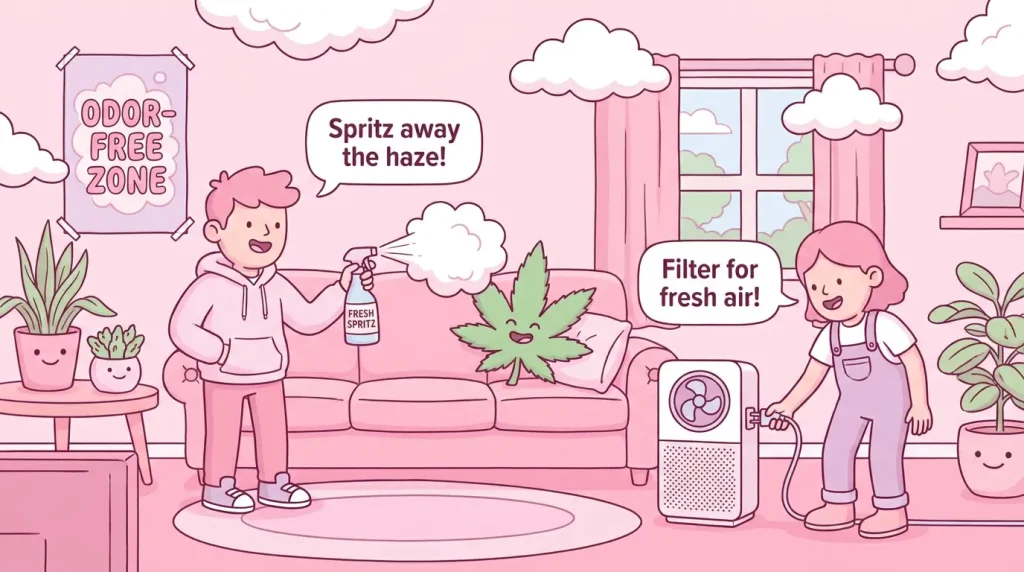
Have you ever sparked up a relaxing joint after a long day, only to panic ten minutes later because your entire apartment smells like a music festival? You’re not alone. For the modern enthusiast, discretion isn’t just a preference—it’s a necessity. Whether you’re renting an apartment with thin walls, living with family, or simply trying to be a considerate neighbor, the lingering smell of cannabis can quickly turn your sanctuary into a source of anxiety.
The problem isn’t the plant; it’s the particulate. Cannabis smoke is notoriously clingy, embedding itself into fabrics, carpets, and drywall. But here’s the good news: you don’t need to hotbox your bathroom like a teenager in a 90s comedy to enjoy your flower. We’re moving past the wet towel under the door trick. In this complete guide to cannabis odor control at home, we’re diving deep into the science of smoke, the technology of air purification, and the behavioral tweaks that deliver maximum discretion with minimum effort.
By the time you finish reading, you’ll have a step-by-step system to neutralize smells at the source, optimize your airflow, and leverage high-ROI habits that protect your privacy. We’re talking about converting your living space into a zero-evidence zone. Ready to clear the air? Let’s get into the nitty-gritty of terpenes, carbon filters, and the #1 mistake people make when trying to keep cannabis smells discreet.
The Science of Smoke: Why Cannabis Odor Is So Pervasive
Before we can control cannabis odor, we need to understand what we’re up against. Why does a single puff linger longer than the smell of burnt toast? The culprit lies in the unique chemical structure of cannabis smoke.
What is Cannabis Smoke?
Cannabis smoke is a complex aerosol containing hundreds of compounds. Unlike steam or vaporized water, true combustion releases sticky, lipophilic (fat-loving) molecules called terpenes and phenols. Terpenes are the aromatic oils that give cannabis its distinct scent—myrcene (earthy/musky), limonene (citrusy), and pinene (piney). While these smells are delightful during consumption, they become a liability afterward. Because these particles are hydrophobic, a simple spray of water-based air freshener won’t trap them; it merely masks them for a few minutes. To truly neutralize cannabis smell, you need to trap or chemically alter these gas molecules.
The “Sploof” and the “Sink”: A Quick Win
Let’s talk about the most basic funnel stage in the odor-control journey. A traditional sploof—a cardboard tube stuffed with dryer sheets—is a classic for a reason. It physically traps some larger particulate matter. However, for a massive upgrade in your odor control strategy, switch to an activated carbon sploof. Products like the Smoke Buddy use a high-grade carbon filter to scrub the smoke. Think of it like a landing page: a home-made sploof is a 1% engagement rate, while a carbon filter is a 10% conversion to clean air.
Optimize Your Airflow: The Conversion Rate of Air Particles
If you’re serious about your cannabis odor control, you need to stop treating the air in your room as a static object and start treating it as a fluid that needs to be directed. This is where optimization comes into play, borrowing a core tenet from conversion rate optimization: control the flow to dictate the outcome.
Negative Air Pressure: The Golden Rule
Professional grow rooms use a concept called negative air pressure. By having fans blowing out, you ensure that air only escapes through a designated exit (usually a carbon filter) rather than seeping under doors into hallways. You can replicate this at home. Place a box fan facing outward in your nearest window. Seal the gaps around the fan with cardboard or a specialized window seal kit. This creates a vacuum effect, sucking fresh air from the crack under your door into the room, and blowing the smoky air outside.
The LTV of a Good Air Purifier
Not all air purifiers are created equal. You need to optimize for a specific metric: CADR (Clean Air Delivery Rate) for smoke. Don’t waste money on ionizers that produce ozone—they are a health hazard and smell weird. You need a unit with a true HEPA filter and, critically, a substantial activated carbon pellet filter.
- True HEPA: Captures 99.97% of dust, pollen, and smoke particles (the tiny solids).
- Activated Carbon: Adsorbs the volatile organic compounds (VOCs) that cause the smell.
The long-term value of investing in a high-quality purifier far exceeds the monthly cost of incense sticks. You’re not just buying a machine; you’re buying experience and peace of mind.
The Tech Stack: Tools That Actually Neutralize Smoke
To truly deodorize a room fast, you need a layered defense system. Think of this as your marketing stack: you don’t rely on just one channel; you use organic, paid, and email. Similarly, don’t rely on just one tool.
1. The On-Site Scrubber (Vaporizer Technology)
The single most effective way to eliminate cannabis smells is to reduce the amount of smoke produced in the first place. Dry herb vaporizers heat cannabis to a temperature that releases cannabinoids and terpenes without combustion. The “vapor” dissipates much faster than smoke and has a less clingy molecular structure. While the upfront cost is a sticking point, the return on investment is incredible—you use less herb, and the scent doesn’t permanently embed in your furniture.
2. The “Set It and Forget It” Approach: The Gel Trap
Let’s pivot to a strategy gaining massive traction in niche optimization circles: the passive defense. ONA (Odor Neutralizing Agent) gel is a staple in the grow-op industry. It doesn’t just mask; the molecules bind to odor molecules, essentially neutralizing them. Place a small tub near the door exit to act as a final line of defense. It’s the long-tail strategy of odor control—low volume, but extremely high intent.
3. The “Carry-Over” Audit
We talk about the “cannabis carry-over effect” when one conversion leads to another. If you smoke in a jacket, then hang that jacket in a closet, the closet now smells. You must optimize your environment by isolating “hot zone” fabrics immediately. Keep a designated smoking hoodie (a “smoking jacket”), or better yet, launder your clothes based purely on engagement with smoke.
Building a Reliable Answer System for Your Peace of Mind
Now, let’s shift gears and talk about how you organize your actual stash and paraphernalia. In digital marketing, our goal is to make information easy to find for algorithms. In home scent control, your goal is to make the scent impossible to find.
How to Get the “Direct Answer” Fast
When you need a quick solution, you want it now. We’re structuring our advice today to give you clear, concise, and actionable data.
- Question: “How to mask the smell of weed?”
- Direct Answer: Don’t mask, neutralize. Use a combination of negative air pressure, a personal carbon filter sploof, and an air purifier.
- Question: “Why does my room still smell after airing it out?”
- Direct Answer: Terpenes have adhered to the tertiary surfaces in your room (carpets, curtains). Use a vinegar-based solution on hard surfaces and steam-clean fabrics.
The FAQ Funnel
Building a “FAQ section” in your mind—or literally printing one out—can save you. What are the fastest ways to eliminate the stench before a landlord visit? Ozone generators work, but they are dangerous for humans and pets. For a non-toxic quick flush, simmer white vinegar on the stove for 30 minutes, then open all windows. The acetic acid vapor neutralizes the alkaline smoke particles.
Building Trust: Why Your Setup Needs Demonstrable Experience
To truly master your cannabis air purification setup, you need to look beyond the product labels and focus on demonstrable proof. We live in a world where social proof is the ultimate trust signal. How do you know if a method really works on a heavy smoking session versus a micro-dose? You test it, or you seek out verified case studies.
Case Study: The Living Room Test
Let’s paint a scenario. User A smokes a 0.5g joint in a 200 sq ft room with no airflow. User B smokes the same joint in the same room with a carbon-filtered sploof and a Levoit or Coway air purifier running on “Turbo.” After 15 minutes, User A’s room smells like a back-stage green room. User B’s room smells faintly of nothing but clean air.
The difference isn’t subtle; it’s the gap between a broken sales funnel and a fully optimized one. The trustworthiness of the process comes from the experience of trying it. One might claim incense works, but the evidence shows it creates a suspicious “burnt flower” perfume rather than true neutrality.
Why Review Mining Matters
Before buying that expensive filter or specialized candle, mine the reviews. Filter the one-star and two-star reviews first. If a candle has thousands of five-star ratings but a handful of users say, “This just smells like a skunk that took a floral bath,” that’s a critical signal. You need a product that chemically interacts with the terpenes, not just a stronger competing scent.
Common Mistakes That Kill Your Cover
Let’s perform a reverse audit. Even with a highly optimized cannabis odor neutralizer plan, a single bottleneck can ruin your strategy. Here are the stealth killers of discretion.
1. The “Exhaust” Leak
Are you blowing sploof-smoke out a window, but there’s a gap in the screen? Or worse, is the wind blowing it right back in? You must lean into optimizing the exit point. Sometimes, a fan blowing in from a window is better if it creates positive pressure that forces the air down a hallway to an exhaust point. This is technical, but understanding your home’s pressure map is a game-changer.
2. The Stale Pipe
If you’ve kept cannabis smells discreet during your session but left an open ashtray or a used pipe on your desk, you’ve leaked value. The pipe is a continuous source of vaporizing phenolic compounds. Have you ever smelled a pipe that’s been sitting for 30 minutes? It’s sharp, acrid, and distinctly weed-like. Clean your tools immediately with isopropyl alcohol and salt. Seal them in an airtight container.
3. The “Towel Threshold” Fallacy
The infamous towel under the door. It’s a bit of a meme now, isn’t it? It’s like putting a band-aid on a broken sales funnel. It stops light and marginal drafts but does almost nothing for gas diffusion. You might slow the smell by 5%. If you use a towel, soak it in water first to make a more airtight seal, but never rely on this alone.
Frequently Asked Questions
Can you completely eliminate cannabis smells without an exhaust fan?
Complete elimination without ventilation is extremely difficult but possible with a multi-layered approach. You must combine a personal carbon filter with a high-CADR air purifier and ensure zero-loose ash. You can achieve a 95% reduction, though the trace scent might remain close to the “epicenter” for about 20 minutes.
How long does it take for weed smell to dissipate naturally?
Without intervention, the distinct odor of combusted flower can stick to fabric for 6–8 hours and can linger in a sealed room for up to 12 hours. This timeline shrinks drastically—to under 30 minutes—with active ventilation and a solid odor eliminator for cannabis use.
Does vaping smell less than smoking flower in a pipe?
Absolutely. Vapor is not combustion. Since you aren’t burning plant matter, the aerosol produced is lighter, less sticky, and doesn’t contain the heavy tars associated with burnt cellulose. However, it still carries terpenes, so it’s not odorless. The key difference is how it interacts with the environment—spent vapor dissipates upwards like steam, while smoke tends to billow and settle. This makes vaping a top-tier air purification method for the modern enthusiast.
Do essential oil diffusers kill weed smell?
No. Essential oil diffusers change the sensory experience (masking) but do not kill the smell. The olfactory bulb can often distinguish between the fresh molecules of peppermint and the stale, skunky signature of old smoke. You end up with a room smelling like peppermint and weed, which is arguably worse than just smelling like one. Use Eucalyptus oil if you must, as its decongestant properties can help temporarily block your own sinuses, but for true elimination, stick to carbon filtration.
Conclusion: Clear the Air, Keep the Peace
Mastering home cannabis odor solutions isn’t just about hiding a scent—it’s about reclaiming control over your space. It’s about shifting from a reactive state of paranoia to a proactive state of confident relaxation. We’ve moved through the science of why the scent sticks, identified the high-ROI tools that actually scrub the air, and exposed the fragile bottlenecks that cause the dreaded “dank house” syndrome.
The ultimate goal here is to integrate these steps into your ritual so seamlessly that they become automatic. Don’t view the fan, filter, and vaporizer as chores; view them as part of the hobby. The true long-term gain comes from stacking these small wins. By igniting that curiosity and applying these optimized methods, you ensure that your private time remains truly private.
Did you find a new trick in this guide that you haven’t tried yet? Or do you have a legendary DIY method that beats commercial purifiers? We want to hear about it. Drop your go-to smoke odor elimination hack in the comments below and let’s build the ultimate crowd-sourced playbook for discretion.