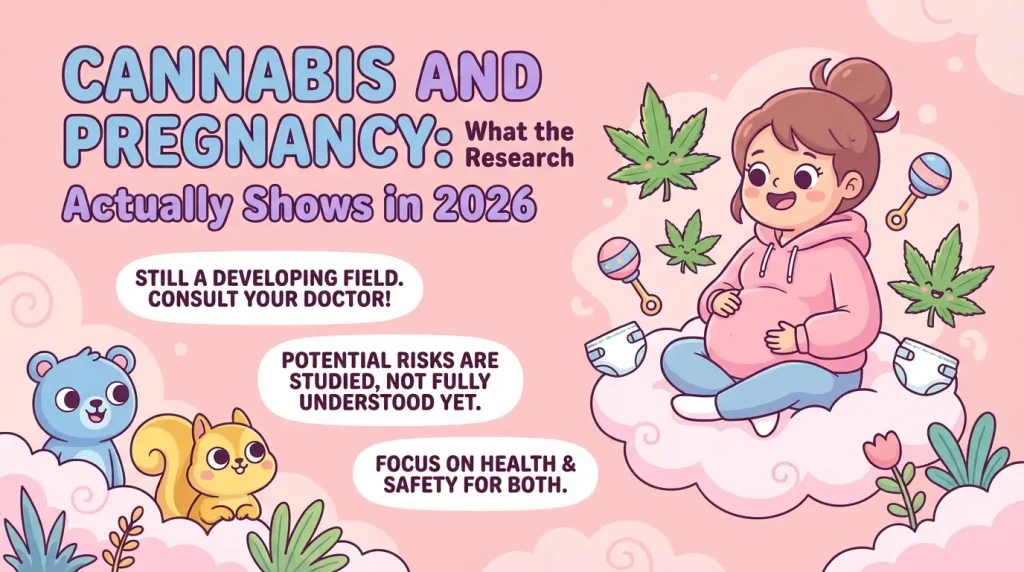
Let’s be real for a second: pregnancy is hard. Between the nausea, the anxiety, and the sheer exhaustion of growing a human, it’s understandable why some moms-to-be look for relief. For decades, that relief has come in many forms, and for a growing number, it includes cannabis.
We see the stories in forums like the Cannamoms pregnancy forum, where mothers share their experiences with using weed to cope with morning sickness or stress. But in 2026, as cannabis legalization expands across the globe, the gap between social acceptance and scientific evidence is wider than ever. If you are navigating this journey, you are likely swimming in a sea of conflicting advice.
Does that edible brownie really help with the nausea? What happens if you accidentally eat an edible while pregnant? And more importantly, what does the law say where you live?
We are cutting through the noise. This article isn’t about judgment; it is about data. We are diving deep into the latest peer-reviewed studies from 2025 and 2026 to answer the tough questions about medical cannabis pregnancy risks, legal pitfalls, and the long-term health of your baby. Let’s separate the myths from the molecular biology.
The Legal Landscape: Is it Illegal to Smoke While Pregnant?
Before we look at the biology, we have to address the immediate, real-world concern: the law. The question “is it illegal to smoke while pregnant” doesn’t have a universal answer, but the trend is moving toward restriction and clarification.
While no federal law in the U.S. specifically criminalizes a pregnant person for using cannabis solely based on their pregnancy status, the state-level landscape is a minefield.
What States is it Illegal to Smoke While Pregnant?
As of 2026, several states classify cannabis use during pregnancy as child abuse or grounds for intervention. States like Alabama, Arkansas (which specifically lists smoking in the presence of a pregnant woman as illegal in certain contexts ), South Dakota, and others have laws that can punish mothers who use cannabis while pregnant.
However, it is crucial to understand the nuance. In many jurisdictions, the issue isn’t just the act of smoking, but the result.
- Child Welfare Involvement: In states like Minnesota and Wisconsin, a positive THC test at birth can be used as evidence in child welfare proceedings.
- Public Consumption Laws: As seen in recent Arkansas legislation (H.B. 1452), it is explicitly illegal to smoke marijuana in the presence of a pregnant woman, highlighting that the legal system views secondhand exposure as a public health hazard .
- Context Matters: In Illinois, while the Cigarette Health Warning Act mandates signs warning of smoking risks, cannabis laws are evolving separately, but the principle of fetal harm remains a legal consideration .
The Takeaway: Even if you live in a state where recreational weed is legal, legality does not equal safety in the eyes of the law or child protective services. The legal system is increasingly treating prenatal substance exposure as a matter of state interest.
The Science of 2026: It’s Not Just About THC Anymore
For years, the debate focused solely on THC. But cutting-edge research from 2026 has shifted the focus to the delivery method and the entourage of chemicals entering your body.
Smoking in First 4 Weeks of Pregnancy: The Critical Window
Many women don’t even know they are pregnant during the first four weeks. If you are asking about smoking in first 4 weeks of pregnancy, you are asking about the most vulnerable period for organogenesis—the formation of the baby’s organs.
Recent studies published in Scientific Reports have used cannabis smoke extract to understand real-world effects. The findings are stark: smoking cannabis introduces combustion by-products like polycyclic aromatic hydrocarbons (PAHs) that pure THC does not. These PAHs trigger a massive stress response in placental cells (specifically, a 900 to 1600-fold increase in CYP1A1 expression), which is not seen with isolated THC exposure .
“The placenta acts as the baby’s life support. When it’s stressed by smoke, its ability to differentiate and build a healthy barrier is compromised,” explains a 2026 Nature publication .
This means that smoking—even just in the first few weeks—can disrupt the very foundation of the placenta, potentially setting the stage for complications long before you ever see a positive test.
Vaping and Edibles: Are They Safer?
This is where the edibles and pregnancy forum discussions get intense. Many mothers turn to edibles thinking they are avoiding the “smoke” risk. But the data suggests caution.
Do edibles affect female fertility? Research published in the Journal of Applied Toxicology (2025) confirms that exogenous cannabinoids can disrupt the hypothalamic-pituitary-ovary (HPO) axis . This disruption can alter the normal secretion of sex hormones and menstrual cycles. For female fertility, chronic use can create an inhospitable hormonal environment for conception.
And if you are already pregnant, the concern shifts to dosage. What happens if you accidentally eat an edible while pregnant?
- Concentration: Edibles often contain high, concentrated doses of THC. Unlike smoking, where the effects are felt immediately, edibles are metabolized by the liver, converting THC into a more potent form (11-hydroxy-THC) that crosses the placenta easily.
- Duration: The fetal exposure window is significantly longer with edibles than with smoked cannabis.
- Placental Impact: Even without smoke, THC alone has been shown to reduce crucial markers of placental fusion (like hCG and syncytin-1), meaning the placenta cannot effectively exchange nutrients .
One user on a pregnancy forum noted their OB “recommended edibles” . However, major health organizations like the American College of Obstetricians and Gynecologists (ACOG) explicitly state that there is no medical indication for cannabis use during pregnancy and that clinicians should guide patients toward alternative therapies .
The Hidden Dangers: What’s Happening Inside the Placenta?
To understand the risk, we have to look at the body’s own endocannabinoid system (ECS) . Think of the ECS as a massive lock-and-key system that regulates mood, appetite, and importantly, pregnancy. Your placenta has its own local ECS that is crucial for implantation and blood flow .
When you introduce external cannabinoids (THC/CBD), you are essentially jamming the locks.
- Blood Flow Disruption: Cannabinoids affect the transient receptor potential channels (TRPV) in the placenta, which are vital for vascular function .
- Mitochondrial Dysfunction: Cannabis smoke extract doesn’t just irritate cells; it disrupts the mitochondria—the power plants of the cell. This leads to bioenergetic dysfunction, meaning the placenta literally doesn’t have the energy to grow properly .
- Low Birth Weight: This cellular stress directly correlates with the epidemiological data linking cannabis use to low birth weight and NICU admissions .
Medical Cannabis Pregnancy: A Delicate Conversation
The term medical cannabis pregnancy is a complex one. ACOG acknowledges that some pregnant women use cannabis to manage severe nausea, chronic pain, or anxiety . But here is the hard truth: “medical” does not mean “proven safe for the fetus.”
Currently, there are no dosing guidelines for pregnant individuals. The potency of cannabis today is drastically higher than it was in the 1990s. The THC concentration in products discussed on forums can be exponentially higher than what was used in older safety studies.
If you are using medical cannabis to manage a condition like hyperemesis gravidarum (severe vomiting), you are in a tough spot. The key is transparency. ACOG recommends universal screening—not to punish, but to inform . Be honest with your OB-GYN. They need to know to differentiate between pregnancy symptoms and potential withdrawal in the newborn, and to monitor fetal growth more closely.
Debunking the Forums: CannaMoms and Misinformation
Online communities like the Cannamoms pregnancy forum provide something vital: social support and a sense of not being alone . Moms share stories of using cannabis to cope with the pressures of modern motherhood, pushing back against the “picture-perfect” stereotype.
However, these forums are often rife with anecdotes that contradict clinical data.
- The Anecdote: “I used edibles my whole pregnancy and my baby is a genius.”
- The Data: A 2026 NIH review concludes that current evidence supports abstaining from cannabis during preconception, pregnancy, and lactation to optimize maternal, fetal, and intergenerational health outcomes .
- The Reality: You cannot see neurocognitive or behavioral effects in a 16-month-old. These issues often manifest later, during school age, with challenges in attention and executive function.
We have to ask you: Are you willing to bet your child’s long-term cognitive development on a forum post from a stranger?
FAQs: Your Burning Questions Answered
We know you still have questions. Here are the direct answers to the most searched queries regarding cannabis and pregnancy.
1. Can I use CBD oil if it has no THC?
Probably not. Most CBD products contain trace amounts of THC. More importantly, the impact of CBD on the placental ECS is still being studied, and early data suggests it can also affect trophoblast function . The safest approach is to avoid it.
2. I smoked before I knew I was pregnant. What now?
Don’t panic. The smoking in first 4 weeks of pregnancy is a risk factor, but it doesn’t guarantee a poor outcome. The most important thing you can do is stop now. Your baby has a remarkable capacity for recovery once the exposure ceases. Inform your doctor so they can monitor your placental health and fetal growth appropriately.
3. Will they test me and my baby at birth?
It depends on your hospital and state laws. Many hospitals perform universal screening (often via questionnaire), but biologic testing (urine, hair, meconium) requires informed consent in many places, though legal nuances vary . Be aware of the policies at your specific hospital.
4. Does secondhand smoke count?
Absolutely. Is it illegal to smoke while pregnant if someone else is doing it? Legally, it varies, but biologically, secondhand smoke exposes the fetus to the same carbon monoxide and nicotine (if tobacco) or THC (if cannabis) that impair fetal heart development and oxygen delivery .
5. How does cannabis affect male fertility?
While this article focuses on the maternal side, research shows paternal smoking is associated with an increased risk of congenital heart defects (like Ventricular Septal Defect) in offspring, likely due to secondhand smoke exposure to the mother and epigenetic changes in sperm .
6. What if I’m using cannabis to treat a mental health condition?
This is a valid concern. Abruptly stopping cannabis can cause anxiety spikes. However, untreated mental health conditions also pose risks to pregnancy. This is why you need a healthcare team—a psychiatrist and an OB-GYN—who can find pregnancy-safe alternatives.
Conclusion: Knowledge is the Best Protection
The research of 2026 is clear: while the social stigma around cannabis is fading, the biological risks remain. From disrupting the delicate endocannabinoid system in the placenta to potentially triggering legal intervention, the use of cannabis during pregnancy carries weighty consequences.
Whether you are scrolling through a Cannamoms pregnancy forum looking for support, or you are worried because you accidentally took a bite of a brownie, we hope this guide has given you the facts you need.