
Forget everything you think you know about just tossing raw cannabis into a batch of brownie mix. If you’ve ever been disappointed by a homemade edible that delivered nothing but a faint, weedy aftertaste and zero effect, you’re not alone. You wasted precious flower, time, and butter on a fundamental chemistry error. The difference between a complete dud and a potent, artisanal cannabis cooking experience lies entirely in thermal precision. You aren’t just cooking; you’re commanding a complex chemical reaction. This isn’t about getting lucky—it’s about mastering the science of heat, time, and plant material to unlock maximum potency and build a consistent, reliable product every single time you step into the kitchen. Ready to stop gambling with your grams and start engineering edible excellence?
The Non-Negotiable First Step: What is Decarboxylation?
Raw cannabis is packed with THCA (tetrahydrocannabinolic acid) and CBDA (cannabidiolic acid). In this raw state, they’re about as psychoactive as a bag of fresh salad. To convert these acidic precursors into the active THC and CBD we know and love, they need to shed a carboxyl group (a carbon dioxide molecule) through precisely applied heat. This thermal transformation is decarboxylation, and it is the single most critical variable in your cannabis cooking process. Skip this step, and you’ve made a delicious snack with all the punch of herbal tea. Master it, and you’ll extract every last milligram of value from your flower.
Think of it as the “unlocking” sequence for your botanical data. You wouldn’t download a compressed file without unpacking it, would you? Applying accurate heat is how you unpack the potential energy sleeping in those trichomes. It’s a binary outcome: either you activate the molecule, or you incinerate it. There is no middle ground in the Cannabis Cooking Temperature Guide playbook.
The Definitive Cannabis Cooking Temperature Guide: Precision Heat for Peak Potency
We’re moving fast into a world where guesswork is the enemy. You don’t just want a recipe; you want a reproducible system. The exact temperature at which you decarboxylate determines not only the potency of your final product but also the quality of the high. Temperature is the master lever that controls the conversion rate and the preservation of delicate aromatic terpenes. Lose your terpenes, and you lose the nuanced entourage effect that differentiates a generic, one-note buzz from a therapeutic, full-spectrum symphony.
This guide exists to give you the exact coordinates for success. According to a foundational study published in the Journal of Chromatography A, specific time-and-heat curves are required to achieve near-total decarboxylation without degradation to CBN (cannabinol), the sleepy, often less-desirable cannabinoid. We are engineering an outcome here. Your funnel is the oven; your conversion metric is bioavailable THC. If your current method involves “baking until it smells nutty,” you’re tracking vanity metrics.
Why THCA Activation is a Chemical Mandate
Let’s be blunt: the human liver cannot process THCA efficiently. It must be converted to delta-9-THC via heat before ingestion to cross the blood-brain barrier effectively when eaten. When you apply heat via the decarboxylation process, you are essentially pre-digesting the plant material for your body. This is why vaping or smoking works instantly—the flame does the conversion on the spot. In the culinary world, you must simulate this flash point conversion in a controlled environment. Have you ever calculated the actual bioavailable content in your last batch of infused oil, or did you just cross your fingers and wait?
Why Your Oven Dial is Lying to You (And Ruining Your Flower)
Here’s a harsh truth most cannabis cooking guides won’t tell you: your domestic oven is a liar. It’s a box of wild thermal fluctuations. The thermostat on your wall maintains a comfortable range, but your oven? It can swing by 20–30 degrees Fahrenheit (or more) as it cycles the heating element on and off to maintain a rough average. If you’re targeting a precise 230°F (110°C) for decarboxylation but the oven spikes to 250°F (121°C), you’ve just crossed the line from activation into rapid vaporization and terpene genocide.
This is an equipment optimization problem. The solution isn’t a new $5,000 stove; it’s calibration and insulation. You need a secondary, oven-safe digital thermometer probe placed directly next to your tray of flower. This is your single source of truth. Furthermore, creating a thermal buffer by placing a pizza stone or a cast-iron skillet on the lower rack stabilizes the temperature. It acts as a heat sink, absorbing the violent spikes and releasing steady, radiant heat.
Checklist: Hardware Optimization for Consistent Heat
- Calibrate your oven with a standalone digital thermometer.
- Place a pizza stone on the lowest rack to stabilize thermal swings.
- Use a heavy-gauge, light-colored baking sheet (dark pans absorb heat too aggressively and can scorch the bottom layer).
- Avoid convection settings unless you’ve secured your flower under a sheet of parchment paper pinned down by weights (the fan will blow it everywhere).
The Infusion Blueprint: Binding Cannabinoids to Fats
Activation is only Phase 1. Once your flower is decarbed, you’ve created a potent powder of activated THC. However, cannabinoids are lipophilic—they bind to fats, not water. The infusion stage is where you extract those activated compounds and hold them in suspension for use in your recipes. This is the extraction efficiency stage of your funnel. If you don’t infuse long enough, you leave precious compounds in the sludge. Infuse too long or too hot, and you degrade your hard-earned THC into CBN, turning your party brownies into a sleepy-time sedation loaf.
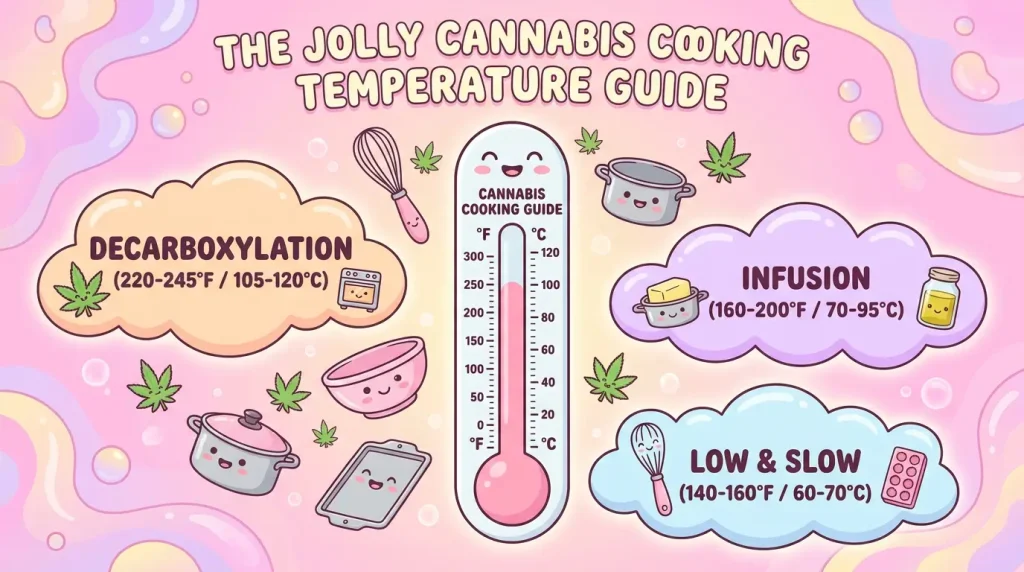
The quality of your fat matters. MCT oil (derived from coconut oil) is often hailed as the king because its medium-chain triglycerides are metabolized rapidly and offer high bioavailability. Butter (clarified, or ghee) brings a richness that is perfect for baked goods, but its milk solids can scorch if your temperature control is sloppy. Regardless of your chosen fat, the scientific consensus for optimal extraction involves maintaining a low temperature (between 160°F and 180°F) for several hours. You are seeking a steady-state extraction, not a violent boil. This is where you build consistent brand quality in your own home kitchen.
How do you define the “stickiness” of your edibles? It’s directly proportional to your fat’s saturation rate at the infusion stage.
Critical Temperature Thresholds: From Activation to Evaporation
To command this process, you need to memorize the thermal danger zones. This isn’t just a guide; it’s your kitchen command center dashboard.
| Temperature (°F) | Temperature (°C) | Biological & Chemical Event | Action Required |
|---|---|---|---|
| 200°F – 240°F | 93°C – 115°C | The Sweet Spot for Decarboxylation. THCA converts to THC. | Maintain for 30–45 mins. Monitor probes carefully. |
| 220°F | 104°C | The “Goldilocks” standard for preserving terpenes during decarb. | Set your oven here if you trust your calibration. |
| 250°F | 121°C | Warning Zone. Rapid decarb but terpene boiling begins. | Reduce time to 20–25 mins. Risk of evaporation spikes. |
| 315°F | 157°C | Terpene Evaporation Limit. Myrcene & Limonene start volatilizing aggressively. | Never exceed this during a “low and slow” oven decarb. |
| 320°F – 350°F | 160°C – 177°C | CBN Conversion Zone. THC begins converting to CBN. | Edibles will be sedative, not euphoric. |
| Above 350°F | Above 177°C | Combustion & Destruction. Plant matter scorches. | Your material is now inert char. Flush and start over. |
Quick-Answer: The Optimal Numbers
For digital assistants and quick reference, here is the direct, concise answer you need:
The optimal temperature for decarboxylation of cannabis is 230°F (110°C) for 40 minutes. For infusion, maintain a fat temperature of 170°F (77°C) for 4 hours. These settings maximize THC conversion while preserving terpenes and preventing degradation to CBN.
Step-by-Step: The Foolproof Activation and Infusion Protocol
Let’s move from theory to execution. This protocol is your standard operating procedure for zero-defect cannabis cooking.
Phase 1: Pre-Processing (The Grind)
- Hand-Break, Don’t Pulverize: Gently break your cured cannabis flower into popcorn-sized nugs. You want surface area for even heat penetration, but grinding it to a fine kief dust exposes too many cut trichome heads, which will oxidize and evaporate faster.
- Single-Layer Architecture: Spread the material loosely on a parchment-lined baking sheet. Overcrowding creates micro-climates of steam and uneven heat. If you’re processing a large batch, use multiple trays.
Phase 2: The Decarb Cycle
- Pre-heat with Stability: Set your oven to 230°F (110°C). Wait 20 minutes after it beeps that it’s preheated. The beep is a lie. Use your digital thermometer to confirm stability.
- The 40-Minute Mission: Place the tray in the center rack. For high-THC cultivars targeting a cerebral effect, stick strictly to 40 minutes. For high-CBD cultivars or if you desire a more relaxed, sleepy outcome, you can push this to 50–60 minutes to nudge some THC into CBN (yes, intentional CBN conversion can be a tool, not a bug, for sleep aids).
- Cool Down: Let the tray cool completely to room temperature without disturbing the flower. The nugs should feel dry and crumble easily, with a slightly darker, toasted hue. They should not be brown or black; that signals carbonization—the death of your active ingredients.
Phase 3: The Infusion Cycle
- The Fat Bath: Combine your decarbed flower with your chosen fat (MCT oil, ghee, or butter) in a mason jar or a double boiler. Do not use a direct pot-on-stove without a water bath; it will scorch.
- Water-Bath Shield: If using a slow cooker (crock pot), fill the basin with water and place your sealed mason jar inside. The water acts as a thermal regulator, keeping the environment exactly at 180-190°F, which translates to about 170°F inside the jar.
- The 4-Hour Extraction: Let the extraction happen slowly. Shake the jar every 30 minutes to disperse the cannabinoids.
- The Final Filter: Strain through a cheesecloth or a fine-mesh nut milk bag. Do not squeeze like a tourniquet—that releases bitter chlorophyll. Allow gravity to work for the final drops of potent, green-gold liquid.
Advanced Hacks for the Cannabis Kitchen Alchemist
If you want to lead the pack, you need to move beyond the basics. The standard oven method is the foundation, but hardware advances are pushing the boundaries of what’s possible in home labs.
- The Sous-Vide Supremacy: For the absolute zenith of precision, ditch the oven. A sous-vide immersion circulator guarantees a temperature variance of only ±0.2°F. Seal your flower in a vacuum bag and immerse at 203°F (95°C) for 1 hour. It’s odorless, foolproof, and chemically superior because the sealed environment traps every volatile terpene. While a study in the Journal of Cannabis Research hasn’t discredited oven methods, the thermodynamic consistency of sous-vide makes it the gold standard for tech-forward kitchen enthusiasts.
- The Instant Pot Pressure Hack: You can use a pressure cooker, but you must use it dry. Place a trivet inside, add a cup of water to the bottom (not touching the flower), and seal your flower in a mason jar placed on the trivet. High pressure for 40 minutes provides a high-altitude boiling point that perfectly decarbs without oxidation. It’s fast and completely contains the smell.
- Dewatering the Chlorophyll: To avoid that “grassy” taste that screams amateur hour, try a water-cure before decarboxylation. Soak your raw flower in distilled water (changed every few hours) for 24 hours. This leeches out water-soluble chlorophyll without affecting the non-water-soluble trichomes. Dry the flower completely, then proceed to your decarb cycle. The resulting infusion will taste like pure terpenes, with zero lawn-clipping bitterness.
Have you implemented a post-infusion shelf-life tracking system, or are you gambling your product’s freshness and potency on fridge guesswork?
Troubleshooting: Why Your Edibles Aren’t Hitting
Despite meticulous planning, things go wrong. Here are the quick conversion killers:
- The Problem: Zero Effect.
- Diagnosis: You likely boiled the fat, or the flower was never activated. If you skipped the decarb stage and just steeped raw cannabis in hot milk for 10 minutes, you missed the conversion threshold completely. Remember, THCA needs sustained heat.
- The Problem: Insta-Nap, Not a Nice High.
- Diagnosis: You over-decarbed or infused at too high a temperature. Your THC has massively degraded into CBN. Check your oven probe; you likely spiked above 300°F. Your brownies are now a potent sleep aid, not a party favor.
- The Problem: The High is Jittery and Unpleasant.
- Diagnosis: You preserved a massive amount of THC but completely destroyed the calming terpenes and minor cannabinoids. This happens with ultra-fast, high-heat decarb methods. You need the entourage effect. Slow down the heat, and protect your terpenes.
Frequently Asked Questions (FAQs)
1. What is the perfect temperature for decarboxylation when cooking cannabis?
The perfect temperature for decarboxylation is 230°F (110°C). Maintain this heat for approximately 40 minutes to achieve maximum conversion of THCA to bioavailable THC, without pushing the material into the temperature range where terpenes evaporate rapidly. For those seeking more CBN for sleep-specific edibles, a slightly extended window at 240°F (115°C) is acceptable, though you sacrifice some “heady” effects.
2. Why does my cannabis-infused oil taste like burnt grass?
The burnt grass flavor is almost always a scorching issue, not a cannabis issue. Your temperature was too high during the infusion stage, causing the fat to burn the delicate plant solids. Alternatively, you squeezed the cheesecloth too aggressively, releasing bitter chlorophyll into your otherwise clean oil. Switch to a gentle gravity strain and a water bath to prevent direct heat contact with your pot.
3. Is it necessary to decarboxylate cannabis before making cannabutter?
Yes, it is absolutely necessary. Raw cannabis flowers are potent in THCA, which has no psychoactive effect. To activate the THC properties that consumers value, you must subject the dry plant material to a dedicated decarboxylation cycle before it touches the butter. If you skip this step, you are infusing fats with non-bioavailable acids, and your edibles will not work regardless of how much premium flower you used.
4. How long should I infuse my decarbed cannabis into MCT oil?
For high-quality MCT oil, the ideal infusion period is between 2 to 4 hours at a controlled temperature of 170°F (77°C). MCT oil is thinner than butter and extracts slightly faster, but rushing the process with high heat will damage the final product. A 4-hour low-and-slow extraction ensures you’ve leeched the maximum amount of cannabinoids from the plant material, providing the strongest value for your money.
5. Can I decarboxylate cannabis without my house smelling like a dispensary?
Yes, you can. The most effective method for odor-free cannabis cooking is using a sous-vide immersion circulator, as the flower is sealed in a vacuum bag and submerged. The mason jar method inside an Instant Pot (pressure-sealed) also completely contains the volatile compounds. If you must use an oven, seal the flower inside a turkey roasting bag; this prevents the aromatic terpenes from off-gassing into your kitchen.
6. Does decarboxylation destroy CBD?
No, but it activates it. Just as THCA converts to THC, CBDA (Cannabidiolic acid) converts to active CBD through the same thermal decarboxylation process. However, CBD is slightly more heat-stable than THC, meaning it can withstand slightly higher temperatures or longer durations without degrading. A standard 230°F/40-minute cycle works perfectly for activating both THC and CBD in high-CBD strains or balanced varieties.
Final Thoughts: Your Kitchen, Your Lab
Mastering the Cannabis Cooking Temperature Guide is the defining line between a casual hobbyist and a craft edible artisan. You’re no longer guessing; you’re calibrating. You’re not just “making due”; you’re optimizing for the highest conversion rate possible—transforming humble plant acids into a premium, experiential product. The journey from seed to sharable edible is paved with thermal precision.
The next time someone tells you they don’t feel edibles, you’ll know the truth: they’ve just never had one engineered correctly. Trust your tools, question your oven, and let the chemistry work for you. Your potency, flavor, and the consistency of your results are now entirely within your control. Now go make something undeniable.