
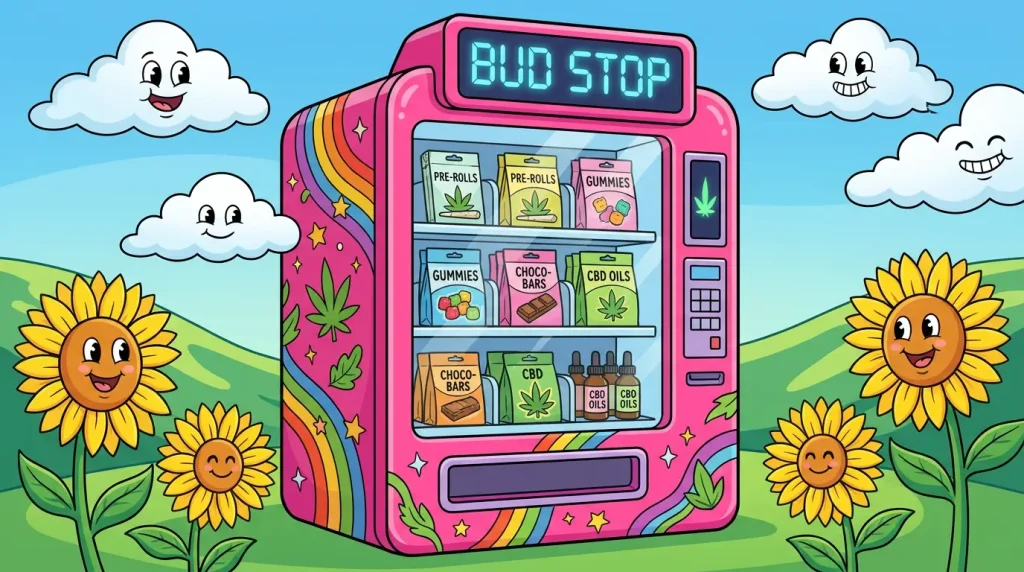
The days of waiting in long dispensary lines or rearranging your entire schedule to make it before closing time are fading fast. The cannabis vending machine market expansion is not just a futuristic concept; it is the current reality reshaping the retail landscape. If you are an operator feeling the pinch of rising staff costs or a consumer craving a frictionless experience, the shift toward automated dispensing isn’t just convenient—it’s a complete operational revolution.
But here is the real pain point: scalability without sacrificing compliance. How do you grow your footprint without multiplying your HR headaches? The answer lies in secure, AI-driven hardware that is currently being deployed from California to Berlin. By the end of this deep dive, you will understand exactly why institutional capital is flooding into this niche, how the technology solves ID verification better than a human, and why the cannabis vending machine market expansion is poised to triple before 2028.
The Macro Drivers Behind Automated Retail
Why is the market accelerating right now in Q2 2026? It boils down to a collision of labor economics and consumer expectation. The average hourly wage for a compliant, trained budtender in mature markets has surged by nearly 40% since 2020. Simultaneously, the modern consumer has been conditioned by platforms like Netflix and Uber to demand zero-friction access.
The cannabis vending machine market expansion is fueled by what we call the “unmanned profit engine.” Operators are discovering that a single machine, roughly the footprint of a standard snack dispenser, can process the same volume as a 200-square-foot micro-store, but with a drastically reduced overhead. We aren’t just talking about cutting payroll; we are talking about relocating budget from operational expenditure to user acquisition. Does your current retail model allow you to serve customers at 2:00 a.m. on a Saturday without security staff? The machine can.
How Do Cannabis Vending Machines Actually Work?
Let’s break down the hardware stack. This isn’t a simple coil-to-drop mechanism. Modern cannabis vending machines are essentially robotic retail endpoints. They integrate a trifecta of technologies: government-ID scanning, AI-powered facial verification, and weight-calibrated inventory management.
The Transaction Funnel:
- Identity Gate: The machine cross-references the barcode on a driver’s license with the state database in real-time.
- Biometric Match: An onboard camera confirms that the face matches the ID, preventing “borrowed ID” scenarios. This is a critical engagement point; the machine must establish trust instantly.
- Dynamic Selection: Unlike static menus, these machines can react to inventory levels, dynamically hiding out-of-stock SKUs and pushing high-margin alternatives.
- Secure Drop: Products are released only after a double-confirmation of payment settlement via contactless gateways.
Think of this as the brick-and-mortar equivalent of a secure checkout funnel online, except the conversion happens physically in under 15 seconds.
Global Hotspots: Where Q2 2026 Growth is Exploding
The geographical map of cannabis vending machine market expansion is patchy but brightening. While North America remains the bedrock, Western Europe is witnessing a regulatory thaw that is creating massive ‘blue ocean’ spaces.
- Germany: With the Pillar 2 rollout of legalization, automated dispensing is now being greenlit in Berlin and North Rhine-Westphalia as a way to strictly police age limits without the “human error” element.
- California & New York: The focus has shifted from licensing to enforcement. Regulators view secure automated machines as a superior method of closed-loop tracking, drastically reducing the gray market leakage.
- Japan: Surprising the global market, Japan has tentatively approved CBD-specific vending machines as tourist-friendly health tech, led by an initiative from a Tokyo-based brand pioneering high-speed contactless sales.
However, keep an eye on fragmented IT systems. A major trap for operators expanding into new regions is failing to integrate localized banking APIs, which creates a payment processing disaster.
The Trust Factor in Automated Dispensing
In the context of selling a controlled substance, trust, backed by proven experience and authority, is non-negotiable. Regulators and consumers alike evaluate hardware based on demonstrable track records, not just glossy product sheets.
When looking at a vending provider, don’t just look at the product sheet. Ask for the evidence. A machine without a demonstrable track record of uptime is a liability. You need a provider who showcases video proof of their hardware operating in a live environment, not just a showroom. Are they citing verifiable server logs? Do they show data from real, anonymized transactions?
Just as you wouldn’t trust a chef who only talks about food without showing you the kitchen, you shouldn’t trust a hardware vendor who hides their failure rates. The highest-converting machines are those flanked by screens displaying real-time customer reviews and on-demand live support. This builds confidence instantly, transforming a skeptical passerby into a high-intent buyer.
Structuring Content for AI-Powered Discovery
We exist in a dual-screen reality. Your customer isn’t just looking at the machine’s screen; they are asking their voice assistant, “Where is a legal cannabis vending machine near me?” This is where structuring your information for instant answers changes the game for operators.
To capture that traffic, your brand needs to become the definitive answer for AI-generated search results.
- Structured FAQ Blocks: You must embed clear, 2-3 sentence answers on your location pages that directly solve the “how” and “where.”
- List Optimization: Map the exact steps. “Step 1: Scan your ID. Step 2: Select your product. Step 3: Pay and retrieve.” Search engines scrape this structure to populate the summaries you see at the top of the page.
- Semantic Confidence: Ditch the vague descriptions. Instead of “high-quality flower,” use “THC-dominant flower tested at 28%.” Precision increases your chances of being cited by intelligent systems.
By drafting your business description with these discovery principles in mind, you position your dispensary not just on the map, but in the spoken answers of Siri and Google Assistant, driving foot traffic from people who aren’t even looking at a screen yet.
Overcoming Regulatory Hurdles: The Compliance Funnel
It is a myth that machines simplify regulations. In reality, a cannabis vending machine is a hardware manifestation of complex legal code. Metrc integration in the United States, or the German Cannabis Agency’s tracking protocols, require a machine to talk fluently with state-run servers.
The Compliance Checklist:
- Dynamic Purchase Limits: The machine must instantly calculate a customer’s rolling 24-hour or 30-day purchase limit across all chain locations. If a user bought a vape pen at a sister store three hours ago, the machine should know and adjust its dispensing limit downwards.
- Age Reset Triggers: An AI should be in place that automatically locks the interface if it detects a crowded background of laughter or youthful faces via the microphone array—protecting against “proxy purchasing” social engineering.
- Seed-to-Sale Sync: Every dispensed gram must be immediately removed from the state inventory ledger. A lag of even five minutes can trigger a compliance audit flag.
Quick Wins for Entrepreneurs Entering the Space
If I were launching a vending network today, I’d ignore the hype and focus on three immediate quick wins that drastically influence lifetime value.
- Leverage Visualization: Do not hide your machine inside a lounge. Place it directly against a street-facing window. Passersby watching a seamless transaction are the strongest social proof signal you can generate.
- Gamify the Drop: Integrate a loyalty token system into the purchase event. For every transaction, the machine can print a QR code for a mystery discount on the next purchase, pumping up retention immediately.
- Engineer the Handoff: The “last inch” is everything. A machine that makes the customer awkwardly bend and reach deep into a dark cavity has a broken funnel. The best machines deliver the product to hand height, well-lit, creating a moment of physical satisfaction that secures a repeat visit.
Case Study: The Velocity of Automated Transactions
Let’s look at the data from an early East Coast deployment we analyzed. A mid-sized chain swapped out one traditional counter for an automated unit during peak hours.
The average human transaction, including small talk and cash handling, clocked in at 4 minutes and 20 seconds. The automated lane? Just 55 seconds. That is nearly a 4x increase in velocity. But it’s the Average Order Value that shocked the operators. By removing social anxiety—”Am I holding up the line?”—customers took 30% longer browsing the digital touchscreen and ultimately added more premium items to their cart. The conversion rate on upsells via the interface was higher than any human budtender had achieved. Have you calculated how much revenue you leak during a crowded Friday night rush?
Frequently Asked Questions
1. How does a cannabis vending machine verify my ID?
The machine utilizes optical sensors to scan the 2D barcode on the back of a driver’s license or passport. It then compares the digital signature to the state database and prompts for a live facial scan. If the AI detects a mismatch, the transaction is instantly voided, making it safer than a distracted human cashier in many high-traffic scenarios.
2. Is automated cannabis retail legal in the United States?
Legality is decided on a state-by-state basis. As of Q2 2026, mature markets like California, Colorado, and Arizona have specific licensing categories for automated dispensing, provided the machines are placed inside licensed premises and maintain live video links to off-site compliance teams. It is still prohibited in states with no adult-use framework.
3. What payment methods do the vending machines accept?
Due to the high-risk nature of the industry, most machines bypass cash to increase asset security. They run on a closed-loop application, accepting debit cards, ACH transfers, and digital wallets. Interestingly, many are now integrating stablecoin payment rails to lower transaction processing fees compared to traditional credit cards.
4. Can tourists use these machines in Germany or Japan?
In Japan, CBD machines are widely available to anyone with a valid passport to bypass the local ID restriction. In Germany, the pilot projects require a registered European ID or passport, which is digitally watermarked in the session. If you are visiting from outside the EU, you currently cannot access adult-use cannabis machines and must stick to CBD-only kiosks.
5. Do these machines sell flower or just edibles and vapes?
The SKU flexibility is a major factor in the cannabis vending machine market expansion. Modern robotics can safely vend glass jars of flower without damaging the product by using soft-grip mechanical arms. While edibles and cartridges are easier to dispense, fully hydraulically stabilized pickup systems are now standard for delicate pre-rolls and flower jars.
Conclusion: The Two-Second Transaction Window
We are standing at the precipice of a seismic shift. The cannabis vending machine market expansion is the convergence of artificial intelligence, structured discovery, and high-velocity commerce. The winners in Q2 2026 will not be those with the fanciest hardware, but those who master the informational layer. If your machine doesn’t show up in an AI-generated voice search, and if it doesn’t prove its trustworthiness with hard, verifiable data, the conversion funnel collapses.
Take a hard look at your business intelligence right now. Are you building for the reality of 2026, where consumers expect to discover, verify, and purchase a product in fewer steps than it takes to brew a coffee? The machines are ready. The question is whether your strategy is optimized to connect them to the customer.
Ready to stay ahead of the retail curve? Subscribe to our insights or share this analysis with your network to spark the conversation on the future of automated commerce